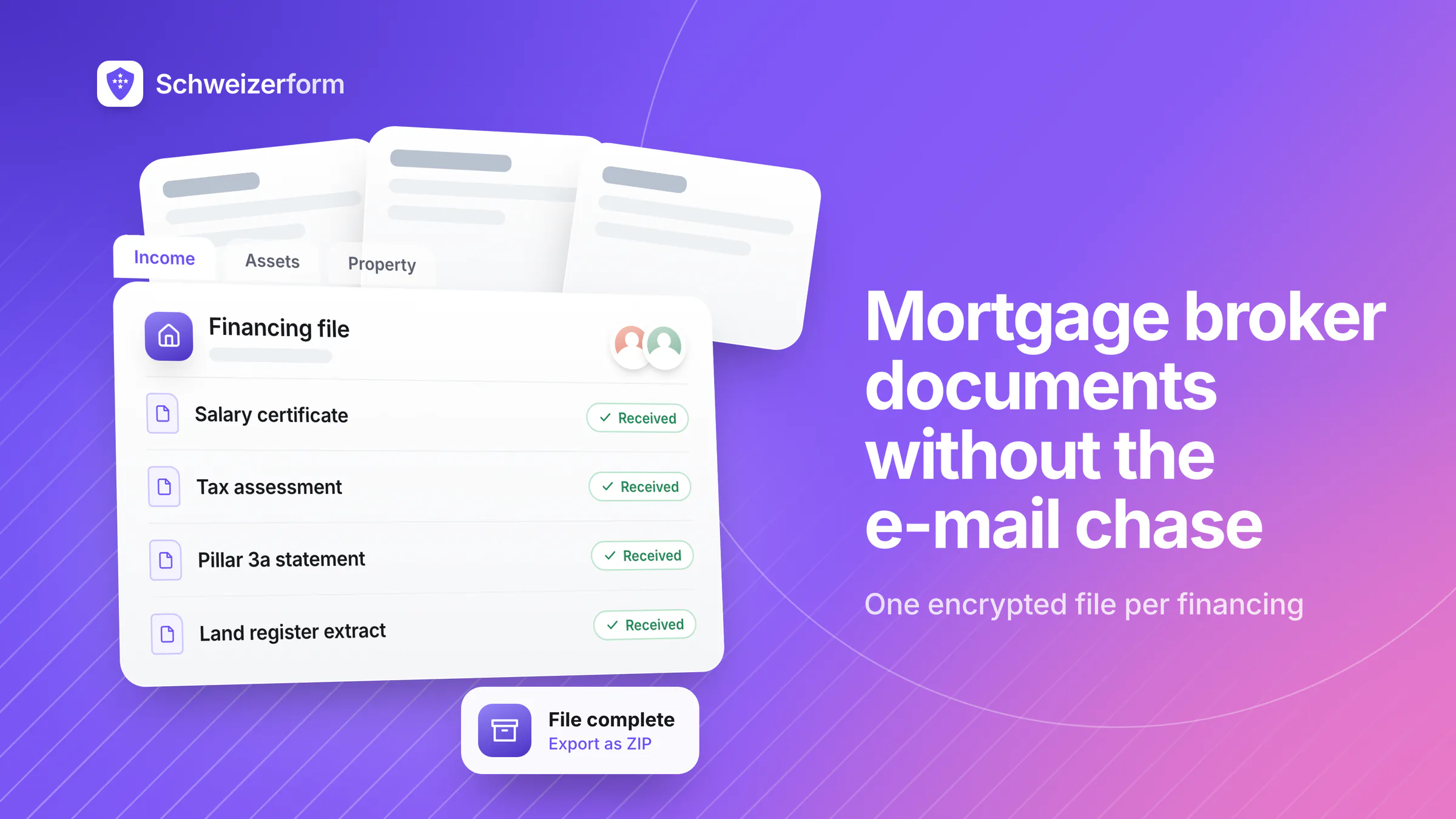
A mortgage file is not a form. It is thirty or forty documents from two or three people, due before a reservation deadline, and every one of them sits as a PDF in somebody's inbox. If you are an independent mortgage broker or financing adviser, you know the rhythm: the first e-mail asks for the salary certificates, the second repeats it, the third attaches the list again because the tax assessment was for the wrong year. That chase is what this page is about: mortgage broker document collection that runs from one encrypted link per borrower instead of from your mailbox.
The Documents module of Schweizerform turns your checklist into a personal request. The borrower sees what is received and what is still missing, uploads from the phone, and comes back later with the same link. You review each item, ask for a replacement when a scan is unreadable, and export the finished file as a ZIP that you pass to the lender through the lender's own channel. Files are encrypted in the borrower's browser, and only your Vault key opens them. This page shows how a broker's file maps onto the module, and where it stops.
Who this page is for
Independent mortgage brokers, financing advisers and small intermediary firms in Switzerland who assemble purchase, renewal and construction files for banks, insurers and pension funds, and who want a checklist, reminders and an encrypted collection point instead of e-mail attachments.
Why mortgage broker document collection is harder than it looks
Few client files in a small business hold as much about a household as a mortgage file. Together, the documents describe what a family earns, owns, owes and plans, and they come from several people at once:
- Income: salary certificates (Lohnausweis) and recent pay slips; for the self-employed, the last annual accounts and often a tax assessment per year
- Tax: the latest tax return and the final tax assessment
- Retirement provision: the pension fund's benefit statement and pillar 3a statements, especially when retirement money is to be used for the purchase
- Liabilities: an extract from the debt enforcement register for each borrower, plus existing loans and leasing contracts
- Identity: an ID or passport copy, and the residence permit where relevant
- The property: draft purchase contract, land register extract, building plans, the building insurance value and, for a construction project, the permit and the cost estimate
- Personal context: marital status, children, planned changes of job or working hours, and a co-borrower's papers
None of these documents is exotic. What makes the file sensitive is the combination: a complete financial profile of a household in one folder. Income, assets and debts are not, as such, on the nFADP's list of sensitive personal data (Art. 5 lit. c), but single papers can touch it: in many cantons the tax assessment shows church membership for church tax, and a file can mention health matters or social-assistance measures, which the list names expressly. Treat the whole file, the debt enforcement extract included, with that level of care. The duty to secure personal data with technical and organisational measures appropriate to the risk (Art. 8 nFADP) applies either way, and a leaked mortgage file can do real harm: fraud, identity theft, a very uncomfortable call with a client. You also owe borrowers clear information about what you collect and why (Art. 19 nFADP).
Confidentiality: what binds a broker and what does not
Mortgage brokers are not on the closed list of professions in Art. 321 of the Swiss Penal Code, so criminal professional secrecy does not apply to the broker as such. Banking secrecy (Art. 47 of the Banking Act) binds the officers, employees and agents of a bank; an independent broker who works for the borrower is, as a rule, not one of them. Your duty of confidentiality rests on the mandate or brokerage contract and on the nFADP, which is why many brokers write it into their terms of business. Depending on their activity, some intermediaries also have duties under financial-market law; check with your association or a specialist whether that applies to you. Background: professional secrecy and online forms.
How document collection works with Schweizerform
A document collection is a checklist of files you ask for. Every borrower gets a request of their own with a personal link. There is no account to create and no password to remember.
- 1
Build the collection once per case type
Start from the «Mortgage application» template or from blank, and check every item against your own practice. Add one item per document, such as «Salary certificate, last year» or «Pillar 3a statement», each with a short hint, a file size limit and the file types you accept. Mark items as required or optional.
- 2
Create a request per borrower
In the Requests tab, add a request with the borrower's name and a note, and set a due date. Each person, a co-borrower included, gets their own link and their own progress.
- 3
Send the link from your own mail program
Copy the personal link and send it yourself. Document requests carry a key, so they go out through your own mail program and never through Schweizerform's mail. Add one sentence on what the documents are used for.
- 4
The borrower uploads, and comes back
On the phone or the laptop, the borrower sees the checklist, uploads to each item and watches «3 of 9 received». Files are encrypted in the browser before they leave it. The same link works again tomorrow for the rest.
- 5
Review item by item
Unlock with your Vault key, preview each file, and set it to Accepted or Upload again with a preset reason: blurry or unreadable, wrong document, expired, incomplete, other. The borrower sees your verdict on the same page.
- 6
Mark complete and export
When the file is complete, mark the request complete and download a ZIP with one folder per borrower (Pro and Business). Hand it to the lender the way that lender wants it.
Where the time goes
The borrower sees the whole list instead of a thread of e-mails, and you see at a glance who is complete, open or overdue. Chasing becomes a single reminder instead of five attachments with different file names.
Where mortgage brokers use Schweizerform
One collection per case type: purchase, renewal, construction
A purchase needs the property papers. A renewal usually needs little more than current income and the existing mortgage. A construction project adds permits, cost estimates and contractor papers. Keep one collection for each type instead of one giant list that nobody finishes. Write each item in plain words and add a hint with the year or the age limit your lender asks for. On Pro and Business you can attach a sample file or a blank form to an item, and a rule can show the annual accounts only to borrowers who say they are self-employed. Each item takes up to 20 files, so multi-page scans and several pay slips fit. Item names, hints and sample files are readable by the server: they are your questions, not the borrower's answers, so keep personal details out of them.
A personal request per borrower, co-borrowers included
Couples and co-borrowers each have their own salary certificate, their own debt enforcement extract and their own ID. Create one request per person from the same collection. Each has a link, a due date and a progress count, so you can see that the first borrower is complete while the second still owes the extract. The request list shows visits, last visit, due date, status (Open, Complete, Overdue) and progress such as «4 / 9». The client name and your note on the request are encrypted in your browser, so the server sees neither.
Due dates tied to the reservation deadline, and reminders
The due date belongs to the request, so you can set it from the deadline in the reservation agreement or from the notary appointment, a few days before the lender needs the file rather than on the day. On Pro and Business, reminders go out three days before the due date, on the due date and weekly afterwards (up to three), at 08:00 Swiss time. Each mail names your business and the due date, carries an upload-only link and a stop link, and never lists items or status. It needs the borrower's e-mail address, stored readable on the server only for sending and deleted one day after reminders stop. Reminders count against the daily client e-mail quota (30 on Pro) and are not sent while unlock codes are on.
Accept, upload again, and the review loop
Many delays come from documents that arrive but cannot be used: the wrong year, a cropped scan, an expired extract. Mark such an item Upload again with a preset reason. The old files stop counting towards the maximum and the borrower sees what to send instead. The review status per item is encrypted and is your working note, not evidence. Reviewing is a manual decision of yours; nothing checks the content for you.
Passing the file to the lender: ZIP export
Schweizerform does not talk to lenders. You export a ZIP with one folder per request and file names in the form client, item, original name (Pro and Business), and you send or upload it through the lender's own portal or secure channel. On Free you download files one by one from the request view and export a CSV overview. A ZIP on your computer is an ordinary readable file: store it and delete it like the rest of your file. The CSV, Excel and JSON exports add due date, request status and completion time per request.
An encrypted intake form for the affordability pre-check
Before any documents you need a few figures: household income, type of employment, equity, planned price, existing loans, number of children. A normal Schweizerform form collects them with answers encrypted in the browser and readable only with your Vault key. Use the Swiss address question, a consent question that points to your privacy notice, and rules (Pro) so that questions about a second borrower appear only when there is one. Schweizerform does not calculate affordability: you read the answers and run the numbers in your own tools. Free allows 15 questions per form, Pro 100.
A booking page for the first consultation
Let prospects book the first conversation from a link or a QR code on your website: a service «First consultation» (on site, by phone or online, where the place is a line of text you type), your weekly hours, a buffer and a minimum notice. What the client writes, such as name, phone and message, is encrypted; the time, the service name and the status are readable by the server so that slots and the calendar work. Give the service a neutral name if you prefer. On Pro and Business, clients can opt in to e-mail confirmations and reminders. Free and Pro include one staff profile, which suits a solo broker.
Contacts and one client page per household
Contacts is an address book encrypted under your Vault key: names, e-mails, phones, notes and groups. Groups work on every plan; notes, the client page and saving respondents as contacts need Pro or Business. The client page is one personal link per household that shows only what is still open: a document request with its progress, a form, a booking link. It needs no account or password, expires after 90 days by default and can be revoked. Whoever holds the link sees what is open, including the file names of a document request, so send it only to the borrower. For the advisory side of the relationship, see financial advisory KYC forms.
Who sees what: encrypted and readable
Borrowers and compliance-minded partners will ask this, and the honest answer is a split. Submissions are encrypted; the structure around them is not.
| Data | On the server | What it means for you |
|---|---|---|
| File contents and original file names | Encrypted in the borrower's browser; stored under random names ending in .enc | Only your Vault key opens them; without it, nobody can, including us |
| Borrower's name and your note on a request | Encrypted in your browser | The server cannot read them |
| Per-item status (received, accepted, upload again) | Encrypted | Your working notes, never evidence |
| Item names (the checklist), due date, number of visits | Readable by the server | Keep personal details out of item names |
| Request status (open, complete, overdue) | Readable by the server | Needed for lists and reminders |
| E-mail address for reminders | Readable, only if you enter it; deleted one day after reminders stop | The mail provider keeps its own delivery logs for up to 90 days |
| Booking time, service name, staff name, status | Readable by the server | What the client writes is encrypted; the time and the service are not |
| Pre-check answers and contacts | Encrypted | The Vault key is needed to read them |
Features that matter for mortgage brokers
- One personal link per borrower and per case with its own due date: 3 requests per collection on Free, 50 on Pro, 500 on Business
- Per-item review, accepted or upload again with a preset reason, visible to the borrower
- Return visits with the same link: the borrower adds the missing files without starting again
- Reminders with an upload-only link and a stop link (Pro and Business)
- Sample files per item (Pro and Business)
- ZIP, Excel and JSON export (Pro and Business); CSV on every plan
- An encrypted intake form and a booking page in the same account; collections, forms and booking pages share one pool of 3 on Free and 50 on Pro
- Contacts for every plan and a client page for returning households (client page: Pro and Business)
- Four languages for borrowers (English, German, French, Italian) and storage of 100 MB on Free, 5 GB on Pro and 50 GB on Business
What it does not do
No affordability calculation, no submission to lenders and no integration with mortgage platforms, no e-signature, no identity verification, no OCR or automatic document checking, no virus scanning of uploads, no SMS reminders and no archive for finished files. Schweizerform collects, protects and hands over the file; the assessment stays with you and the lender.
What mortgage brokers ask
Can it calculate affordability?
No. There is no calculation engine. The intake form collects the figures, encrypted; you calculate in your own tools and the lender applies its own criteria. We would rather say so than let a form look like an assessment.
Can I submit the file to the bank through it?
No. There is no lender integration, no public API and no webhook. You export the ZIP and use each lender's own portal or channel. What you gain is a complete, reviewed file in one place before you open that channel.
Are we bound by professional secrecy?
As a rule, no: brokers are not on the list in Art. 321 of the Penal Code, and banking secrecy binds banks. Confidentiality is a matter of contract and the nFADP, so state it in your mandate and privacy notice. Because the files are encrypted before upload, Schweizerform cannot read them; that is a technical measure you can describe to clients, not a legal guarantee. Check with your association or a specialist if your activity has additional duties.
What if a borrower forwards the link?
Whoever holds a request link sees what is open, meaning item names, progress and file names, and can upload; nobody reads file contents without your Vault key. Treat the link like a key and never call a forwarded link harmless. Send it only to the borrower's own address, set a due date, and mark the request complete when the file is done, because a completed request takes no uploads. The link identifies a request but does not prove who is using it.
Does it check documents or verify identity?
No. The browser checks file type and size, and nothing reads the content. An uploaded ID copy is just a file; the lender runs its own identification. If you collect ID copies, read sending ID copies by e-mail first.
How long do we keep the files?
Only as long as the mandate and your own retention duties require. Once the file has gone to the lender and the case is closed, delete the requests, and handle any exported ZIP the same way. Tell borrowers in your privacy notice what you keep and for how long.
Getting started
- 1
Write the checklist from your last file
Take your most recent completed purchase file and turn its document list into items, with hints on year and format.
- 2
Run one real case on Free
Free allows 3 requests per collection and 100 MB of storage, enough to try it with your own file or a friendly borrower before you change your routine.
- 3
Set up and store your Vault key
Agree who holds it and where it is kept. Without it nobody can open the files, including us, so treat it like the key to the office safe.
- 4
Add a few lines to your privacy notice
Say what you collect, why, that you pass the file to the lender, how long you keep it, and that you may use an e-mail address for reminders and for bookings.
- 5
Add the intake form and the booking page
Once the collection runs smoothly, add the pre-check form and the booking page. Move to Pro when you run several borrowers at once or want reminders, sample files and the ZIP export.
From e-mail chase to one complete file
The documents a lender wants are well known; what costs a broker days is getting them in the right year, in a readable scan, from two people, before the reservation deadline. A personal request per borrower with a visible checklist, a due date and a review per item takes the guessing out of that, and the encryption means the household's financial profile does not pile up in inboxes.
Schweizerform is operated from Switzerland and stores encrypted submissions in Switzerland. It will not calculate affordability or submit to a lender, and it does not replace your judgement. It gives you a calm, complete and protected file to start from.
Start on the Free plan with one collection for your most common case type and one real borrower. More: collecting client documents securely, document request checklists, insurance brokers and client documents, tax documents for fiduciaries, tenant application forms, features, security and pricing.
Disclaimer: This page is general information and marketing content, not legal, tax or financial advice. References to the nFADP (Art. 5, 8 and 19), Art. 321 of the Swiss Penal Code, Art. 47 of the Banking Act and financial-market regulation are simplified and open to interpretation. Responsibility for protecting borrowers' data and for meeting your own professional and contractual duties stays with your business. Consult a qualified data-protection or financial-law specialist before relying on this page.