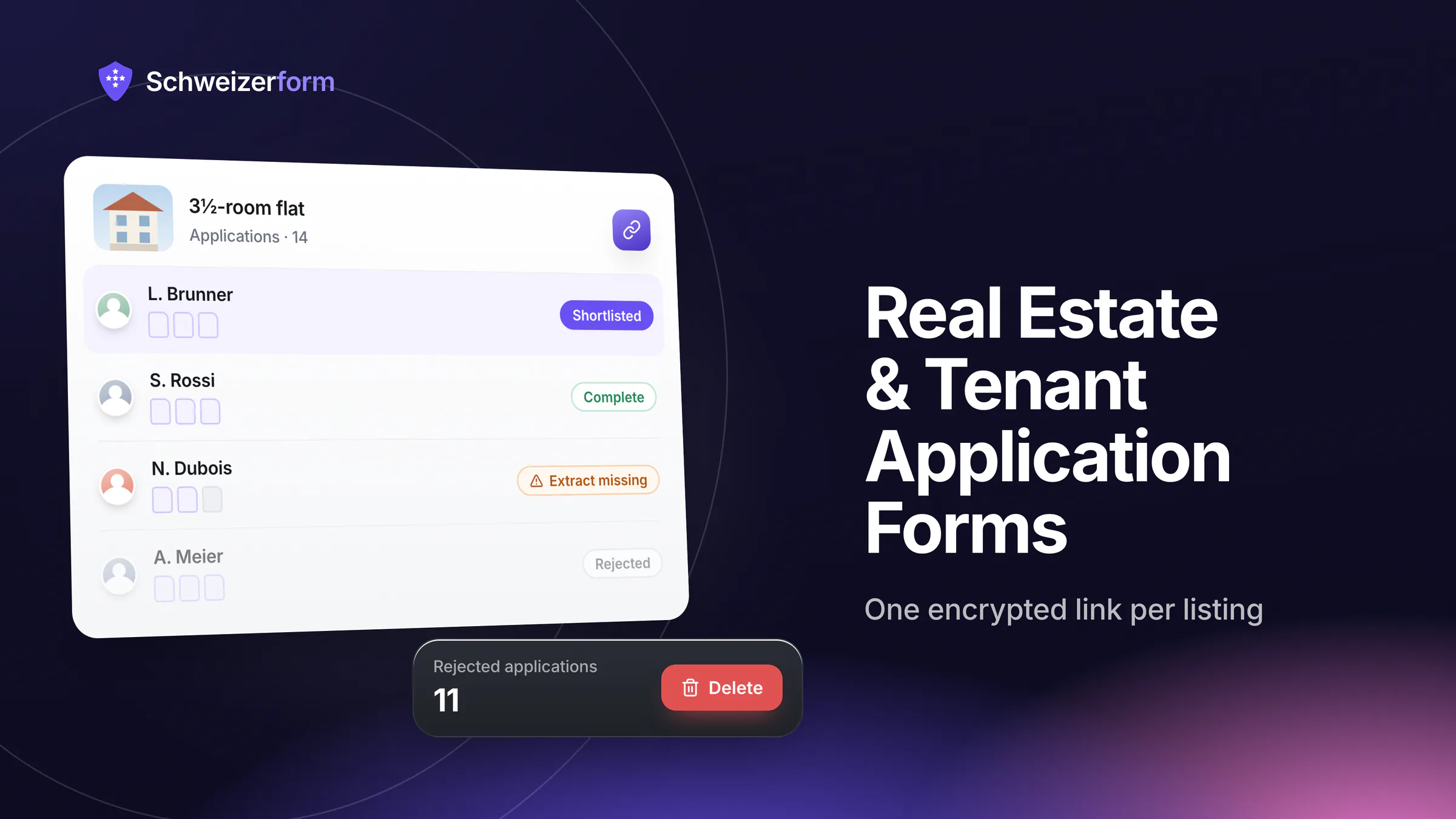
A typical Swiss or European tenant application packet collects more sensitive personal and financial data than most bank account openings: a copy of an ID or residence permit, three months of salary slips, an extract from the debt collection register, employer references with phone numbers, family composition, prior addresses, sometimes pet declarations and health-relevant context. Today, most property management firms, real estate agencies, and private landlords still receive this packet by email PDF, fax, or paper at the viewing — and the data sits in shared inboxes, on agents' laptops, and in property-management drives forever after the apartment is let.
Schweizerform replaces that workflow with one encrypted intake link per listing. Every applicant submission is encrypted in the applicant's browser before it leaves their device. We physically cannot read tenant applications, salary slips, or debt-register extracts. Hosting is in Switzerland, the four UI languages (EN / DE / FR / IT) are native — which matters for a tenant population that speaks every language Switzerland recognises plus several it does not — and retention can be set to delete rejected applicants automatically after a defined window. This page is for property professionals who already feel uneasy about the email PDF process and want a defensible alternative.
Who this page is for
Property management firms (Hausverwaltungen, régies immobilières, amministrazioni immobiliari), real estate agencies, private landlords with multiple units, relocation agencies, student-housing operators, co-living and serviced-apartment providers — particularly in Switzerland and the EU, where tenant data is unambiguously personal data under nFADP and GDPR and the volume of rejected-applicant records sitting on disk is rarely measured.
Why Real Estate Has an Outsized Data-Protection Profile
Tenant data sits at the intersection of three categories that each carry strict protection rules — and a fourth dimension (volume of rejected applicants) that quietly multiplies the exposure:
- Identity and immigration data — ID copies, residence permits (B, C, L, G in Switzerland), passport scans, photographs — proof-of-identity material that is the keystone of identity-theft fraud if it leaks
- Financial and creditworthiness data — three months of salary slips, employer letters, tax extracts, bank statements, debt-register extracts (Betreibungsregisterauszug, ZEK in CH; Schufa in DE; equivalent registries elsewhere) — a complete financial profile
- Sensitive contextual data — family composition, marital status, dependants, pet ownership, sometimes prior eviction or insolvency disclosures, sometimes accessibility or health-relevant context for ground-floor or accessible units
- Volume — for every successful tenant, a property management firm typically receives 5 to 50 rejected applications, each holding the same packet of data; this is rarely retained with intent and almost never deleted on schedule
Most property firms today receive this data via email PDF, fax, or a generic SaaS form. The applicant emails their packet to a shared inbox; multiple agents and assistants forward and download it; it lands on laptops, on property-management software, in printed copies at the viewing, and in the email backups of every staff member who saw it. The same data exists in eight or ten places by the end of week one. None of those copies were planned with retention or erasure in mind.
The rejected-applicant problem
Under both nFADP and GDPR, personal data must not be kept longer than necessary for the purpose. "Necessary" for a rejected tenant application is typically days to a few months — not the years that emailed PDFs sit in shared inboxes. The first time a regulator, a rejected applicant, or an audit asks where the data of last year's 200 unsuccessful candidates is, the answer is rarely defensible from an inbox alone.
What Changes With Zero-Knowledge Intake in a Property Firm
The technical shift is simple. Tenant application data is encrypted in the applicant's browser before transmission, then locked inside a vault only the firm can open. The server stores ciphertext. Only authorised staff at the property firm — holding the firm's vault key — can open the vault and decrypt the submission. The agency holds the vault key; it never reaches us, so no reset is possible. The form provider becomes a courier of unreadable data, not a custodian of tenant identity and financial information.
- 1
Listing goes live with a single secure intake link
Instead of "please email your full application packet to apartments@firm.ch", the listing carries a single Schweizerform link. Applicants click, fill in the structured form, upload IDs and salary slips. Everything is encrypted in their browser before transmission.
- 2
Transmission and storage
Only ciphertext crosses the network, and it lands on Swiss infrastructure. The server stores ciphertext only — no plain-text copy of any applicant's ID, salary, or debt extract exists anywhere on our infrastructure.
- 3
Property manager reviews shortlisted applications
The reviewing agent or property manager opens shortlisted submissions in their browser. The firm's vault key unlocks the vault and decrypts the data on the device. The firm chooses who to invite for viewings and which packet to forward to the landlord — without the data ever existing in plain text on a third-party server.
- 4
Successful tenant transitioned, rejected applicants deleted
Once a tenant is selected, the chosen applicant's data flows into the property management system or lease workflow. The remaining (often dozens of) rejected applications can be deleted from the form-side store on a defined schedule — and because we hold no keys, deletion is cryptographically final. The compliance posture improves automatically with the cadence of letting.
The shortlisting speed advantage
Property managers report that structured intake (vs free-form email PDFs) cuts shortlisting time by half: every applicant has filled the same fields in the same order, missing documents are flagged at submission rather than chased by phone, and the system can sort by completeness automatically. The tenant experience also improves — the applicant gets a clear receipt and a defined process instead of an empty inbox.
Where Property Firms Use Schweizerform
Tenant application packets
The flagship use. A structured form covers personal details, current address, employer and salary, debt-register extract upload, ID upload, family composition, references, pet declaration, requested viewing dates. The form replaces the email PDF; the data flows directly to property managers in encrypted form.
Pre-viewing self-disclosure
Some firms pre-screen applicants with a short disclosure before scheduling a viewing — proof of income range, employment status, residence permit category. Filtering early reduces wasted viewings for both sides without exposing applicants to a long-form intake before they have even seen the apartment.
Co-tenant and guarantor forms
Couples, flatshares, and applications with a guarantor (often a parent for a young tenant) involve multiple parties each submitting their own financial and ID data. Each co-applicant fills the same secure form independently; the property firm receives a complete set of encrypted records associated with the same listing.
Move-in and handover protocols
The condition report at handover (Übergabeprotokoll, état des lieux, verbale di consegna) typically includes photos of every room, meter readings, and the new tenant's signature on the inventory. Encrypted intake from a tablet at the property gives the firm a tamper-evident, time-stamped record without exposing photos and signed inventories to a SaaS vendor.
Move-out and damage-claim documentation
Photos of damage, contractor estimates, security-deposit deduction proposals — sensitive enough to fuel disputes and litigation. Keeping the documentation in an encrypted intake record (with timestamps and access log) gives the firm defensible evidence without distributing photos through email threads.
Maintenance request intake
Tenant maintenance requests sometimes touch sensitive context (mould affecting a child's asthma, plumbing affecting a tenant with mobility needs, security concerns after a domestic incident). A structured intake form with optional photo upload routes the request to the right contractor without exposing the underlying tenant context to the form vendor.
Tenant complaints and neighbour-dispute reports
Noise complaints, neighbour disputes, anti-social behaviour reports, safeguarding concerns — content that is highly sensitive both for the reporter and the subject. An encrypted intake channel that the firm controls (and where the vendor cannot read) is the appropriate level of confidentiality for material that may end up in cantonal mediation or court.
What Applicants, Regulators, and Insurers Actually See
Three audiences notice the difference between an emailed-PDF process and a zero-knowledge intake form: the applicants who hand over their financial life, the data-protection authority that supervises the firm, and the professional-liability or cyber-insurance underwriter who calculates the firm's risk profile.
| Perspective | Email PDF / generic SaaS form | Schweizerform |
|---|---|---|
| Applicant submitting the packet | "My ID, salary, and debt extract are sitting in a shared inbox somewhere" | "The firm's form encrypts my packet in my browser; only the firm can read it, and I get a clear receipt" |
| Cantonal / national DPA | Has to assess every mailbox, backup, and forwarded copy of the packet | Provider holds no readable copy — analysis collapses to the firm's own systems and retention |
| Cyber-insurance underwriter | Standard SaaS / email risk profile (plain-text PII and financials in distributed inboxes) | Materially reduced breach-impact profile for tenant-application data |
| Rejected applicant exercising rights | Erasure means tracing every copy across mailboxes — usually unfulfillable | Single deletion removes the record cryptographically; one place, one rule, one log |
Features That Matter for Real Estate Firms
- End-to-end encryption on every form — no paid upgrade for protecting tenant ID, salary, and credit data
- Swiss hosting in Swiss data centres — direct answer to where tenant financial data lives, important for relocation candidates and international applicants
- Encrypted file uploads — covers ID scans, residence permits, salary slips, debt-register extracts, employer letters, prior-tenancy references
- Native EN / DE / FR / IT — every label, error, and confirmation in the applicant's language; essential for a Swiss tenant pool that often crosses language regions
- Mobile-first applicant experience — most applicants fill the form on their phone, often during a viewing or immediately after
- Defined retention per form — set a 30 / 60 / 90-day retention for rejected applicants once the property is let, and the system enforces it
- Audit logging of administrator actions and submission access — documentation for DPA inquiries and for internal review when an applicant complains
- Multiple administrators — give each agent or property manager access to their own listings without exposing the entire firm's pipeline
- No third-party trackers on public forms — the applicant's browser is not pinging marketing analytics with their salary and ID data
What landlords and agencies push back on
"Email PDFs work fine — applicants are used to them"
Email PDFs work for the firm and hurt the applicants — and they hurt the firm too the moment a regulator asks where last year's 300 unsuccessful applicant packets are. A structured intake form is faster for applicants (one form vs assembling and zipping documents), faster for the firm (no manual sorting), and produces a defensible audit trail. The transition is small.
"Older landlords or smaller agencies will not adopt this"
Most resistance is at the receive-side, not the applicant-side. The applicant's experience is just clicking a link and filling a clear form. Smaller agencies often benefit most because they do not have a dedicated property-management software handling intake — Schweizerform fills that gap with a free or modestly priced subscription.
"We already have a property management system that handles tenants"
Most property management systems are designed for active tenancies — rent collection, maintenance, accounting — not for the intake of applicants who may never become tenants. They typically encrypt in transit and at rest, but the vendor still holds a readable copy of every applicant's ID and salary. Schweizerform is a specialised intake layer that can sit in front of any property management system — encrypted intake, then export of the chosen tenant's data into the system of record.
"What about credit-check integrations and reference checks?"
Credit-check and reference-check workflows happen on the firm side after decryption. Authorised staff decrypt the application in the browser, extract what is needed for the credit check (typically a name, date of birth, and address) and submit that to the credit-check provider through normal channels. The point of the zero-knowledge layer is that the form vendor never sees the applicant's full packet; once decrypted on the firm side, the data flows like any other input.
"What if the managing agent loses the key?"
This is the honest trade-off of genuine zero-knowledge security: because the vault key never touches our servers, we can't reset it for you, and if you lose it along with your recovery code, even we can't open the vault. That impossibility is exactly what makes Schweizerform truly end-to-end encrypted. We support a recovery-key flow: a second key set up in advance and stored separately (typically a printed copy in the firm's safe). Most firms treat the vault key the same way they treat the office building's master key — formal procedure, two trusted custodians (e.g. principal and operations manager), regular review.
"Will this slow down listing turnover?"
Usually the opposite. Structured intake reduces the time spent chasing missing documents, sorting incomplete packets, and forwarding files between staff. Most firms report faster shortlisting after switching, especially for high-demand listings that previously generated dozens of half-complete email packets.
Getting Started in a Property Firm or Real Estate Agency
- 1
Pilot with one listing
Pick the next high-demand vacancy and replace the "email your packet" instruction with a Schweizerform link. The free tier (3 forms, 100 submissions/month) is enough to test the workflow on a single property; paid plans scale across the portfolio.
- 2
Build the standard application form
Replicate your current paper / PDF packet as a single structured form: personal details, current address, employer and salary, debt-register extract (file upload), ID (file upload), family composition, references, pets, viewing preferences. Keep the packet to what every applicant must answer, and put the property-specific extras (guarantor, pets, residence permit) either behind a conditional rule or into their own short form. The rule is the stronger option here for a reason worth stating: an applicant who never sees the guarantor question leaves no guarantor data in the submission at all — answers to conditionally hidden questions are stripped before encryption, so you are not holding personal data you had no basis to collect.
- 3
Set up the Vault Key and recovery key
Two custodians, written procedure, recovery key stored separately (the firm's safe is a common choice). About 15 minutes for a small firm. This is what makes the encryption real — without it, the zero-knowledge property is theoretical.
- 4
Define retention for rejected applicants
Set the form's retention so that submissions older than 30 / 60 / 90 days (your call, document the choice) are deleted automatically. This is the single highest-impact compliance improvement most firms make in their first month.
- 5
Document the processor relationship
Add Schweizerform to your record of processing activities (Verzeichnis der Verarbeitungstätigkeiten / registre des traitements). Record where applications rest, that we cannot read them, and that no US sub-processor is in the chain. For DPOs and external compliance consultants, this typically simplifies the analysis compared to US-hosted intake tools.
- 6
Roll out across the portfolio
Once the first listing is stable, replace the email-PDF instruction across all listings. Most firms reach "all new listings on Schweizerform" within four to eight weeks. The retention policy then takes care of the historical email backlog as it ages out of relevance.
Screening tenants without building an archive
Tenant applications are, in data terms, a complete financial disclosure with an ID copy attached. Most property firms still receive them by email PDF and store them indefinitely in shared inboxes — a posture that is fine until a regulator, a rejected applicant, or an insurer asks the obvious question. The volume of rejected-applicant data quietly accumulating in property-firm mailboxes is the single largest avoidable exposure in the sector.
Schweizerform offers a direct answer: zero-knowledge end-to-end encryption on every form, Swiss hosting, native four-language support, encrypted file uploads sized for the documents the sector actually exchanges, and retention you can set once and forget. No paid upgrade for protection. No US cloud dependency for tenant identity and financial data. No readable third-party copy of an applicant's salary slip sitting on a server you cannot control.
Start with a single listing on the free plan — encrypted submissions stored in Switzerland, zero-knowledge encryption, native EN / DE / FR / IT — and replace the next "email me your packet" instruction with a clean intake link.
Disclaimer: This page is general information and marketing content, not legal, regulatory, or property-management advice. References to nFADP, GDPR, debt-register extracts, residence-permit categories, and tenancy-law conventions are summarised at a conceptual level and subject to jurisdictional interpretation. Responsibility for tenant-data protection remains with the firm. Consult a qualified data-protection or real-estate specialist in your jurisdiction before relying on any summary here for compliance or procurement decisions.