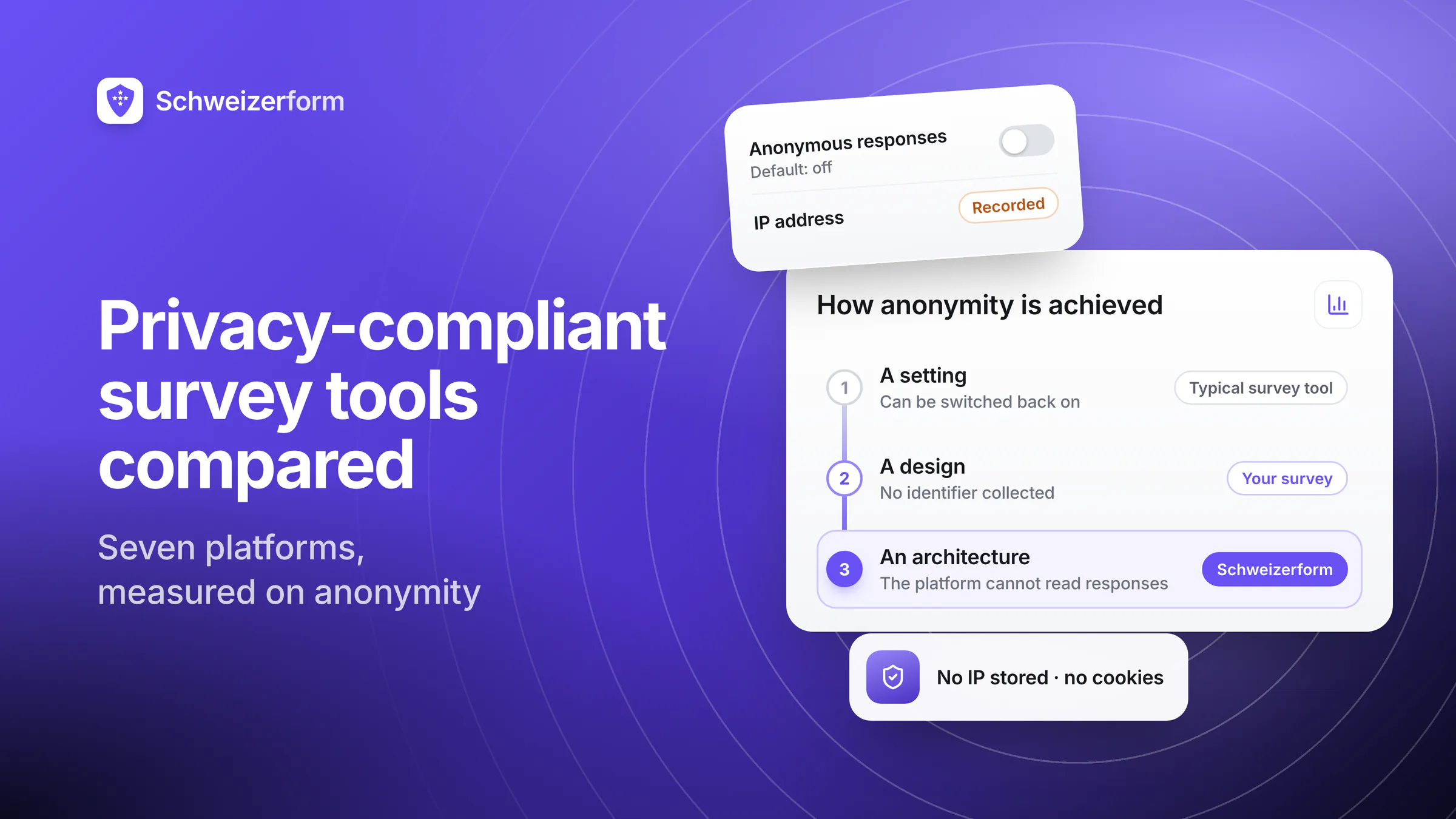
The finding that organised this page: in every mainstream survey platform we checked, anonymity is a setting somebody has to switch on, and it is off by default. SurveyMonkey records the respondent's IP address unless you disable it in each collector. Qualtrics records IP and location unless the Anonymize Response option is enabled. LimeSurvey's «Anonymized responses» setting defaults to No, which leaves survey answers joinable to the participant table. None of that is a scandal — it is a sensible default for many research designs. It does mean that the sentence «our survey is anonymous» is, in almost every tool on the market, a claim about a checkbox rather than a claim about the software.
Surveys are not just forms with more questions. The difference is that in a survey, anonymity is frequently the product: it is what makes people answer honestly about their manager, their health, their salary or their experience of harassment. So this comparison is organised around anonymity guarantees, minimum response thresholds, cross-tabulation, panel and quota handling, and — the question nobody in this category asks out loud — where the analysis happens relative to the encryption boundary. We also state plainly what a zero-knowledge platform gives up, because for serious survey research the answer is «quite a lot».
Status: July 2026
Every product claim below was checked against vendor documentation on 25 July 2026. Default settings, hosting regions and plan gating change — and defaults change silently more often than features do. Re-verify the anonymity settings of whichever tool you choose before the survey goes out, not after the responses are in.
What Makes a Survey Tool «Privacy-Compliant»?
The phrase is used to mean at least six different things, and vendors are happy to let you assume they mean all of them. In descending order of how hard they are to deliver:
- The provider cannot read the responses. An architectural property. Delivered by end-to-end encryption, or by running the software yourself.
- Nobody inside your organisation can link a response to a person. A design property of the survey: no tokens, no IP capture, no invitation-level tracking, and no demographic combination fine enough to single someone out.
- The responses stay in a jurisdiction you have chosen. A hosting property. Verifiable from a sub-processor list, not from a flag on the website.
- The tool does not track respondents with cookies or third-party scripts. A property of the survey page, checkable in thirty seconds with a browser network inspector.
- There is a processing agreement, a sub-processor list, and a documented retention rule. A contractual property — necessary, and the easiest of the six to obtain.
- The vendor holds a certification. An audit property. Meaningful, and often confused with the first item on this list, which it does not imply.
A tool can deliver items three to six perfectly and still fail one and two, which is the normal state of this market. Our checklist for the paperwork half is the nFADP compliance checklist for forms and surveys.
The Uncomfortable Finding: Anonymity Is a Default, and the Default Is Off
SurveyMonkey tracks IP addresses per collector unless you turn tracking off, and the setting lives on each collector — so a survey distributed through a web link and an e-mail invitation needs the switch flipped twice. Full anonymous-response handling, including stripping IP addresses, sits on the paid tiers; on Enterprise, a primary admin can set an organisation-wide default. Respondent IP addresses are also recorded in backend logs and deleted after thirteen months, which is a separate question from what appears in your results export.
Qualtrics records IP address and derived location data unless the Anonymize Response option is enabled for the survey. An «anonymous link» distribution does not, by itself, make responses anonymous — it means no panel identifier is attached, while the IP is still captured by default. This distinction has produced a small library of university IRB guidance pages explaining to researchers how to switch it off, which tells you how frequently it is missed.
LimeSurvey is the most explicit of the three, and worth reading closely because it shows what a real anonymity guarantee looks like inside a conventional database. «Anonymized responses» defaults to No. Set to Yes, there is no foreign-key relationship between the participant table and the answers, and the submission date and the token completion date are both set to 1980-01-01 00:00 — because otherwise two timestamps a few seconds apart would re-link the invitation to the response. That last detail is the mark of a design that took the problem seriously, and it is also the clearest illustration of how easily anonymity leaks through metadata nobody thought of as data.
«Anonymous» is a configuration, not a property — in almost every tool
Before you promise anonymity to respondents, check three things in the tool you actually use: is IP capture off, on every distribution channel; is the link between invitation and response broken, not merely hidden from the default view; and can an administrator re-enable tracking mid-survey without anyone noticing? If the answer to the third is yes — and it usually is — your anonymity promise is a policy commitment, not a technical one. It can still be the right promise. It should just be described accurately.
The Seven Platforms, One at a Time
SurveyMonkey and Qualtrics — the research suites
SurveyMonkey is the volume leader and the default answer for a marketing or customer survey. It runs on AWS with the United States as the default region, an EU region in Dublin and a Canadian region; the EU data centre is limited to SurveyMonkey Enterprise and GetFeedback Direct, and accounts opened before 2019 cannot move questions and responses at all. Our per-feature view is in the SurveyMonkey comparison.
Qualtrics is the enterprise research platform: the deepest logic, the strongest panel and quota management, and analysis features nothing else on this list approaches. It is a US-headquartered platform with regional data centres available and the region set contractually — which means the answer to «where is our data» is in your order form rather than in a support article, and you should get it in writing. If your requirement is a longitudinal study with weighted samples and complex quota enforcement, Qualtrics is the tool, and no encrypted intake platform is a substitute for it.
LimeSurvey — the self-hosted incumbent
LimeSurvey is the default at Swiss universities, hospitals and cantonal administrations, for good reasons: unmatched question-logic depth, no per-response cost, and an install you control end to end. Two things to be exact about. First, responses land in clear text in your MySQL database — «self-hosted» answers the jurisdiction question and not the confidentiality one, and anyone with database access can read everything. Second, LimeSurvey Cloud offers hosting in Australia, Canada, Finland, Germany, Singapore, the United Kingdom and the USA — Switzerland is not on the list — and the provider is LimeSurvey GmbH in Hamburg. Swiss residency with LimeSurvey means installing it yourself on Swiss infrastructure.
onlineumfragen.com and Findmind — the Swiss survey platforms
onlineumfragen.com is the most serious Swiss survey suite. onlineumfragen.com GmbH is seated in Sarnen OW, its terms state that all data — personal data, survey data and account data — is stored in its own secure data centres in Zurich with only ping-monitoring servers abroad, and it holds an ISO/IEC 27001:2022 certificate, which we do not. If your procurement checklist literally says «ISO 27001-certified Swiss survey platform», the honest answer is onlineumfragen.com rather than us.
Findmind is the free Swiss option. The educa Navigator, maintained by the Swiss agency for digitalisation in education, records the storage location as Basel, the contractual partner as Fabian Keller with no sub-processors, Swiss law and jurisdiction in St. Gallen; the University of Zurich's BF-Tools directory lists comprehensive free functions with no participant limit and a one-time premium subscription of CHF 49 per survey. For a course evaluation or a club poll it is very hard to beat, and paying a monthly subscription for encryption you do not need would be over-engineering.
Microsoft Forms — the one you already own
Microsoft Forms is genuinely fine for an internal pulse check, and it is already paid for. The two facts that decide whether it can carry a sensitive survey: a Swiss (EFTA) tenant lands in the European macro region rather than a Swiss one, and Forms carries no specific data-residency commitment even though Switzerland is an Advanced Data Residency geography — so a tenant approval covering Exchange, SharePoint and Teams does not cover Forms. Add the tenant-admin question, which for an employee survey is usually decisive. Detail in is Microsoft Forms compliant with Swiss data protection law and in the Microsoft Forms comparison.
Schweizerform — encrypted intake, not a research suite
Schweizerform encrypts every response in the respondent's browser; the server stores ciphertext it cannot open, and decryption happens in your browser with the Vault key. Encrypted submissions are stored in Switzerland at Infomaniak, the survey page loads no third-party trackers, and one survey definition publishes in EN, DE, FR and IT. We are an encrypted intake layer — not a survey research platform. What that means concretely is the subject of the section below, and we would rather you read it before choosing us than after.
The Seven Compared
| Platform | Where responses are stored | Can the provider read them? | How anonymity is achieved | Research depth |
|---|---|---|---|---|
| SurveyMonkey | AWS — US by default, EU in Dublin, Canada | Yes | Per-collector setting; IP tracked unless switched off | High — panels, quotas, weighting |
| Qualtrics | Regional data centres, set contractually; US-headquartered | Yes | Anonymize Response option; IP and location captured unless enabled | Highest on this list |
| LimeSurvey (self-hosted) | Your own server — Swiss if you choose it | No provider; your DBAs can read everything | «Anonymized responses» = Yes breaks the token link and zeroes timestamps | Very high — deepest question logic |
| LimeSurvey Cloud | AU, CA, FI, DE, SG, UK, US — no Swiss region | Yes — LimeSurvey GmbH, Hamburg | Same setting, provider-operated | Very high |
| onlineumfragen.com | Own data centres in Zurich; only monitoring servers abroad | Technically yes — ISO/IEC 27001:2022 certified | Platform settings plus contractual commitments | High — a full Swiss research suite |
| Findmind | Basel, per the educa Navigator entry | Technically yes | Platform settings | Moderate — free, no participant limit |
| Microsoft Forms | EU/EFTA macro region for Swiss tenants; no residency commitment | Yes — Microsoft and your tenant admin | A «record names» toggle; the admin boundary remains | Low — polls and pulse checks |
| Schweizerform | Encrypted submissions stored in Switzerland (Infomaniak) | No — encrypted in the browser, only the Vault key decrypts | Architectural: no IP stored, no cookies, nothing to link | Low — intake and aggregate counts, not analysis |
The last two columns pull in opposite directions, and that tension is the honest summary of this whole category. Research depth comes from the platform being able to see, join and model the data. Anonymity guarantees come from the platform being unable to. There is no product that maximises both, and any vendor claiming otherwise is describing a policy, not an architecture.
Anonymity Guarantees: Setting, Design, or Architecture?
Three grades, and it is worth knowing which one you are buying. A setting — the platform can identify respondents and has been told not to; reversible, auditable in the vendor's logs at best, and dependent on nobody re-enabling it. A design — the survey collects no identifier at all: no token, no invitation link tied to a person, no free-text field inviting a name. An architecture — the platform is structurally incapable of reading responses, so the anonymity question reduces to what the survey owner chose to ask. The distinction between anonymity and pseudonymity, which most survey copy blurs, is set out in anonymous vs pseudonymous forms.
For an employee survey the grade matters more than in any other use case, because the person being protected from is inside the organisation and often controls the tooling. A works-council-approved survey where the HR administrator can technically re-enable respondent tracking has a governance problem no privacy policy fixes. That is the specific gap an encrypted platform closes: not because we are more trustworthy, but because there is no toggle for us to be trusted about.
Response Thresholds and Cross-Tabs — Where Anonymity Actually Breaks
Anonymity rarely fails at the platform. It fails in the reporting, and it fails to arithmetic. Minimum cell sizes of five or ten responses are a statistical-disclosure convention rather than a Swiss legal threshold, and they exist because a team of nine reported by department, tenure band and gender produces cells of one. Every additional cross-tab dimension multiplies the number of ways a person becomes the only member of their group. Free text is worse still: people describe incidents only they experienced, in their own writing style, and no cell-size rule catches that.
So the platform capability that matters is not «does it support anonymous responses» but «does it stop me publishing a cross-tab that identifies someone». Research suites give you the tools to build such a report and, at best, a warning. We take the opposite approach and count each dimension independently without ever crossing them — which is a real limitation for research and the correct behaviour for a small-population survey. The arithmetic, with worked examples, is in how many responses before anonymity holds.
The de-anonymising report is usually written by the person who commissioned the survey
Set the minimum cell size and the suppression rule before the survey launches, in writing, and put it in the announcement to respondents. Once results are in, the pressure to «just break it down by team» comes from exactly the people whose access to the breakdown is the reason the survey was anonymous in the first place.
What a Zero-Knowledge Platform Gives Up
This is the section the brief for this page insisted on, and rightly. If the server cannot read the responses, the server cannot compute anything that depends on their content. Here is what that costs, stated without hedging:
| Capability | Research suites | Schweizerform |
|---|---|---|
| Server-side cross-tabulation and filtering | Yes, interactively | No — the server sees ciphertext; analysis happens after export |
| Weighted samples, quotas, panel management | Yes — core to Qualtrics and SurveyMonkey | No |
| Longitudinal linkage of the same respondent over waves | Yes, via panel identifiers | No — by design there is no respondent identity to link |
| Sentiment or text analysis of free-text answers | Yes, server-side | No — answers never reach a model or an analysis engine |
| Live dashboards updating as responses arrive | Yes | Counts and completion metrics only; content requires the Vault key |
| Recovery if the analyst loses their credentials | Yes — the provider can restore access | No — lose the Vault key and the responses are unrecoverable |
| Aggregate performance metrics without trackers | Usually via cookies and beacons | Yes — counted server-side without reading content |
| Provider able to read responses under compulsion | Yes | No |
Read the last two rows against the first four. If your survey is a market-research study on brand perception, the top half of that table is your job and you should buy Qualtrics or SurveyMonkey. If your survey asks employees whether their manager retaliates, or patients about their symptoms, or students about bullying, the bottom half is your job and the analysis you lose was mostly analysis you should not have been running on that data anyway.
Where the Analysis Happens Relative to the Encryption Boundary
This is the question that actually separates the products, and almost nobody asks it. In a conventional platform the boundary is at the network edge: data is encrypted in transit and at rest, and everything inside — storage, indexing, reporting, dashboards, exports, support tooling — operates on plaintext. In an end-to-end encrypted platform the boundary is the respondent's browser, so anything that requires reading content has to happen on a device holding the key. Analysis does not disappear; it moves to you.
What survives on the server side is everything that is a counting problem rather than a reading problem: views, starts, completions, drop-off point, completion time, device split, language chosen, and per-question answered counts. Those are the metrics that change decisions about the survey instrument, and none of them requires knowing what anyone answered. We describe exactly what is counted, and what is deliberately never crossed, in form analytics without tracking.
The practical workflow, then, is: run the survey, watch the aggregate metrics live, export when it closes, and analyse in the tool your statisticians already use. That is a genuine downgrade against a live Qualtrics dashboard and a genuine upgrade over a platform that could be compelled to produce readable responses. Which one is the upgrade depends entirely on the survey.
Which Survey Tool Is Best for a Swiss SME?
For most Swiss SMEs, most of the time: a Swiss-hosted general survey platform for ordinary surveys, and an encrypted tool for the two or three surveys where anonymity is load-bearing. Concretely — onlineumfragen.com if you want a certified Swiss suite with real research features, Findmind if the survey is small and the budget is zero, Microsoft Forms if it is an internal pulse check in a tenant you already run, and Schweizerform for the employee survey, the whistleblowing intake, the patient questionnaire and anything where a respondent's honesty depends on nobody being able to trace it back. Running two tools is scoping, not a consolidation failure.
Which Tool Fits Which Survey
Choose Qualtrics or SurveyMonkey when…
…the survey is research: representative samples, quotas, weighting, waves, brand tracking, customer experience programmes. The analysis is the deliverable, the respondents are consenting participants rather than exposed insiders, and you need the platform to see the data in order to do its job. Ask for the hosting region in writing and check the anonymity defaults per collector before launch.
Choose LimeSurvey when…
…you have institutional IT, complex question logic and a preference for owning the stack. Install it on Swiss infrastructure if residency matters, set «Anonymized responses» to Yes deliberately rather than by accident, and remember that your database administrators can read every response — which is fine when they are covered by the same institutional rules as the researchers, and not fine when the survey is about them.
Choose onlineumfragen.com or Findmind when…
…you want a Swiss platform without operating one. onlineumfragen.com for professional research with an ISO/IEC 27001:2022 certificate on the requirement list; Findmind for a free, small, low-sensitivity survey where a Basel storage location and Swiss jurisdiction are enough. Both are honest Swiss answers, and for a large share of Swiss survey work they are the right ones.
Choose Schweizerform when…
…the reason for anonymity is that the truthful answer could cost the respondent something. Employee surveys where the finding is about a named manager, health questionnaires, whistleblowing intake, surveys of patients, students or asylum seekers, research on stigmatised behaviour. You give up server-side analysis and you get a guarantee that survives a change of management, a subpoena and a curious administrator. The security page sets out the mechanism.
The Bottom Line
Every survey platform in this comparison can be operated in a data-protection-compliant way, and most Swiss organisations will get there fastest with a Swiss-hosted suite plus a written retention rule. The narrower question — can the promise of anonymity survive someone changing their mind about it — has only two answers on this list: run the software yourself and control who touches the database, or use a platform that cannot read the responses at all. Decide which of your surveys needs that grade of promise before you standardise on a single tool for all of them.
A practical split. Use a research suite for research. Use a Swiss-hosted platform for ordinary internal surveys. And for the surveys where anonymity is the reason people answer honestly, use a platform where anonymity is not a setting anyone can change: responses encrypted in the browser, encrypted submissions stored in Switzerland, no trackers on the survey page, and aggregate metrics that never cross one dimension with another. Start on the Free plan and run a real survey through it before you commit.
Disclaimer: This comparison is general information and marketing content, not legal, regulatory or compliance advice. Product behaviour, default settings, hosting regions, certifications and plan gating for SurveyMonkey, Qualtrics, LimeSurvey, onlineumfragen.com, Findmind and Microsoft reflect each vendor's publicly available documentation as checked on 25 July 2026 and may change — verify current details directly with the vendor before making procurement or compliance decisions. Minimum cell sizes of five or ten are statistical-disclosure conventions, not Swiss legal thresholds. References to the DSG are summaries, not a substitute for advice from qualified Swiss counsel on your specific processing. All product and company names are trademarks of their respective owners and are used here for factual comparison only.