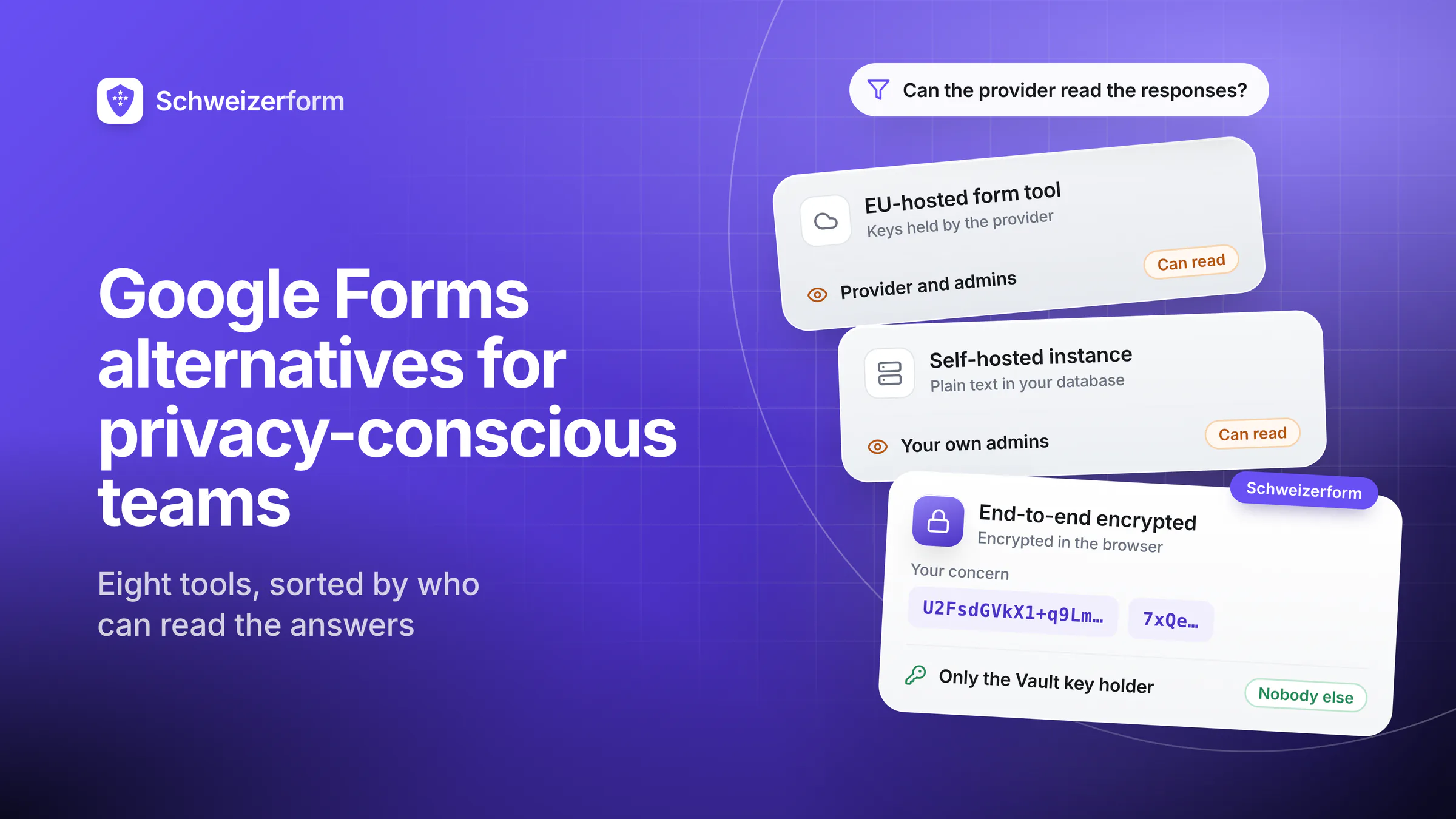
Short answer first. If your objection to Google Forms is that an American company holds readable copies of your responses, only two of the eight alternatives on this page actually fix that: an end-to-end encrypted platform such as Schweizerform or CryptPad Forms, or an instance of Nextcloud Forms, LimeSurvey or Formbricks that you run yourself. Everything else — Tally, Typeform, Jotform, Microsoft Forms — moves the readable copy to a different company, usually in the EU. That is a genuine improvement for European organisations, and it is not the same improvement.
So this page is a shortlist, not a pitch. The word «alternative» hides three different requirements — a different jurisdiction, a different commercial model, or a different threat model — and the tool that satisfies one of them is rarely the tool that satisfies the others. We take the eight candidates one at a time, say what each one actually changes relative to Google Forms, price them, estimate the migration effort, and finish with the cases where staying on Google Forms is the correct decision.
Status: July 2026
Every hosting, pricing and plan-gating claim below was checked against the vendor's own published documentation on 25 July 2026. Prices and data-residency options change — Typeform cut its free plan from unlimited responses to ten per month in February 2026, to take one recent example. Re-verify before you commit, and get the answer in writing rather than from a comparison page, including this one.
What Is Actually Wrong with Google Forms, Privacy-Wise?
Let us be precise, because the loose version of this complaint is easy to refute and it makes the rest of the argument look weak. Google Forms is encrypted: TLS in transit, encryption at rest in Google's infrastructure, with Google holding the keys. Google states that Workspace customer data is not used for advertising and is not used to train generative AI models outside the service. The product is professionally operated by one of the best security engineering organisations on earth. Almost nothing on the list below beats Google on raw operational security.
The gap is not encryption. It is access, jurisdiction and account type. Five specific things push teams off Google Forms:
- The provider can read the responses. Encryption with provider-held keys protects against a stolen disk, not against the provider, its support tooling, or a lawful order addressed to it. That is not a Google flaw — it is how almost every form platform works.
- Your Workspace administrator can read them too. Domain admins can access files and responses in the organisation. For an HR grievance form, a whistleblowing channel or a staff satisfaction survey, that is frequently the disqualifying fact, and it has nothing to do with Google.
- There is no Swiss region. Workspace data regions do cover Forms, but the choices are «No preference», the United States or Europe. Switzerland is not on the list, and the Google Cloud region in Zurich is Google Cloud Platform, not Workspace.
- Data regions are a plan feature. They require a supported Workspace edition — Business Standard/Plus, Enterprise Standard/Plus, Education Standard/Plus, Frontline or Enterprise Essentials Plus. On the free consumer product there is no region control at all.
- Consumer accounts are a different contract. A form built from a personal
@gmail.comaccount runs under the consumer Google Terms, not a Workspace agreement: no processing agreement, no admin controls, no data regions. Plenty of organisational forms are quietly built this way.
We work through the security question in detail in is Google Forms secure? and the Swiss legal question in can I use Google Forms legally in Switzerland?. The short version of the legal one: it is not prohibited, it is a documentation exercise under Art. 16 and 17 nDSG — until a professional secrecy duty or a genuinely sensitive data category enters the picture.
The Eight Alternatives — and What Each One Actually Changes
If the requirement is that nobody can read the responses
Schweizerform encrypts each submission in the respondent's browser before it leaves the device. The server stores ciphertext and wrapped keys; decryption happens in your browser with the Vault key, which never reaches us. Forms are authored in EN, DE, FR and IT, encrypted submissions are stored in Switzerland at Infomaniak, and the public form page loads no third-party trackers, so there is no consent banner between the click and the first question. What we can see is the form itself — your question text and settings are stored in plain text on the server. What we cannot see is any answer. The mechanism is described in zero-knowledge architecture explained.
CryptPad Forms is the genuinely comparable end-to-end encrypted option, and it is free software. CryptPad is a zero-knowledge collaboration suite from the French company XWiki SAS: encryption and decryption happen in the browser, the server stores only ciphertext, and the Forms app supports text, multiple choice, polls, ranked lists and date pickers, with CSV and JSON export. You can use the public instance at cryptpad.fr or host your own following the administrator guide. It is the right answer for a lot of teams — and it is a general-purpose office suite rather than a form product, so multilingual publication, per-form branding, payment fields, file-upload handling and response quotas are not its focus.
If the requirement is European hosting with a normal SaaS contract
Tally is the closest thing to a straight replacement, and the most generous free plan in the category: unlimited forms and unlimited submissions within its fair-usage guidelines, including conditional logic, calculations, file uploads, signatures, payments and multilingual forms. Tally BV is Belgian, its published GDPR page states that form data is encrypted in transit and at rest and stored in Europe, and a processing agreement is accepted at account creation with no signature step. Read its sub-processor list before you decide it is the privacy option: it runs to sixteen-plus entries including Google Cloud for hosting, Cloudflare, SendGrid, Stripe, Sentry and Mixpanel. Paid tiers are Pro at USD 24 per month and Business at USD 74 per month. Our per-feature view is in the Tally comparison.
Typeform is the conversational, one-question-per-screen experience, and nothing else on this list matches its polish for marketing and research forms. The privacy picture is weaker than its European branding suggests: main servers run on AWS in Virginia, with an EU data centre available on its higher, custom tiers. Pricing as listed in July 2026 is Basic USD 29, Plus USD 59 and Business USD 99 per month, and the free plan was cut to ten responses per month in February 2026. Detail in the Typeform comparison.
Jotform is the feature maximalist: thousands of templates, deep integrations, payment processing, PDF generation, approval workflows. Response data sits on Google Cloud in Iowa and Frankfurt, with AWS Virginia and Frankfurt for backup replication; the EU data centre is auto-enabled for accounts created in the EU. Note the plan gating carefully — the Starter plan is free with 100 submissions a month, Bronze is USD 39 for 1,000, Silver USD 49 for 2,500, Gold USD 129 for 10,000 and adds HIPAA features, and configurable data residency is an Enterprise-only option. See the Jotform comparison.
Microsoft Forms is the alternative most Swiss organisations already own, and for an internal poll inside an existing tenant it is a reasonable choice that requires no procurement cycle. Two facts decide whether it can carry more than that: a Swiss (EFTA) tenant lands in the European macro region rather than a Swiss one, and Forms is listed among the services without a specific data-residency commitment — so an Advanced Data Residency approval covering Exchange, SharePoint and Teams does not cover Forms. Tenant administrators can also reach response data. Detail in the Microsoft Forms comparison.
If the requirement is that you run it yourself
Nextcloud Forms is free with an instance you already have. If your organisation runs Nextcloud on Swiss or European infrastructure, hosting and sovereignty are already solved and adding forms costs nothing. The distinction to be clear-eyed about: responses are stored server-side in your Nextcloud, readable by anyone with administrative access to it — which is your own IT team rather than a vendor, but it is not the same as nobody.
LimeSurvey and Formbricks are the serious open-source survey engines. LimeSurvey is the incumbent at Swiss universities, hospitals and cantonal administrations, with question-logic depth nothing on this list matches. Formbricks is the modern one — AGPLv3, unlimited responses when self-hosted, with a cloud tier whose free plan is capped at 250 responses a month. Installed on Swiss hosting such as Infomaniak or Hostpoint, either gives you a Swiss home for your data and complete control over retention. The honest cost: responses land in clear text in your own database, and patching, backups, TLS renewal, access reviews and breach detection become your obligations under Art. 8 nDSG. We work that trade-off through in the self-hosted forms comparison.
The Eight Alternatives Compared
| Tool | Where responses are stored | Can the provider read them? | Free tier | Best fit |
|---|---|---|---|---|
| Google Forms | US or Europe, by Workspace data region; no Swiss option | Yes — Google and your Workspace admin | Yes, with a consumer account under consumer terms | Internal, low-sensitivity collection inside an existing Workspace |
| Tally | Europe — Google Cloud in Belgium, plus Cloudflare | Yes — plus sixteen-plus sub-processors | Yes — unlimited forms and submissions under fair use | The straight, cheap, EU-hosted replacement |
| Typeform | AWS Virginia (US); EU data centre on higher custom tiers | Yes | Ten responses per month since February 2026 | Marketing and research forms where the experience sells |
| Jotform | Google Cloud Iowa and Frankfurt; AWS backup replication | Yes | Yes — 100 submissions per month | Feature breadth: payments, PDFs, approvals, integrations |
| Microsoft Forms | EU/EFTA macro region for Swiss tenants; no residency commitment | Yes — Microsoft and your tenant admin | Included with Microsoft 365 | Internal polls in a tenant you already pay for |
| CryptPad Forms | The instance you choose — cryptpad.fr or your own | No — end-to-end encrypted, zero-knowledge | Yes — free software, free public instance | Confidential collection where an office suite fits the workflow |
| Nextcloud Forms | Your own Nextcloud instance | No vendor — but your own administrators can | Yes, if you already run Nextcloud | Municipalities, schools and SMEs already on Nextcloud |
| LimeSurvey / Formbricks, self-hosted | Your own server — Swiss hosting if you choose it | No vendor — responses sit in clear text in your database | Yes — open source; Formbricks Cloud free tier is 250/month | Survey research and product feedback with in-house operations |
| Schweizerform | Encrypted submissions stored in Switzerland (Infomaniak) | No — encrypted in the browser, only the Vault key decrypts | Yes — Free plan, Swiss hosting and encryption included | Sensitive intake: health, HR, legal, whistleblowing, finance |
Read the third column first and the rest afterwards. It splits the list into two groups that are not really competing with each other: five products where a provider holds readable data under a contract, and four where the readable data is either mathematically out of reach or physically on your own hardware. Choosing between Tally and Typeform is a product decision. Choosing between Tally and CryptPad is a threat-model decision.
Privacy: The Criterion That Sorts the List
There are exactly three privacy architectures in this market, and every product on this page is one of them. Provider-held keys: the platform encrypts your data with keys it controls, which stops an attacker with a stolen disk and does not stop the platform. Self-hosted plaintext: no external provider is involved, and your own database contains readable responses that your own administrators, backups and any server compromise can reach. End-to-end encryption: the key never leaves the client, so the operator stores material it cannot open. The differences are set out in encryption at rest vs end-to-end.
The reason this ordering matters more than a feature grid is that the second and third columns of any vendor's privacy page — certifications, processing agreements, sub-processor lists — all describe promises about readable data. They are meaningful, enforceable and worth having. They are also a different category of protection from an architecture in which there is nothing readable to promise about. Both are legitimate. Only one of them survives a subpoena addressed to the provider, which we cover in subpoenas, warrants and your form data.
«EU-hosted» and «unreadable» are different claims
Moving from Google Forms to an EU-hosted platform changes which jurisdiction's authorities can compel disclosure and which supervisory authority you deal with. It does not change whether a provider can read your responses. If your reason for leaving Google is that you handle medical intake, employee reports or client matters under a professional secrecy duty, an EU-hosted alternative with provider-held keys has not addressed your problem — it has relocated it.
Hosting and Jurisdiction: Where the Responses Actually Land
None of the mainstream alternatives offers Switzerland. Tally is in Europe on Google Cloud in Belgium; Typeform's default is Virginia with an EU option on custom tiers; Jotform is Iowa and Frankfurt; Microsoft puts Swiss tenants in the EU/EFTA macro region. For a Swiss organisation, that means the alternatives to Google Forms are mostly a move from «adequate third country plus a Data Privacy Framework question» to «adequate third country under the EU adequacy decision» — an improvement in paperwork, not an escape from cross-border transfer analysis. The legal test itself is in which form data can legally leave Switzerland.
Genuine Swiss residency comes from three places only: a Swiss-hosted product, a self-installed instance on Swiss infrastructure such as Infomaniak or Hostpoint, or a self-hosted CryptPad on Swiss hardware. We keep a vendor-by-vendor list of who genuinely qualifies in form and survey tools hosted in Switzerland, including the Swiss-branded tools that process on AWS in Ireland.
Pricing: What Leaving Google Forms Costs
| Tool | Free tier | Entry paid tier | What the price is really buying |
|---|---|---|---|
| Tally | Unlimited forms and submissions, fair use | Pro USD 24/month | Branding removal, team seats and advanced features — not privacy |
| Typeform | 10 responses/month since February 2026 | Basic USD 29/month | Response volume; EU hosting sits on the higher custom tiers |
| Jotform | 100 submissions/month | Bronze USD 39/month | Volume; HIPAA from Gold at USD 129, data residency at Enterprise |
| Microsoft Forms | Included with a Microsoft 365 subscription | n/a — bundled | Nothing extra; residency for Forms is not purchasable |
| CryptPad Forms | Free software, free public instance | Instance subscriptions or your own hosting | Storage and support, or the hardware you run it on |
| Nextcloud Forms | Free with a Nextcloud you already run | n/a — bundled | Nothing, if the instance exists; otherwise the instance |
| LimeSurvey / Formbricks | Open source, unlimited when self-hosted | Hosting plus your own operations time | Control — paid for in administration hours, not licence fees |
| Schweizerform | Free plan with encryption and Swiss storage included | Pro CHF 29/month, Business CHF 69/month | Volume, seats and advanced features — encryption is never a tier |
One pattern is worth naming because it repeats across the commercial products: the privacy-relevant feature is the one behind the highest paywall. Jotform sells configurable data residency at Enterprise. Typeform's EU hosting sits on custom tiers. Google's data regions require a supported Workspace edition. If data residency is a legal requirement for you rather than a preference, budget for the tier that carries it — or choose a product where it is not a tier at all. Our own position is the simple one: encrypted submissions are stored in Switzerland on every plan, including Free, because there is no other region to sell. The plan limits are on the pricing page.
The other pattern is the one behind Google Forms itself. Free tools are not charities, and the currency is usually attention, lock-in or data. We take that apart in the hidden cost of «free» form tools — and note in passing that Tally, CryptPad, Nextcloud Forms and Formbricks are all genuine counter-examples where the free tier is simply generous.
Migration Effort: How Hard Is Each Move?
| Move to | Effort | What actually costs time |
|---|---|---|
| Tally | Low — an afternoon | Rebuilding questions by hand; there is no Google Forms importer worth relying on |
| Typeform / Jotform | Low to medium | Rebuilding, then reconnecting whatever consumed the Google Sheet |
| Microsoft Forms | Low | Nothing technical; the work is checking that residency assumptions hold |
| CryptPad Forms | Medium | Rebuilding, plus teaching the team how sharing links and keys work |
| Nextcloud Forms | Low if the instance exists, high if it does not | Standing up and operating Nextcloud, if you are not already |
| LimeSurvey / Formbricks self-hosted | High | Install, upgrade path, backups, TLS, access control, monitoring |
| Schweizerform | Low to medium | Rebuilding the form, then the one genuinely new step: storing the Vault key properly |
Two honest notes. First, nobody in this market has a reliable Google Forms importer, so budget for rebuilding rather than migrating — which is a good moment to delete the fields you stopped needing three years ago. Second, the extra step on an end-to-end encrypted platform is real: because we cannot read your data, we also cannot recover it if the Vault key is lost. That is the trade the architecture makes, and it needs a key-custody decision before the first form goes live, not after.
How to Move Off Google Forms Without Losing Anything
- 1
Export the existing responses first
Download the linked Google Sheet as CSV and keep it somewhere with the same access controls the new system will have. Do this before you touch the form — it is the only copy that is entirely under your control.
- 2
Sort your forms by sensitivity, not by volume
The event sign-up and the grievance form should not end up on the same platform by default. Most organisations need one cheap general-purpose tool and one encrypted tool for a small number of forms. That split is scoping, not a failure to consolidate.
- 3
Rebuild the form and cut fields while you do it
You are retyping the questions anyway. Apply Art. 6 nDSG proportionality: every field you do not carry over is a field you never have to secure, retain, export or delete. Our guide to creating a secure online form has the field-by-field version.
- 4
Redirect the old form rather than deleting it
Set the Google form to stop accepting responses and put the new link in its closing message. Old links live in e-mail signatures, intranet pages and printed handouts far longer than anyone expects.
- 5
Reconnect whatever consumed the responses
The Google Sheet was probably feeding a report, a Zap or a person's Monday morning. Check exports, webhooks and notification e-mails on the new platform before you announce the switch, not after.
- 6
Write down retention and transfer basis, then delete the old data
Set how long responses are kept and who deletes them — see form data retention — record your Art. 16 nDSG transfer basis if the new platform is outside Switzerland, and only then delete the responses left behind in Google Drive.
Which Alternative Fits Which Team
Choose Tally, Typeform or Jotform when…
…the data is ordinary business data and the requirement is a better product with a European contract. Tally is the value pick and the closest thing to a like-for-like Google Forms replacement, Typeform wins where the respondent experience affects the completion rate, and Jotform wins where you need payments, PDFs and approval workflows in one place. All three give you a processing agreement and a named EU hosting story. None of them changes who can read the responses.
Choose Nextcloud Forms, LimeSurvey or Formbricks when…
…control is the actual requirement and you have the operational capacity to back it. You own the schema, the retention, the export format and the upgrade path, and there is no processor in the chain at all. Choose it because you want that control, not because self-hosting sounds safer by default — the responses are in clear text in a database you are now responsible for defending, and Art. 8 nDSG puts the technical and organisational measures on you.
Choose CryptPad Forms when…
…you want end-to-end encryption, free software and no vendor relationship, and your workflow fits an office suite. It is a serious, credible project, and for an activist group, a small association or a research team already using CryptPad for documents it is an excellent answer. What you are giving up relative to a dedicated form product is the form-specific machinery: multilingual publication of the same form, per-form branding, submission quotas and analytics, structured attachment handling, and someone to call.
Choose Schweizerform when…
…the submissions contain something a provider should not hold in readable form, and you do not want to become a system administrator to achieve that. Patient intake, employee reports, whistleblowing, client onboarding, anything touching the professional secrecy duty of Art. 321 StGB — which binds not only the professional but their auxiliary persons. Encrypted submissions stored in Switzerland, forms published in four languages from one definition, no trackers on the form page, and no way for us to read an answer even if we were compelled to try.
Where Google Forms Is Still the Right Answer
Plenty of places, and a comparison page that pretends otherwise is not worth reading. A team lunch poll, a workshop feedback form, a conference session sign-up, a quiz in a classroom, an internal availability check inside a Workspace domain — Google Forms is free, everybody already knows it, it is reliable, and the data is not sensitive. Switching tools has a cost in training and habit, and spending that cost on low-stakes collection is a bad trade. The right question is never «should we leave Google Forms» in the abstract, but «which of our forms should never have been on it».
What Is the Most Privacy-Friendly Alternative to Google Forms?
By the strict definition — the smallest set of parties able to read a response — the answer is a tie between an end-to-end encrypted platform and a self-hosted instance you operate, and which of those is right depends entirely on whether you have someone to run a server. Among end-to-end encrypted options, CryptPad Forms is the free-software answer and Schweizerform is the product answer whose submissions are stored in Switzerland. Among EU-hosted commercial products, Tally is the strongest combination of price, features and a European contract. And if you take only one thing from this page: run the sub-processor list, not the marketing page, of whichever one you shortlist.
A practical shortlist. For low-stakes forms, keep Google Forms or move to Tally and stop worrying about it. For a team that already runs Nextcloud on European infrastructure, use Nextcloud Forms — you have already paid for the hard part. For survey research with in-house IT, self-host LimeSurvey or Formbricks. And for the handful of forms where the answer «the provider can read it, but contractually promises not to» is not good enough, that is the gap Schweizerform was built for: see how the encryption works or start on the Free plan and test it with a real form.
Disclaimer: This comparison is general information and marketing content, not legal, regulatory or compliance advice. Hosting locations, prices, plan gating, free-tier limits and sub-processor lists for Google, Tally, Typeform, Jotform, Microsoft, CryptPad, Nextcloud, LimeSurvey and Formbricks reflect each vendor's publicly available documentation as checked on 25 July 2026 and change frequently — verify current details directly with the vendor before making procurement or compliance decisions. References to the DSG and to Art. 321 StGB are summaries, not a substitute for advice from qualified Swiss counsel on your specific processing. All product and company names are trademarks of their respective owners and are used here for factual comparison only.