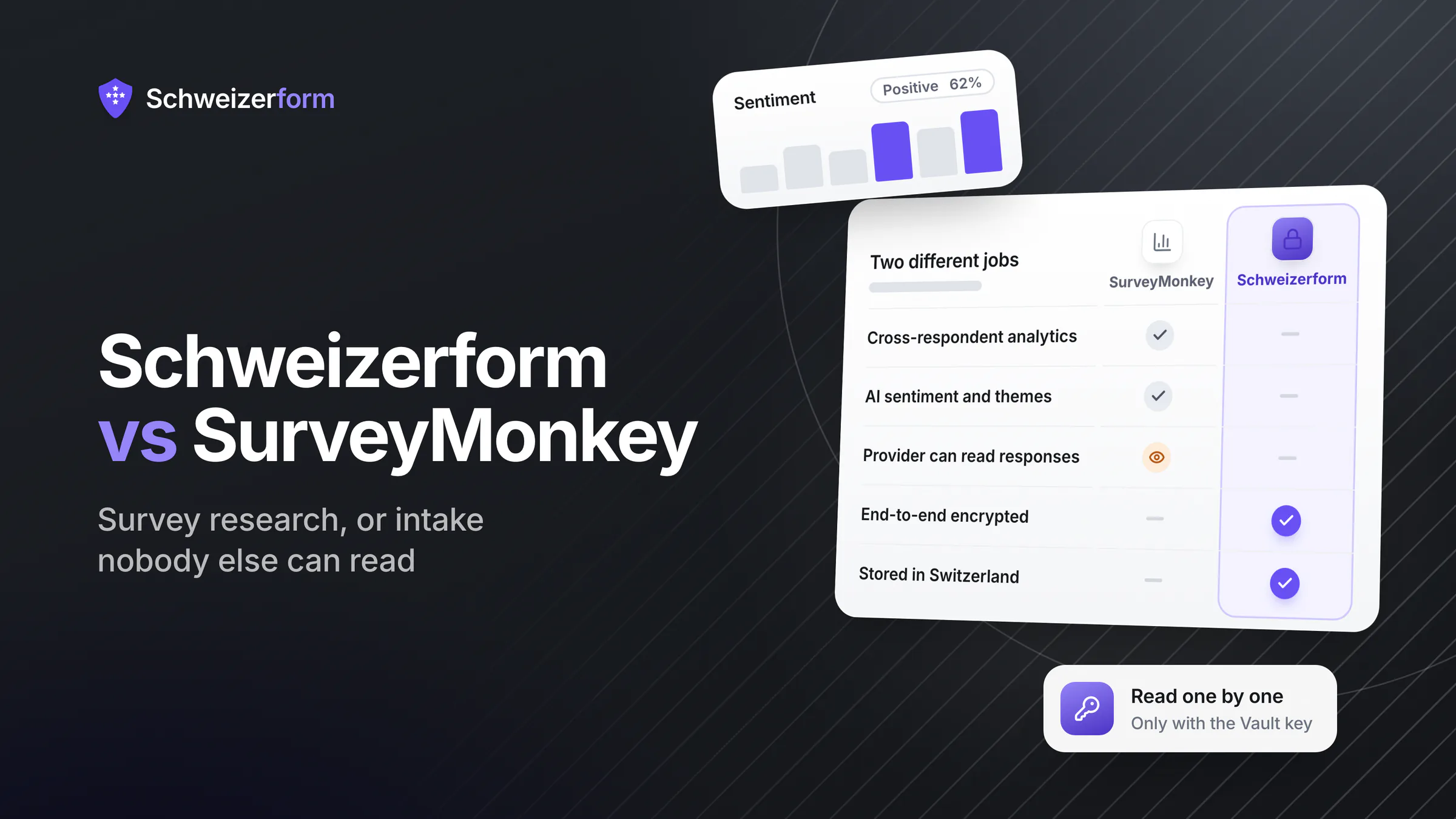
SurveyMonkey is the most recognisable name in the survey category. It has been the default choice for customer satisfaction surveys, employee engagement studies, NPS programmes, and academic research for two decades. For organisations whose primary need is to ask questions of large populations and analyse the answers statistically, it is a serious, capable product.
It is also a product whose entire value proposition is built on reading your responses. AI-driven sentiment analysis, automatic theme detection, benchmark comparisons, weighted scoring, and the rest of the analytics suite all depend on SurveyMonkey having full plaintext access to every answer respondents submit. That is fine — for the use case the tool is built for. It is the wrong fit for confidential intake, and the comparison rests on understanding which problem you actually have.
Our bias, declared
We have an interest in one side of this comparison. SurveyMonkey is genuinely strong for survey research — analytics depth, question bank, longitudinal tracking. We will say so plainly. The point of this page is to draw the line between survey research (where SurveyMonkey wins) and confidential intake (where the architecture rules it out).
How SurveyMonkey and Schweizerform position themselves
SurveyMonkey — research, analytics, and benchmarking at scale
SurveyMonkey is built for asking many people the same questions and turning the answers into insight. Its real product is not the form-builder; it is the analytics, AI insight engine, statistical reporting, and benchmark dataset behind the responses. Customer experience teams, HR analytics, market research firms, academic researchers, and brand tracking programmes are the canonical users. Pricing reflects this — paid plans are largely about analyst seats, response volume, and analytics features.
Schweizerform — confidential intake, zero-knowledge by default
Schweizerform is built around a different premise: every submission is end-to-end encrypted in the respondent's browser, and our servers physically cannot decrypt it. The product is designed for one-off, confidential intake — patient onboarding, legal client questionnaires, whistleblower reports, financial KYC, journalism source forms, HR investigations. We deliberately do not provide cross-respondent analytics, sentiment scoring, or AI insights — because doing so would require us to read what we have spent the entire architecture making unreadable.
The Security Models — Where the Real Difference Lives
Both products encrypt data. The word covers very different mechanisms in each.
SurveyMonkey — TLS in transit, server-side encryption at rest
SurveyMonkey encrypts traffic between respondents and its servers (TLS) and encrypts response data at rest in its US-hosted infrastructure. Higher-tier plans add features such as HIPAA compliance with a BAA, single sign-on, and stricter access controls. This is solid baseline security and is appropriate for the threat model SurveyMonkey serves. The plaintext, however, is necessarily available to SurveyMonkey's services — that is what makes the analytics work.
Schweizerform — zero-knowledge end-to-end encryption, by default
Schweizerform encrypts the entire submission in the respondent's browser before any data reaches our servers. The encryption keys are derived from the form owner's vault key, which never touches our servers and is never transmitted. Submissions live in a vault only the owner can open, and our servers see ciphertext only. That is what makes it truly end-to-end encrypted: it applies to every form, every field, every plan including the free tier. It is structural, not configurational.
The threat model difference, concretely
A breach of SurveyMonkey infrastructure could expose plaintext responses across customers (encryption-at-rest protects against disk theft, not running services). A US subpoena, warrant, or CLOUD Act order to SurveyMonkey can compel disclosure of decryptable data. A breach of Schweizerform infrastructure exposes ciphertext with no decryption path; a Swiss lawful request yields ciphertext only.
The Analytics Trade-off — Why Zero-Knowledge Is Not a Feature SurveyMonkey Could Add
It is tempting to imagine that SurveyMonkey could simply "add" zero-knowledge encryption as an option. The reason it does not — and structurally cannot, without becoming a different product — is that its core capabilities depend on reading respondent data:
- Sentiment analysis on open-text responses requires running NLP on plaintext
- AI-generated insights and automatic theme detection require plaintext input
- Cross-survey benchmarking against SurveyMonkey's global dataset requires aggregating real responses
- Weighted, comparative scoring across question types requires the analytics engine to interpret answers
- Statistical significance testing across cohorts requires the platform to compute on real values
This is not a criticism — it is the architecture the product needs to deliver what its customers buy it for. It is also the reason SurveyMonkey is the wrong tool for forms where the operator's ability to read the data is itself the risk. Confidential intake forms do not need cross-respondent benchmarking. They need the opposite: a guarantee that nobody outside the form owner can read what was submitted.
Two different jobs, not two competitors
If you are running an NPS programme across 50,000 customers, SurveyMonkey is genuinely better than Schweizerform — and it is not close. If you are intaking patient histories, whistleblower reports, or KYC documents, Schweizerform is genuinely better than SurveyMonkey — also not close. The honest comparison is about which job you have, not which product is generally superior.
SurveyMonkey and Schweizerform, feature by feature
| Schweizerform | SurveyMonkey | |
|---|---|---|
| End-to-end encryption (client-side) | Yes — default, all fields | No — TLS in transit, server-side encryption at rest |
| Zero-knowledge architecture | Yes — provider cannot decrypt | No — provider holds keys; analytics require plaintext |
| Cross-respondent analytics | Not provided — by design | Yes — primary product strength |
| AI-driven sentiment / insights | Not provided — by design | Yes — central value proposition |
| Question bank / pre-validated questions | Not provided | Yes — large library across industries |
| Benchmark dataset comparisons | Not provided | Yes — global benchmarking on higher plans |
| Best fit | Confidential intake, sensitive disclosures, one-off submissions | Recurring surveys, market research, NPS / engagement programmes |
| Data hosting | Switzerland | United States (some EU residency on Enterprise) |
| Subject to US CLOUD Act | No — Swiss entity, Swiss hosting | Yes — US company, US infrastructure |
| nFADP alignment | Designed around the nFADP | Generic US privacy posture |
| GDPR compliance | Yes, plus Swiss adequacy for EU transfers | Yes, with SCCs / Data Privacy Framework for EU-US transfers |
| HIPAA compliance | No BAA — we are not a HIPAA vendor. Submissions are encrypted in the browser, so we cannot read PHI, but a US covered entity should treat that as a technical safeguard, not as a reason a BAA is unnecessary | Yes — with BAA on enterprise plans only |
| Free plan | 3 forms, 100 submissions/month, full encryption | Limited — 10 questions per survey, 40 responses |
| Conditional logic / branching | Yes — show/hide a question based on earlier answers (Pro) | Yes — strong, multiple variants |
| File uploads | Encrypted in-browser, up to 100 MB each / 1 GB total | Yes — paid tiers, server-stored |
| Localisation (EN / DE / FR / IT) | All four, native, fully localised UI | Available, primarily English-led |
| Audit logging | Yes | Yes (higher plans) |
| Single sign-on / SAML | No | Yes (higher plans) |
| Designed for whistleblower / clinical / source intake | Yes | No — research-focused product |
| AI form creation | Yes — draft from a prompt; the AI never sees responses | Yes — Build with AI (OpenAI-powered) from a prompt; its AI also reads responses for analytics |
| Automatic form translation | Yes — DE / FR / IT / EN; only form text is translated, never responses | Partial — multilingual surveys, but you supply the translations; only default UI text is auto-translated |
| Team workspaces & roles | Yes — shared workspace, still end-to-end encrypted, role-based | Yes — Team plans with roles, seats & workgroups (min. 3 seats); responses remain readable by the provider |
Jurisdiction, Hosting, and Data Sovereignty
SurveyMonkey is a US company (Momentive Inc / SurveyMonkey Inc), incorporated in Delaware and headquartered in California. Its primary infrastructure is US-hosted; some EU data residency options are available on higher-tier enterprise plans. For US and global customers without strong sovereignty requirements, this is rarely an issue. For Swiss organisations and EU entities subject to nFADP or GDPR with sensitive workloads, the picture is different.
Even where regional data residency is offered, the parent company's nationality determines the legal exposure. The US CLOUD Act applies to data held by US providers regardless of the physical server location, and SurveyMonkey, as a US-headquartered entity, is structurally subject to US compulsory process. A Swiss provider operating only under Swiss law is not.
| Question | SurveyMonkey | Schweizerform |
|---|---|---|
| Where is response data physically stored? | United States by default; EU residency on enterprise tiers | Switzerland |
| Legal nationality of the provider? | United States (SurveyMonkey Inc) | Switzerland |
| Subject to the US CLOUD Act? | Yes | No |
| Can the provider decrypt responses if compelled? | Yes | No — ciphertext only |
| Adequacy for EU data subjects? | Yes (Data Privacy Framework / SCCs) | Yes — Swiss adequacy decision |
Compliance Frames — nFADP, GDPR, and HIPAA
SurveyMonkey carries the standard enterprise compliance set: ISO 27001, SOC 2 Type II, HIPAA on enterprise plans with a BAA, GDPR data processing addendum, and a published trust portal. For most non-sensitive survey work this is more than sufficient. For sensitive personal data — particularly nFADP and GDPR Article 9 categories — certifications are necessary but not architecturally decisive. The processor's ability to read the data still drives notification, transfer, and breach obligations.
Schweizerform's architectural argument is simpler. We process ciphertext only. That narrows GDPR Article 28 obligations, simplifies the cross-border transfer analysis (Swiss adequacy applies to the metadata we see), and changes the breach-notification calculation under GDPR Article 33 and nFADP Article 24: a breach exposing ciphertext is, by definition, not exposing identifiable personal data.
Pricing — Tier-Heavy vs Capacity-Based
Both products offer free tiers and paid plans, but the shapes are very different.
SurveyMonkey's model
SurveyMonkey's free tier is restrictive — 10 questions per survey, 40 responses, very limited export and analytics. Paid plans (Standard Monthly, Advantage, Premier, Enterprise) unlock features layer by layer: question types, branching depth, analysis, exports, branding, response volume, SSO, HIPAA. Pricing scales with seats and feature tier, and many capabilities that competitors include by default sit on the higher plans.
Where Schweizerform's architecture diverges from SurveyMonkey's
Schweizerform's free tier is narrower in submission volume (100 submissions/month) but does not gate encryption, sovereignty, or any security feature. Paid plans (Pro and Business) raise form and submission counts. The deliberate choice is to never put cryptographic guarantees behind a paywall — every plan is end-to-end encrypted, including the free tier.
The structural trade-off: SurveyMonkey gates analytics features behind paid tiers. Schweizerform gates capacity but never security. For high-volume survey research, SurveyMonkey's tier ladder is appropriate. For confidential intake, the cost of using the wrong tool is not measured in CHF per month.
Survey analytics against unreadable responses
Pick SurveyMonkey when
- You need to ask many respondents the same questions and analyse aggregate trends
- Sentiment analysis, AI insight generation, and benchmark comparisons are core to the value you deliver
- Pre-validated question banks and templated survey methodology save you research design effort
- You run recurring NPS, employee engagement, or customer satisfaction programmes
- Statistical reporting, weighted scoring, and longitudinal tracking matter to your downstream decisions
- The data you collect is acceptable to share with SurveyMonkey as a processor with full read access
Choose Schweizerform when you would rather not be able to cross-tabulate
- The form collects health data, financial disclosures, identification documents, or any nFADP/GDPR Article 9 special category
- You handle whistleblower reports, journalism source intake, or any workflow where the respondent's safety depends on confidentiality
- You are subject to nFADP and need a Swiss-hosted, Swiss-operated provider with no US legal exposure
- Zero-knowledge — the operator physically cannot read submissions — is a procurement requirement, not a nice-to-have
- Localisation into German, French, and Italian for Swiss/EU respondents is essential
- Each submission is read individually by a human form owner; cross-respondent analytics are not part of the workflow
- You need encryption on every form including the free tier without a paid upgrade path
When You Might Use Both
A common pattern: SurveyMonkey for the recurring, aggregate-analysis surveys — annual employee engagement, customer NPS, market research panels — and Schweizerform for the one-off, confidential, individually-read submissions — patient intake, exit interview disclosures, whistleblower reports, sensitive HR investigations, KYC document collection.
Splitting the workload this way is not a workaround. It is the architecture each tool is optimised for, used for what it is best at. A privacy team that consolidates everything into one platform almost always ends up making either the analytics or the confidentiality story weaker than it needs to be.
Moving Sensitive Surveys Off SurveyMonkey
Many organisations come to this comparison with a small handful of SurveyMonkey surveys that — on review — were never really surveys. They were intake forms wearing a survey's clothes: an internal whistleblower channel, a clinical screening, a financial onboarding form. Migrating just those is straightforward.
- 1
Identify the forms in scope
Look for surveys where each response is read by a human, not aggregated; where one-to-one confidentiality matters more than cross-respondent analytics; and where the questions cover health, financial, identification, or other sensitive data.
- 2
Export historical responses
SurveyMonkey supports CSV / XLS / SPSS export from the analyse view. Pull a snapshot for the records you need to retain. Once moved to Schweizerform, you will not have ongoing access to that historical data via SurveyMonkey.
- 3
Rebuild the form in Schweizerform
Most question types map directly. Conditional logic is supported on the paid plans, so a branching SurveyMonkey survey maps across: show or hide a question based on earlier answers, and split a long survey across pages. Question-level randomisation and quotas do not map. For file uploads, plan for our 100 MB per file / 1 GB per submission limits. Localise into German, French, Italian, and any other languages your respondents need.
- 4
Update processor agreements
If your DPA listed SurveyMonkey as a processor for the workflow, add Schweizerform and document the architectural arrangement (zero-knowledge, ciphertext-only). For Swiss respondents, the Swiss-to-Swiss processing simplifies the transfer analysis significantly.
- 5
Communicate the change
If respondents have been submitting via a SurveyMonkey URL that is being replaced, communicate clearly. For ongoing programmes (whistleblower lines, intake forms), the move from a US survey URL to a Swiss-hosted form URL is itself a positive trust signal — make it visible.
- 6
Retire the old survey
Close the SurveyMonkey form once live traffic is routed to the new one. Archive the historical export under whatever retention period applies. Remove integrations to downstream systems that depended on SurveyMonkey's webhook or API for that workflow.
SurveyMonkey or Schweizerform
SurveyMonkey is a serious survey research platform. Its analytics, AI insights, question bank, and benchmark dataset are the reasons it has dominated the category for two decades, and they are real, useful tools for the people running survey programmes at scale. Nothing in this comparison argues otherwise.
It is also a platform whose entire value depends on the provider being able to read every response. That is the architecture survey research demands; it is the wrong architecture for confidential intake. Where the data is sensitive enough that the provider's read access is itself the risk, SurveyMonkey is structurally not a candidate — and no upgrade tier changes that.
Schweizerform is built for the workflows on the other side of that line. Patient intake, legal client onboarding, whistleblower reports, financial KYC, journalism source intake — submissions that are read once, by a single owner, never aggregated, and never visible to the provider. The cryptographic guarantee is identical on the free tier and on the largest plan, the hosting is Swiss, and the operator physically cannot read submissions.
Schweizerform offers zero-knowledge end-to-end encryption, encrypted submissions stored in Switzerland, and full nFADP alignment on every plan — including a free tier with the same cryptographic guarantees as our highest plan. For the forms where SurveyMonkey's strength becomes a liability, try Schweizerform with real submissions before you decide.
Disclaimer: Competitive details for SurveyMonkey (features, plan tiers, free-plan question and response limits, pricing, hosting regions, EU data residency availability, HIPAA / BAA terms, analytics scope) reflect publicly available information at the time of writing and may change — verify current details directly with the vendor before making procurement or compliance decisions. This content is general information, not legal, regulatory, or compliance advice. All product and company names are trademarks of their respective owners, and their use here is for factual comparison only. Competitive details were last verified on 25 July 2026.