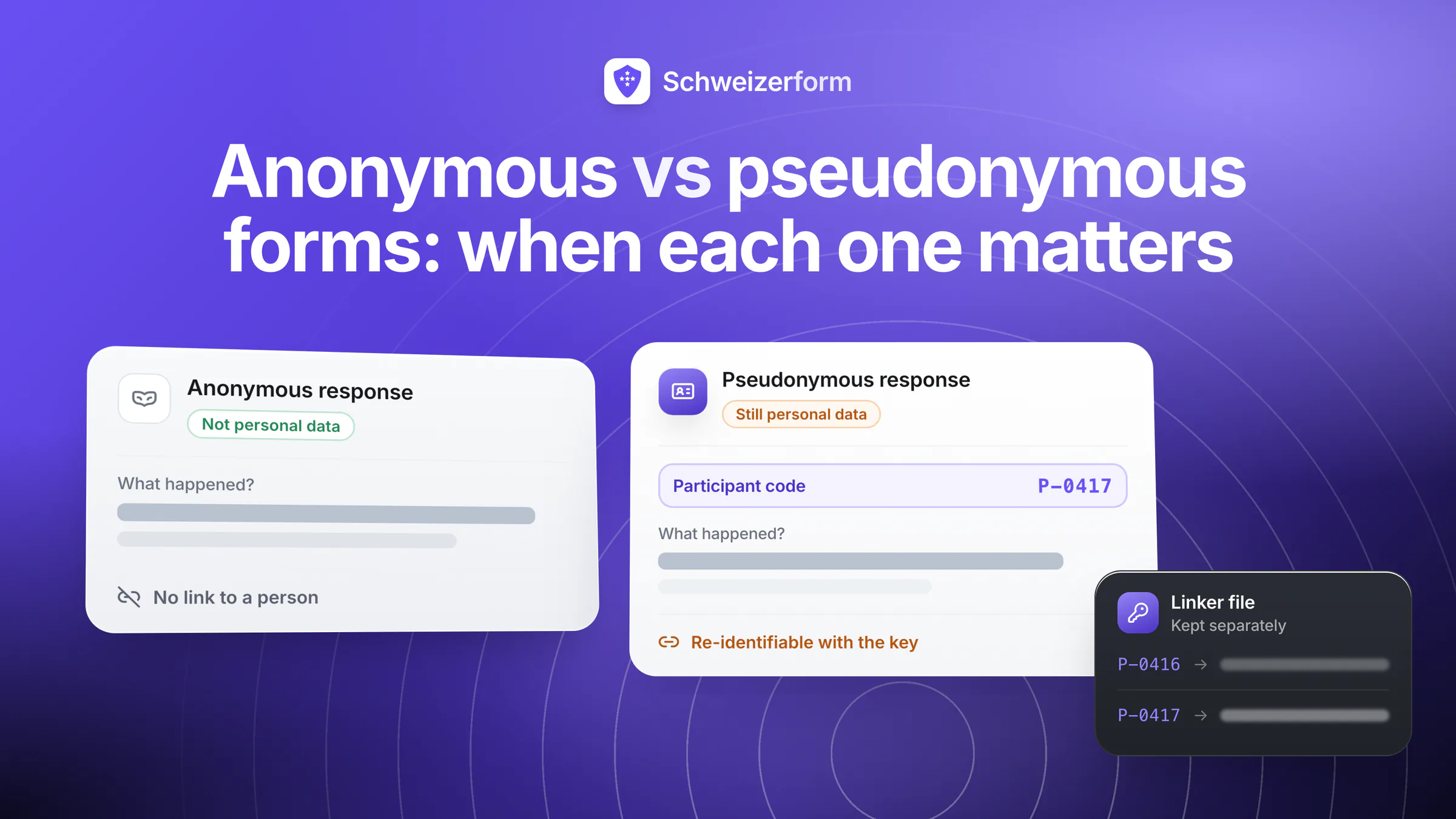
Two forms can both promise to protect the respondent's identity and still mean entirely different things. One is genuinely anonymous: nothing in the submission, in the metadata around it, or in any other system the operator runs can be reasonably linked back to the person who filled it out. The other is pseudonymous: the submission is not labelled with a name, but a code, ID, or token allows the operator — or someone holding a key — to re-attach an identity later. The difference looks small on a UI; it is enormous in law, in operational risk, and in what each form is actually fit for.
This article walks through that distinction, why it matters under the GDPR and the Swiss nFADP, the technical reasons most so-called 'anonymous' forms quietly leak identity, when pseudonymity is genuinely the better choice, and how to choose architecture that delivers the property you actually need. It covers research, journalism, whistleblower channels, healthcare follow-up, HR investigations, and public surveys.
Who this is for
Researchers and IRB members, ethics committees, journalists running tip lines, HR and compliance leads designing whistleblower channels, clinicians collecting longitudinal data, public-sector teams running consultations, and any operator advertising 'anonymous' forms who wants to know whether the claim survives scrutiny.
The Distinction That Actually Matters
The shortest accurate definition: a submission is anonymous when no party — including the operator and any reasonably motivated third party — can re-identify the submitter using means likely to be used in practice. A submission is pseudonymous when the link to a person is replaced by a code, but a separate piece of information (a key, a linker file, a contact list) can re-establish that link.
Both regulators and researchers test the claim of anonymity with a 'reasonably likely' standard. If the operator holds the data plus a side channel (account email, IP log, browser fingerprint, payment record) that, alone or in combination, can identify the submitter, the form is not anonymous. It is pseudonymous at best, and treating it as anonymous is both legally risky and operationally misleading.
| Property | Anonymous | Pseudonymous |
|---|---|---|
| Link to a real person | None reasonably exists | Exists, separated from the submission via a key |
| GDPR / nFADP scope | Outside the scope of personal-data law | Personal data; full obligations apply |
| Right to access / deletion | Not applicable — there is no identifiable person | Applicable; operator must respond |
| Re-identification risk | Should be negligible by design | Real, depending on key holder and key controls |
| Follow-up communication | Impossible by design | Possible via the linker key |
| Typical fit | Whistleblower tips, public surveys, sensitive disclosures with no follow-up | Longitudinal research, clinical follow-up, traceable QA |
Anonymity is a property of the whole system, not of the form
A form that captures no name and no email can still produce a pseudonymous record if the operator's web server logs IP addresses, the analytics provider fingerprints the browser, the email-delivery service stamps a unique tracking pixel, or the workflow tool records who clicked the submission link. Anonymity must hold across every system that touches the submission, end to end.
Why Most 'Anonymous' Forms Aren't
Operators tend to assume that omitting the name field is enough. Real-world forms leak identity through a long list of side channels, most of which are invisible to the person filling in the form. The honest audit asks not 'did we ask for the name?' but 'what could anyone — internally or under legal compulsion — combine to identify the submitter?'
- Server-side IP logs that the form vendor or its CDN retains by default, often for 30 to 90 days, sometimes indefinitely
- Browser fingerprinting through analytics, anti-fraud, or session-replay scripts loaded on the form page
- Account-level data when the form is gated behind a login (SSO, employee SSO, Microsoft 365, Google Workspace)
- Email-delivery metadata when the response triggers an automated email and the recipient's mail server logs the source IP and timestamps
- Free-text fields that the submitter populates with self-identifying details ('as the only person in the team who manages X…')
- Small populations: in a 12-person department, asking for role plus tenure plus location often pinpoints one individual
- Cross-form linkage: a submitter who fills two related forms from the same browser session ties their submissions together even when each form individually claims anonymity
- Payment trails when the form is part of a paid workflow (e.g. a research stipend, a registration fee)
- Workflow systems that record who reviewed, opened, or moved a submission — with reviewers seeing data the system metadata also retains
| Common claim | Where the leak typically lives |
|---|---|
| 'We don't ask for your name' | IP logs at the form vendor and its CDN; account login behind the form; browser fingerprinting scripts on the page |
| 'Submissions are anonymous' | Free-text answers self-identify; small subgroups make demographic combinations unique |
| 'Only HR sees the response' | HR system stores the timestamp; mail server logs delivery; ticket system records who acknowledged |
| 'Hosted on our intranet, so it's safe' | Intranet auth ties the submission to a corporate identity even when no name is shown to reviewers |
| 'No tracking, no analytics' | Default vendor analytics, error monitoring (Sentry, Bugsnag), session replay, or A/B tooling installed without a fresh review |
The pattern is consistent: the form-level question 'do we ask for identifying fields?' is necessary but nowhere near sufficient. Anonymity has to be designed across the page, the network path, the storage backend, the workflow tool, and the operational practices around access. Anything less is pseudonymity wearing a different label.
When Pseudonymity Is the Right Choice
Pseudonymity is not a failure mode. For many legitimate use cases, the operator genuinely needs the ability to re-attach an identity to a submission later — and the right design is not to ditch that requirement but to apply pseudonymisation deliberately, with the linker key kept under separate control.
- Longitudinal research where wave-2 and wave-3 surveys must be matched to the same participant for valid analysis
- Clinical follow-up: a patient questionnaire that may flag a safety signal requiring the clinician to call them back
- Quality assurance with traceability: customer-experience surveys that need to be reconciled to a transaction without exposing the customer to internal staff
- Research consent withdrawal: participants must be able to ask for their data to be deleted, which requires identifying their record
- Adverse-event reporting where a regulator may later compel re-identification under a defined legal basis
- Beta-testing programs where bug reports must be tied to specific test accounts for reproduction
Pseudonymisation done well
The European Data Protection Board and the GDPR (Article 4(5), Recital 28) treat pseudonymisation as a recognised security measure when the linker key is kept separately, access to it is logged and limited, and the operator's technical and organisational measures genuinely prevent re-identification by anyone who only holds the pseudonymous record. It is still personal data — but it is materially safer personal data than direct identifiers.
What good pseudonymisation looks like
- A separate linker file that maps participant ID → identity, held by a different team from the analysts who work with the data
- Access to the linker file logged, time-bounded, and limited to specific reasons (re-contact, withdrawal request, safety signal)
- The pseudonymous dataset stripped of free-text identifiers and high-risk demographic combinations before analysis
- A documented procedure for re-identification, with names of authorised approvers and a written rationale per use
- A retention schedule that destroys the linker before the dataset itself, ending re-identification while preserving aggregate analysis
When Anonymity Is the Right Choice
Genuine anonymity — verified across the whole system, not asserted on the form page — is the right choice when the relationship between submitter and operator should not exist after the form is submitted, and when the consequences of re-identification could be serious for the person who filled it out.
- Whistleblower and ethics-hotline channels where retaliation risk is real
- Journalism source intake and tip lines
- Sensitive public-health or domestic-violence surveys where the submitter must be able to disclose without fear
- Employee climate or psychological-safety surveys whose value depends on candour
- Human-rights monitoring and NGO case intake where the submitter may face state or non-state pressure
- Academic surveys on illegal, stigmatised, or politically sensitive behaviour
- Public consultations where genuine candour is the goal and tracking would chill participation
Anonymity has costs the operator must accept
Genuine anonymity means: no follow-up if a submission is unclear; no ability to comply with a deletion or access request from a specific person, because the system cannot identify which record is theirs; no ability to deduplicate properly; reduced ability to verify a submission. If any of those costs are unacceptable for the use case, the right choice is pseudonymity, not a weak form of anonymity that pretends to deliver both worlds.
GDPR & nFADP: What the Distinction Buys You
Under the GDPR, Recital 26 makes the binary clear. Personal data that has been rendered anonymous in such a manner that the data subject is no longer identifiable falls outside the regulation's scope. Pseudonymous data, by contrast, remains personal data — Article 4(5) defines it as 'processing of personal data in such a manner that the personal data can no longer be attributed to a specific data subject without the use of additional information', which the regulation still treats as in scope.
Switzerland's nFADP follows the same logic. Anonymised data, where re-identification is no longer reasonably possible, is not personal data within the meaning of the Act. Pseudonymised data is. The practical implications are wide-ranging:
| Obligation | Anonymous data | Pseudonymous data |
|---|---|---|
| Lawful basis required (consent, contract, legitimate interest) | Not required | Required |
| Records of processing activities (ROPA / Art. 30 GDPR; Art. 12 nFADP) | Not required for the dataset itself | Required |
| Data-subject rights (access, rectification, erasure, portability) | Not applicable | Applicable |
| Breach notification (Art. 33–34 GDPR; Art. 24 nFADP) | Generally not triggered if exposure cannot identify anyone | Triggered when likely to result in risk to data subjects |
| Cross-border transfer rules (Chapter V GDPR; Art. 16 nFADP) | Not applicable | Applicable |
| Retention limits (Art. 5(1)(e) GDPR; Art. 6(4) nFADP) | Driven by other purposes, not data-protection law | Driven by purpose limitation and storage limitation |
Anonymity is not a magic word
Calling a dataset 'anonymous' does not make it so. Regulators apply the 'reasonably likely' test using all means likely to be used by the operator or another person. If a third party plausibly motivated to re-identify (a journalist, a hostile state, an internal investigator) could combine the dataset with other available information to single someone out, the data is pseudonymous. The label changes nothing; the technical reality decides.
Architectural Choices That Actually Deliver Each Property
Delivering genuine anonymity
- Strip identifying request metadata at the edge: drop or hash IP addresses before they reach any database, and disable user-agent logging where possible
- Serve the form without third-party analytics, error monitors, session replay, or fingerprinting scripts — a clean page is a precondition, not a polish
- Do not gate the form behind authentication when anonymity is the goal; an SSO trail destroys it before the submitter clicks send
- Suggest the use of Tor or another anonymising network for high-risk submitters, and do not block their traffic
- Encrypt submission content end-to-end so that even the form vendor's staff cannot read it; only the form owner with the vault key can open the vault and decrypt
- Design free-text fields and demographic combinations to minimise re-identification: avoid asking for a precise location, exact role, or tenure when a coarser bucket will do
- Set retention so that submissions and any residual logs are destroyed on a schedule no longer than the use case actually needs
- Audit the workflow tools that downstream submissions: ticketing, email, dashboards, exports — every system inherits the anonymity claim or breaks it
Delivering robust pseudonymity
- Generate a participant code at recruitment, store the linker file (code → identity) in a separate system from the dataset
- Restrict access to the linker file to a small, named team distinct from the analysts; log every access with reason
- Encrypt the dataset and the linker file under separate keys, and keep the keys with separate custodians
- Define the conditions under which re-identification is permitted (safety signal, withdrawal, regulator request) before the study starts
- Run a re-identification risk assessment before data is shared or published, including k-anonymity, l-diversity, and free-text screening
- Destroy the linker before the dataset itself when the legitimate need for re-identification ends
Encryption is not the same as pseudonymisation
Encrypting a submission protects it from anyone without the decryption key. Pseudonymising it removes direct identifiers and replaces them with a code. They are complementary, not substitutes: encryption protects confidentiality, pseudonymisation reduces re-identification risk if confidentiality is breached. A well-designed system uses both.
Choosing the Right Property: A Decision Framework
- 1
Name the use case in plain language
Are you collecting tips, running research, gathering safety data, surveying employees, intaking grievances? Each has a different default answer and a different downside if you get it wrong.
- 2
Decide whether you ever need to re-contact
If yes, anonymity is wrong by definition — design pseudonymity properly. If no, design genuine anonymity and accept the operational cost.
- 3
Identify your re-identification adversaries
Internal HR investigator? Hostile state? Journalist? A future court order? The threat model changes which side channels matter and how aggressively to remove them.
- 4
Audit the full system, not just the form
Walk the submission through every system it touches: form vendor, CDN, analytics, error monitoring, workflow tool, email, exports. Anywhere identity could re-attach is a leak.
- 5
Apply the GDPR / nFADP test honestly
If a reasonably motivated party could re-identify using means likely to be used in practice, you have pseudonymous data and full obligations apply. Treat it as such, even if the marketing copy says 'anonymous'.
- 6
Document and review
Write the design down, including residual risks and the reasoning behind the choice. Re-audit annually — vendors install new analytics; new tooling can quietly weaken anonymity claims that were once defensible.
How Schweizerform Fits This Picture
Schweizerform is built so that the operator can credibly choose either property, depending on the form. The default posture supports anonymity; pseudonymity is achieved by adding a participant identifier — a deliberate design step, not an accidental side effect.
- Form submissions are encrypted in the submitter's browser using zero-knowledge end-to-end encryption — the vendor cannot read content even if compelled to produce it
- Submissions can be configured without authentication, without persistent IP retention, and without third-party analytics or fingerprinting on the form page
- When pseudonymity is the goal, the operator can include a participant code field and keep the linker file outside Schweizerform under separate access controls
- Swiss corporate jurisdiction and Swiss hosting reduce the cross-border legal-process surface compared with US-based form vendors
- Documented retention controls let operators destroy submissions on a schedule that fits their re-identification risk model
None of this is a substitute for a careful design and a documented threat model. The architectural choices Schweizerform offers are necessary conditions for credible anonymity or robust pseudonymity — not sufficient ones on their own. The form is one component; the operator's wider workflow is the rest.
Choosing between anonymous and pseudonymous
Anonymous and pseudonymous are not synonyms. The first removes the link to a person across every system; the second separates the link behind a key. Each fits a different use case, each carries different obligations under the GDPR and the nFADP, and each fails in characteristic ways when an operator confuses one for the other. Most forms that claim anonymity deliver only weak pseudonymity, because the operator looked only at the form and not at the system around it.
The honest move is to pick deliberately. If you need to follow up with submitters, do pseudonymity properly: separate the linker, lock down access, run re-identification risk checks. If you do not need to follow up, deliver genuine anonymity — strip the side channels, audit the full path, and accept the operational cost. The dishonest move is to ship a form labelled 'anonymous' and rely on no one looking too closely.
Schweizerform supports both modes. Zero-knowledge end-to-end encryption on every submission, optional anonymous configuration, deliberate pseudonymisation when re-contact is needed, Swiss hosting and Swiss corporate jurisdiction, full EN / DE / FR / IT support — no credit card required on the free tier.
Disclaimer: This article is general information and marketing content, not legal advice. References to the GDPR (in particular Recitals 26 and 28 and Articles 4(5), 5, 12, 24, 30, 33–34) and to the Swiss nFADP (in particular Articles 6, 12, 16, and 24) summarise complex provisions at a conceptual level and are subject to interpretation by competent authorities, evolving case law, and future legislative change. Specific situations — including IRB / ethics-committee determinations, sector-specific obligations (HIPAA, clinical-trial regulations, whistleblower-protection laws), and cross-border transfers — require tailored legal advice. Consult qualified counsel before relying on any single article, including this one, for design or compliance decisions.