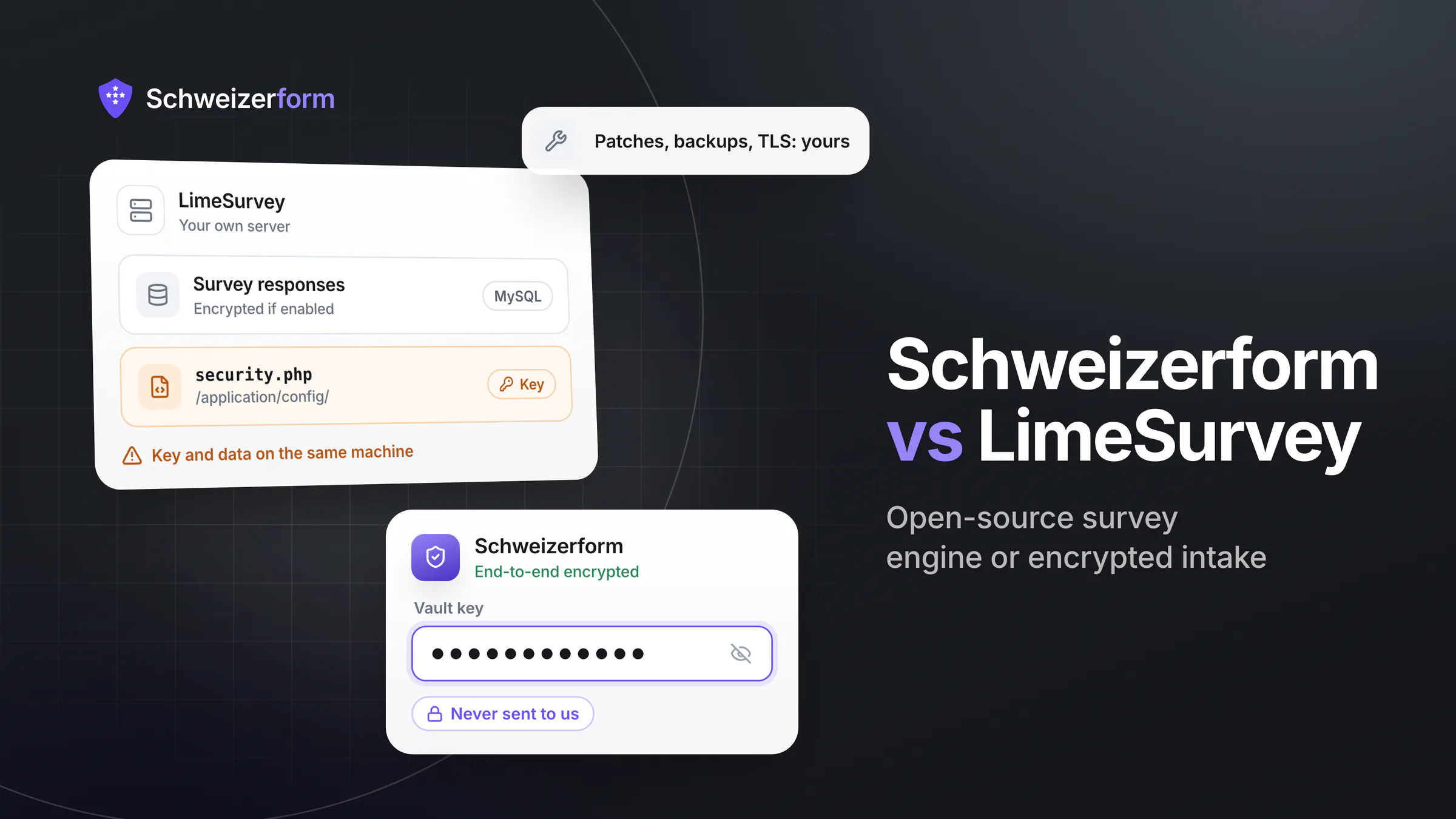
LimeSurvey is the default survey tool at a large share of Swiss universities, hospitals and cantonal administrations, and the reason is straightforward: it is free software with question logic nothing else in this market matches, no per-response fee, and an installation you own end to end. If your requirement is a 200-question instrument with branching, quotas, randomisation and multilingual versions, LimeSurvey does that and we do not.
The comparison worth making is therefore not «which is better» but «what does each one make impossible». LimeSurvey makes it impossible for an external provider to hold your data, because there is no external provider. Schweizerform makes it impossible for anyone — including us, including a court order addressed to us — to read a response, because decryption happens in your browser with a key we never receive. Those are different guarantees, and the honest way to choose between them starts with LimeSurvey's own encryption feature, which is more often assumed than read.
Status: July 2026
LimeSurvey behaviour, pricing and hosting regions below were checked against the LimeSurvey manual and website on 25 July 2026. LimeSurvey is actively developed and its cloud plans change; verify current details directly before making a procurement decision.
How Each Product Positions Itself
LimeSurvey — the open-source survey engine
LimeSurvey Community Edition is GPL software you install on your own server; LimeSurvey Cloud is the hosted commercial version operated by LimeSurvey GmbH in Hamburg. The feature set is genuinely deep: dozens of question types, complex conditional logic and expressions, quotas, randomisation, participant tokens and invitations, panel integration, multilingual surveys, statistics and export in every format a statistician asks for. For academic research it is the reference implementation of an online survey tool, and a page that pretended otherwise would be useless to you.
Schweizerform — encrypted intake, zero-knowledge by default
Schweizerform is an encrypted intake layer rather than a research platform. Each submission is encrypted in the respondent's browser with AES-256-GCM, the submission key is wrapped to the form's public key, and the server stores ciphertext it has no way to open. Decryption happens in your browser with the Vault key, which is derived client-side and never sent to us. Encrypted submissions are stored in Switzerland at Infomaniak, one form definition publishes in EN, DE, FR and IT, and the public form page loads no third-party trackers. We can see your question text — it is stored in plain text on the server so the form can be rendered — and we cannot see a single answer.
LimeSurvey's Encryption Option — What It Does, and What It Does Not
This is the section that decides most of this comparison, because «LimeSurvey supports encryption» is technically true and widely misread. The feature encrypts personal data in the central participant database, data in survey participants tables, and individual survey responses where the question's «Encrypted» attribute is switched on. It requires the PHP Sodium library. It is a real, useful feature and it is used by serious institutions.
The part that changes the analysis is where the key lives. Per the LimeSurvey manual, the public and secret keys are found in /application/config/security.php and are generated automatically on first use of the encryption feature. In other words, the key sits in a file on the same server as the database it protects — which is the correct design for what this feature is for, and which means it protects against a stolen database dump, not against anyone with access to the server. The manual is also blunt about the consequence of losing it: create backups of the keys, because if you lose them the data becomes unusable and cannot be recovered. And once created, the keys must never be changed, or existing data becomes unreadable.
- It is at-rest encryption with an operator-held key. Anyone who can read the server filesystem can read the key, and therefore the data. That includes your administrators, your hosting provider if it is managed hosting, and an attacker who has achieved server access rather than only database access.
- It costs you searching. The manual states that partial string search is not possible on encrypted database columns — only exact-match search. Encrypt a free-text field and you lose the ability to search inside it.
- It is per-question and opt-in. Response encryption is a question attribute someone has to enable, survey by survey and question by question. The default is off, in the same way anonymisation is.
- Key loss is unrecoverable and key rotation is not supported in the ordinary sense. That is the same trade a zero-knowledge platform makes — worth knowing before it is discovered during an incident.
Encryption is only meaningful relative to who holds the key
A LimeSurvey install with the encryption attribute enabled is genuinely better protected than one without it. But the key is on the same machine as the ciphertext, so the property you gain is «a stolen database export is useless» — not «the operator cannot read responses». If your requirement is the second one, no configuration of LimeSurvey delivers it, and no configuration of any conventional survey platform does either. The difference is set out in encryption at rest vs end-to-end.
The Security Models Side by Side
Strip away the feature lists and there are two questions: who can technically read a response, and what has to go wrong for that to change.
LimeSurvey — you are the operator, and the trust boundary is your server
In a self-hosted install, no vendor sees your data — a real and often decisive advantage. In exchange, the confidentiality of every response rests on your server hardening, your patch cadence, your database access control and your backup handling. Responses are stored in your MySQL database, in clear text unless per-question encryption is enabled, and readable by anyone with database or filesystem access. For an institutional survey run by a research group under the same governance as the researchers, that is entirely appropriate. For a survey about the institution — harassment, management conduct, whistleblowing — the people with database access are frequently inside the population the survey is protecting respondents from.
Schweizerform — the key never reaches the server
We hold ciphertext and wrapped keys. There is no configuration, no support tool and no administrative override that produces a readable response on our side, because the material needed to decrypt is derived from a Vault key we never receive. That property does not depend on us behaving well, on our staff vetting, or on which government asks. It also cuts the other way: if you lose the Vault key, we cannot help you, and the responses are gone. The mechanism is described in zero-knowledge architecture explained.
Both models remove the vendor — differently
Self-hosting removes the vendor by having no vendor. Zero-knowledge removes the vendor by making the vendor useless to an attacker or an authority. The practical question is which residual risk you would rather carry: the operational burden of running secure infrastructure, or a platform relationship in which the platform cannot read your data but does control availability.
Head-to-Head Feature Comparison
| LimeSurvey | Schweizerform | |
|---|---|---|
| Who can read responses | You and anyone with server or database access | Only the Vault key holder — not us |
| Encryption model | Optional at-rest encryption; keys in security.php on the server | End-to-end, always on; key derived client-side |
| Question logic depth | Exceptional — conditions, expressions, quotas, randomisation | None — no branching, no quotas; per-question validation only |
| Panels, tokens and invitations | Yes — full participant management | No panel management |
| Statistics and cross-tabs in the tool | Yes, server-side | Aggregate counts only; analysis after export |
| Anonymity mechanism | «Anonymized responses» setting; defaults to No | Architectural — no IP stored, no cookies, nothing to link |
| Multilingual surveys | Yes, per-survey translations you maintain | Yes — EN/DE/FR/IT from one definition, AI-assisted |
| Hosting | Your server, or LimeSurvey Cloud in 7 regions | Encrypted submissions stored in Switzerland (Infomaniak) |
| Who patches, backs up and monitors | You (CE) or LimeSurvey GmbH (Cloud) | Us |
| Cost model | Free software plus your operations, or a cloud subscription | Free plan; Pro CHF 29/month; Business CHF 69/month |
Hosting and Jurisdiction — Including LimeSurvey Cloud's Regions
This is where Swiss institutions most often discover a gap between what they assumed and what they bought. LimeSurvey Cloud offers a choice of hosting region across its plans, and the published set is Germany, Finland, the United Kingdom, the USA, Canada, Australia and Singapore. Switzerland is not among them, and the contracting party is LimeSurvey GmbH in Hamburg. A Swiss university that wants LimeSurvey with Swiss data residency has exactly one route: install the Community Edition on Swiss infrastructure — Infomaniak offers one-click LimeSurvey installs in its Swiss data centres, and Hostpoint runs its hosting on Swiss servers.
| Deployment | Where responses sit | Who operates it | Swiss residency? |
|---|---|---|---|
| LimeSurvey CE, self-installed on Swiss hosting | Your own database in Switzerland | You | Yes |
| LimeSurvey CE, self-installed elsewhere | Wherever your server is | You | Only if you chose a Swiss host |
| LimeSurvey Cloud | DE, FI, UK, US, CA, AU or SG | LimeSurvey GmbH, Hamburg | No |
| Schweizerform | Encrypted submissions stored in Switzerland (Infomaniak) | Us — but we cannot read them | Yes, on every plan |
If your survey processes data covered by a professional secrecy duty or by cantonal data protection law, the residency question is only half the analysis; the other half is who can read the data once it is there. Our vendor-by-vendor Swiss residency list is in form and survey tools hosted in Switzerland, and the wider category view is in privacy-compliant survey tools compared.
The Operational Cost of Running LimeSurvey Yourself
«Free» describes the licence, not the deployment. A LimeSurvey install that is actually safe to put a sensitive survey on requires, continuously and by someone accountable:
- PHP, database and LimeSurvey version upgrades, including the breaking ones, on a cadence that keeps pace with published vulnerabilities
- TLS certificate lifecycle, HTTP security headers and a hardened web server configuration
- Database and filesystem backups that are tested by restoring them, plus safe storage of the encryption keys separately from the server if the encryption feature is used
- Access control and periodic access review — who has shell, who has database credentials, who left the institution last quarter
- Log retention, monitoring and an actual detection path for compromise, because Art. 24 nDSG requires you to notify the FDPIC as quickly as possible of breaches likely to cause a high risk
- Retention and deletion routines, because responses accumulate in a database that nobody is watching once the study ends
Under Art. 8 nDSG the technical and organisational measures are the controller's obligation, and self-hosting concentrates every one of them on you. Institutions with a professional IT department absorb this comfortably — it is what they are for. A four-person research group, a clinic or a school administration frequently cannot, and the failure mode is not dramatic: it is an unpatched instance still serving a closed survey three years later. We work through the general version of that trade-off in the self-hosted forms comparison, and the estate-management view is in digital form management for Swiss organisations.
Pricing
LimeSurvey's model
The Community Edition is free software: no licence fee, no per-response cost, and your costs are hosting plus staff time. LimeSurvey Cloud is subscription-based and metered by responses and storage — as listed in July 2026, Basic at CHF 44 per month for 1,000 responses per month and 250 MB, Expert at CHF 40 per month billed annually for 10,000 responses per year and 1 GB, Business at CHF 70 per month billed annually for 50,000 responses per year and 3 GB, and Corporate on request. Note the shape: the cloud plans meter responses, so a single large study can consume a year's allowance.
Schweizerform's model
Free, Pro at CHF 29 per month and Business at CHF 69 per month. End-to-end encryption and Swiss storage of encrypted submissions are not a tier — they are how the product works on every plan, including Free, because there is no unencrypted mode to sell you. Plans differ on volume, seats and advanced features; current limits are on the pricing page.
The honest cost comparison
Against LimeSurvey Cloud, we are cheaper. Against a self-hosted Community Edition, the licence cost is zero and we are not — so the comparison is our subscription against the fully loaded cost of the staff time to run a server safely for years. Whichever way that lands for you, decide it with the operations list above in view rather than with the licence fee alone.
Which Tool Fits Which Use Case
Pick LimeSurvey when
- The instrument is complex: branching, expressions, quotas, randomisation, repeated measures, multiple language versions with different logic
- You need participant tokens, invitation and reminder management, or panel integration
- The analysis has to happen in the tool, with statistics and cross-tabs available server-side
- You have institutional IT that already operates the stack, or a hosting arrangement in which someone is accountable for it
- The survey is research with consenting participants, rather than a channel someone uses at personal risk
Pick Schweizerform when
- A truthful answer could cost the respondent something — employee surveys about named managers, whistleblowing intake, patient questionnaires, surveys of students or vulnerable groups
- You are bound by professional secrecy under Art. 321 StGB, which binds the professional and their auxiliary persons
- You want encrypted submissions stored in Switzerland without becoming an infrastructure operator
- The form is intake rather than research: applications, referrals, reports, onboarding, document collection
- You need the same form live in EN, DE, FR and IT without maintaining four instruments
When You Might Honestly Use Both
This is the common outcome at Swiss institutions, and it is a sensible one. LimeSurvey stays where it earns its place — the research instruments, the course evaluations, the longitudinal studies with panels and quotas. An encrypted intake platform takes the narrow set of channels where the content is sensitive and the respondent's willingness to be honest depends on nobody being able to trace it: the ethics complaint line, the harassment survey, the patient recruitment questionnaire, the clinical site feedback form. Two tools scoped by sensitivity is not a consolidation failure; it is the correct answer to two different problems. Where the boundary sits for research specifically is set out in data protection in clinical research — including the honest statement that a zero-knowledge platform is the wrong tool for a regulated eCRF, because monitors, auditors and inspectors must be able to read the records.
Moving a Sensitive Survey Off LimeSurvey
You are unlikely to migrate your whole LimeSurvey estate, and you should not try. The realistic move is to identify the handful of surveys that should never have been in a readable database and relocate those.
- 1
List the surveys by who is protected from whom
Not by volume, not by department. If the person who could be harmed by disclosure is inside the organisation that runs the server, that survey is a candidate. Everything else can stay.
- 2
Export and archive the existing responses properly
Export in a format your statisticians can use, store it under the same access controls the new platform will have, and record where the archive lives. Do this before you touch the instance.
- 3
Rebuild the instrument, cutting fields as you go
Apply Art. 6 nDSG proportionality. Demographic fields are where anonymity breaks — every additional cross-tab dimension shrinks the group a respondent belongs to, as set out in how many responses before anonymity holds.
- 4
Decide key custody before launch, not after
On a zero-knowledge platform the Vault key is the whole security model and the whole recovery model. Decide who holds it, where the backup lives, and what happens when that person leaves — the same discipline the LimeSurvey manual demands for
security.php. - 5
Announce the change to respondents in plain language
«Responses are encrypted in your browser; the platform and the IT department cannot read them» is a sentence that measurably changes response rates on sensitive surveys. Say it, and make sure it is true of the survey you actually built.
- 6
Delete the old responses and write down the retention rule
Purge the migrated responses from the LimeSurvey database and its backups on a defined schedule, and record the new retention period — see form data retention.
The Bottom Line
LimeSurvey is a better survey tool than Schweizerform and will remain one: deeper logic, real panel management, server-side statistics, and a licence cost of zero. If your work is survey research, install it, put it on Swiss infrastructure if residency matters, set «Anonymized responses» to Yes deliberately, and enable the encryption attribute on the fields that need it.
What LimeSurvey cannot give you — in any configuration, because of where the key lives — is a guarantee that the people running the server cannot read the answers. When that is the requirement, the choice is not between two survey tools. It is between a survey tool and an architecture.
If you already run LimeSurvey well, keep it. Add an encrypted channel only for the surveys where anonymity is the reason people answer honestly: responses encrypted in the browser, encrypted submissions stored in Switzerland, no trackers on the survey page, and one definition publishing in four languages. The Free plan is enough to run a real survey end to end before you decide — start there, or read how the encryption works on the security page.
Disclaimer: This comparison is general information and marketing content, not legal, regulatory or compliance advice. LimeSurvey product behaviour, encryption implementation details, cloud plan pricing and hosting regions reflect the LimeSurvey manual and website as checked on 25 July 2026 and may change — verify current details directly with LimeSurvey before making procurement or compliance decisions. References to the DSG and to Art. 321 StGB are summaries, not a substitute for advice from qualified Swiss counsel on your specific processing. LimeSurvey is a trademark of LimeSurvey GmbH; all product and company names are trademarks of their respective owners and are used here for factual comparison only.