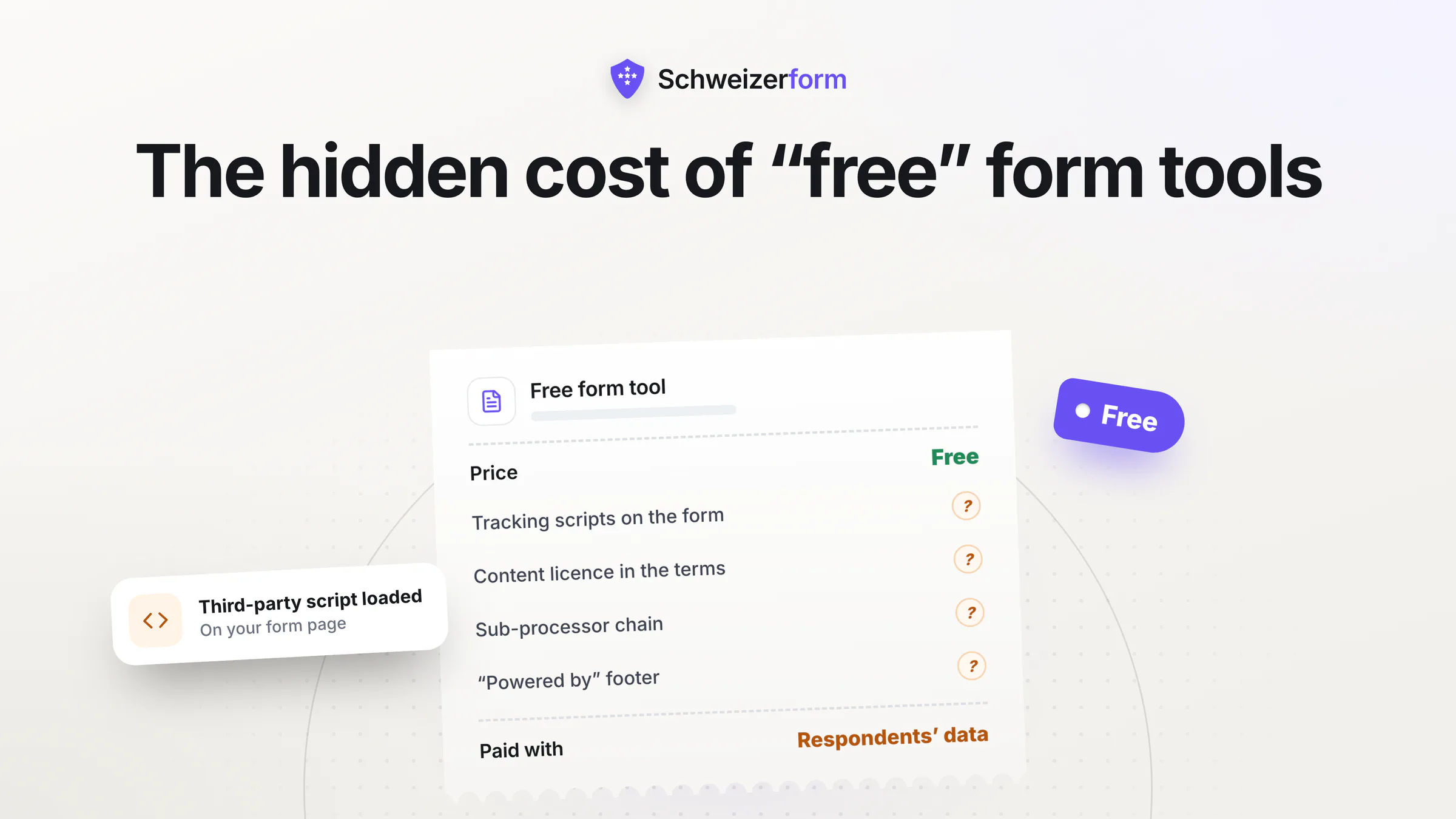
"It's free, so why not use it?" is one of the most common justifications for picking a form tool — and one of the least examined. Free form builders are a genuinely useful category; they have made data collection trivially easy for millions of people. But the word "free" hides an exchange, and with form data the exchange deserves scrutiny.
This article is not a hit piece on any specific product. It's a practical look at the business models behind the most common free form tools — Google Forms, the free tiers of Typeform, JotForm, SurveyMonkey, and others — and what those models mean when you collect data on behalf of other people.
The two questions we're really asking
When a tool is free, the only useful questions are: (1) how does the company make money from giving it to me? and (2) does that business model align with the kind of data I'm collecting? For casual surveys, it often does. For sensitive, regulated, or confidential data, it usually doesn't.
How "Free" Form Tools Actually Make Money
There are five business models used — sometimes in combination — by free form tools. Understanding which ones apply to your chosen product is the single most useful piece of due diligence you can do.
1. Ecosystem tying
The tool is free because it drives usage of a larger paid ecosystem. Google Forms is the canonical example: it is bundled with Google Workspace, serves to lock organisations into Drive, Gmail, and Sheets, and strengthens the overall account relationship. You are not the revenue — you are the retention.
2. Freemium conversion
The free tier is a sales funnel. Response limits, branding watermarks, feature gates, and file-upload caps are designed to make the free tier unpleasant enough that a meaningful fraction of users upgrade. Typeform, JotForm, and SurveyMonkey all fit this model. The product is honest about the trade: the "cost" is friction, and you can buy it away.
3. Data aggregation and analytics
The tool's provider aggregates metadata, response patterns, or usage analytics across the platform to produce insights, benchmarks, or trend reports that are sold — typically to enterprise clients. Terms of service often grant broad rights to de-identified or aggregated data. The individual respondent never sees this happen.
4. Advertising and profiling
Less common for dedicated form tools, more common for embedded form widgets inside larger platforms. Form engagement signals — which questions cause abandonment, which fields are filled — are folded into broader user profiles used for ad targeting on the same ecosystem.
5. Content ownership and service improvements
This is the most under-read risk. Many free form tools reserve the right, via their terms of service, to use submitted content to "improve services", train models, or generate derivative works. The content itself may remain yours in name, but you grant a perpetual licence for the provider to use it. For non-sensitive data, this is usually immaterial. For confidential submissions, it is often a deal-breaker.
What "Free" Looks Like From the Respondent's Side
When you build a form, you think about features, price, and integrations. When your respondent fills it out, they see something different: another dialog box, another privacy policy, another company they've never heard of that now holds their answers. The respondent's trust is the real currency in a form submission — and free tools spend it on your behalf.
- Tracking scripts embedded in the form host domain often fire during the submission flow — analytics, heatmapping, third-party fonts, session replay
- Branding elements ("Made with X") signal the provider to the respondent, meaning their data relationship extends beyond you
- Privacy policies of the form provider take effect on top of yours — and many respondents will not, in practice, read either
- Third-party integrations (spam filters, captcha providers, CDN edges) see submission traffic even when the form "feels" local to your brand
The transitive data question
GDPR Art. 28 and nFADP Art. 9 treat your form provider as a data processor. Their sub-processors become your sub-processors. With free tools, the chain of sub-processors is often long, opaque, and subject to change unilaterally — which complicates your own privacy notice and record of processing.
The Quiet Costs, Made Concrete
Abstract concerns about privacy policies don't change behaviour. Concrete trade-offs do. Here are the most common operational costs organisations discover months after adopting a free form tool.
| Cost category | What it looks like in practice |
|---|---|
| Regulatory exposure | Form data crossing into the US under an inadequate transfer, triggering nFADP/GDPR cross-border concerns |
| Branding and trust | "Powered by" footer on sensitive forms undermines your perceived professionalism |
| Respondent drop-off | Forms hosted on suspicious-looking domains see measurably lower completion rates, especially for sensitive data |
| Data portability | Export formats are limited; moving historical submissions to another tool requires manual work |
| Feature cliff | Core needs (conditional logic, file uploads, team access) are only on paid tiers — you planned around free and now need to replatform |
| Compliance documentation | DPAs, SCCs, and sub-processor lists that you must gather and maintain for your own records — free tiers often provide them only on request or not at all |
| Audit and access logs | Who viewed which submission when? Often unavailable or minimal on free tiers, leaving compliance gaps |
When a Free Form Tool Is Genuinely Fine
Not every form needs fortress-grade protection. For many use cases, a free tool is the right answer — and this article is not arguing otherwise. Here are the contexts where the trade-offs usually make sense:
- Internal polls and casual surveys with non-personal, non-sensitive questions
- RSVP collection for public events where attendees already expect minimal data handling
- Feedback requests that collect optional, low-stakes opinions
- One-off experiments where the expected lifetime of the form is measured in days
- Student, hobbyist, or small-scale personal projects
The common thread is that the respondent's expectation matches what the tool actually does. Nobody is surprised that a public RSVP is casually handled. The problem only emerges when the data is sensitive, regulated, or confidential and the tool's business model quietly undermines those properties.
When a Free Form Tool Is Almost Always the Wrong Choice
Conversely, there are categories where the cost of "free" is consistently higher than the cost of a paid, purpose-built tool. If your form touches any of the following, free tiers generally fail on compliance, ethics, or both:
- Health, medical, or therapy intake — HIPAA, nFADP sensitive-data categories, GDPR Article 9 data
- Legal client intake — attorney-client privilege risk, confidentiality obligations
- Whistleblower and HR grievance reporting — the whole point is that no unintended third party sees the content
- Financial, tax, or KYC data collection — regulatory scope, audit obligations, retention requirements
- Research participant data with IRB or ethics-board oversight
- Journalism, source tips, or secure submissions — safety of sources is not compatible with aggregated analytics
- Minors' data, especially where consent chains are involved
A hard line
If a competent regulator could plausibly ask "why did you send this data to that third party?" and you can't defend the answer, that's the signal. Free tools make the question harder to answer, not easier.
A Simple Test: Substitute "Paper"
A useful framing exercise: imagine the same data being collected on paper, and then handed to the provider you are considering, to store in their filing cabinet in exchange for free access. Does that trade make sense for your use case? Does it make sense for your respondent's use case?
- A restaurant guestbook at a conference — yes, obviously fine
- A patient intake form at a dental practice — clearly not fine; you would not hand that to a random third party in return for free filing cabinets
- A whistleblower report inside a large organisation — absolutely not; the whole point is that the provider never sees it
- A satisfaction survey after a support call — probably fine; the data is low stakes and the respondent already knows the company
The paper test strips away the abstraction. Once you picture a physical equivalent, the "free" tool's actual price becomes much clearer.
A Different Model: Sustainable Paid, or Free With the Same Guarantees
Schweizerform is commercial software. We have a paid business and we pay the bills with subscription revenue — not data mining, not ecosystem tying, and not content licensing. That structure is deliberate, because collecting encrypted submissions and then trying to monetise them would be a contradiction.
We also have a free tier — capped at 3 forms and 100 submissions/month — but with the same zero-knowledge architecture, encrypted submissions stored in Switzerland, and nFADP-aligned practices as every paid plan. The difference is scale, not trust level. The point of the free tier is not to extract value from your data; it's to let you verify the product with real submissions before upgrading.
- No ads, in the product or around the forms
- No third-party analytics firing on respondent devices
- No content licensing clauses in the terms — your submissions are yours, full stop
- No "powered by" footer required on paid plans, and a minimal one on the free tier
- The same end-to-end encryption regardless of plan — cryptography is not a paywall
- Swiss hosting for every plan — no jurisdictional downgrade for free users
The Bottom Line
"Free" is not a product category — it's a pricing model, and it exists because someone else is paying. For most non-sensitive uses, that's a fair bargain and there is no reason to avoid it. For sensitive, regulated, or confidential data collection, the bargain typically falls apart — because the things your respondents trust you to do (not share, not monetise, not lose) are exactly the things a "free" business model quietly does.
The question is never "is this tool free?" The question is "is the business model that makes this tool free aligned with the data I'm collecting?" Ask that question explicitly, and most decisions about form tooling become much easier.
Schweizerform offers a genuine free tier — end-to-end encrypted, submissions stored in Switzerland, no ads, no data mining, no content licensing. Upgrade when you outgrow it, not when privacy becomes optional.
Disclaimer: This article is general information, not legal, regulatory, or compliance advice, and is not an endorsement of or an attack on any specific product. Business-model descriptions of other tools reflect publicly available terms of service and industry patterns at the time of writing and may not apply to every product named. Vendors frequently update their terms — always review the current terms of service before relying on any specific behaviour. Competitive details were last verified on 25 July 2026. All product and company names are trademarks of their respective owners and are used here for factual comparison only.