A short online test before the first interview is attractive: ten minutes on spreadsheet skills, a numeracy check for an apprenticeship, a few job scenarios. It saves time for a small team. But a test collects personal data about a person who has not yet signed anything, and in Switzerland the data protection rules for aptitude tests in recruiting already apply at that stage.
This article explains, in plain terms, what you may test, what you must tell applicants, why a score should never reject anyone on its own, and how long results are usually kept. It is written for SMEs and training companies that screen applicants without an HR department.
What you will learn
The Art. 328b CO test for applicant questions, a table of common test types with what to watch, the transparency and automated-decision rules of the nFADP, how equality law and retention periods fit in, and a checklist for a fair screening test. The last third shows how it can be set up with Schweizerform, including its limits.
What Art. 328b CO Lets You Ask Applicants
Art. 328b of the Code of Obligations (CO) limits what an employer may process about employees: only data that concern their suitability for the job or are needed to carry out the employment contract. The provision is formally about employees, but the prevailing view and the FDPIC apply the same logic to applicants. Treat it as the yardstick for every question and every test you use in hiring. In a small business this is easy to forget, because the test often comes from a template or a colleague and nobody checks what it actually asks before it goes out.
The question to ask for each test item
For each question, ask: does the answer tell me something about whether this person can do this specific job? If yes, it is as a rule fine. If it is merely interesting, or useful for some other job, drop it. The nFADP adds the general principles of proportionality and purpose limitation (Art. 6), which point the same way.
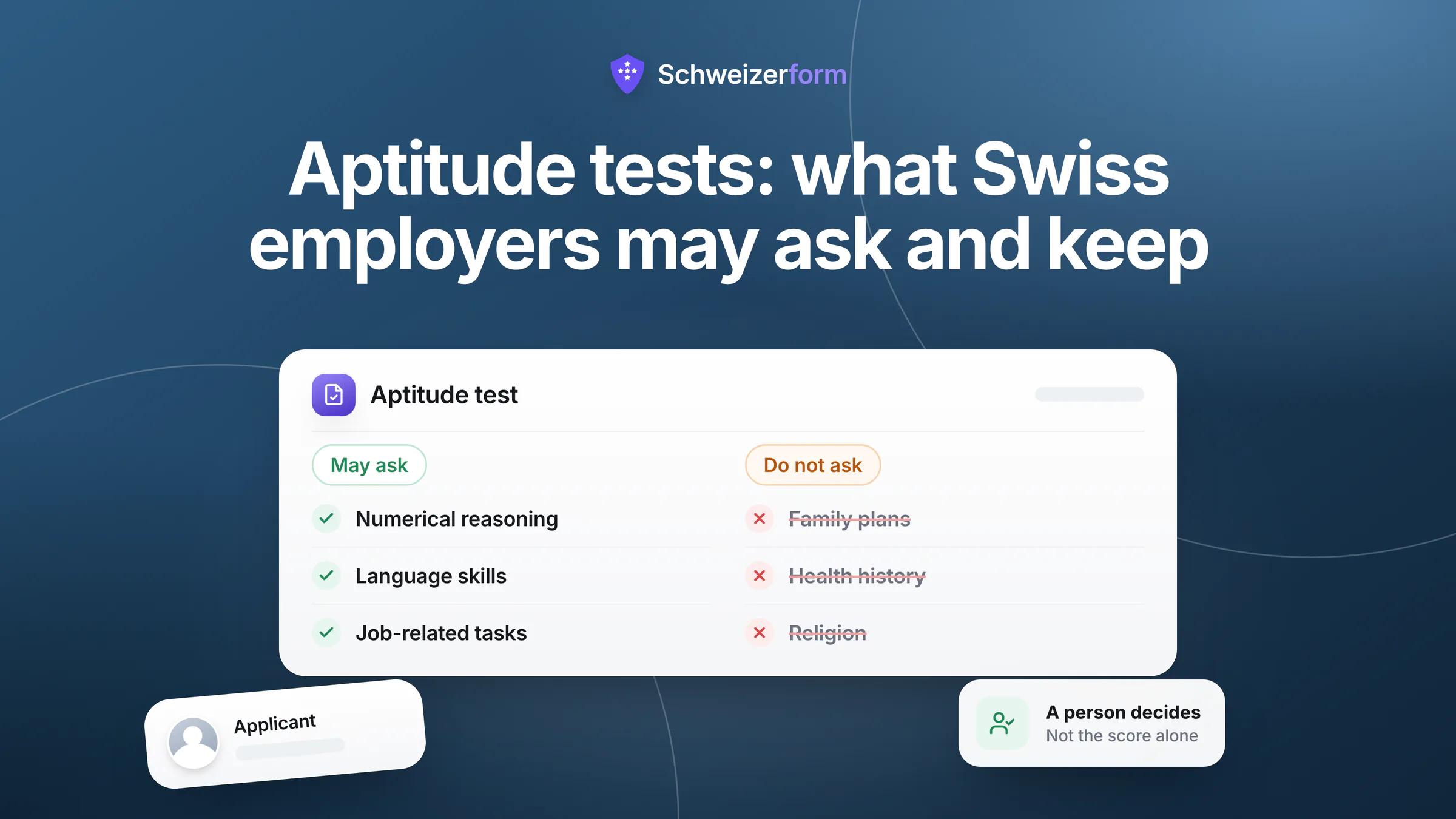
- Knowledge and skills the job needs on day one or after normal training
- Language level where the job really requires it, for example German for client contact
- Practical work samples that mirror real tasks
- Reasoning or numeracy at the level the role or apprenticeship demands
Off-limits as a rule
Questions about health, pregnancy or family planning, religion, political views, union membership, origin or private life do not tell you whether someone can do the job. As a rule they must not be asked or tested. Exceptions exist only where the information is directly necessary for the specific role; if in doubt, leave it out. Most of these topics (health, intimate sphere, religious and political views, union membership, ethnic origin) are also sensitive personal data under the nFADP (Art. 5 lit. c).
Which Aptitude Tests Are Usually Acceptable in Recruiting
There is no official list of permitted tests. The table gives a practical reading for a small employer; it is a starting point, not a legal opinion.
| Test type | Usually acceptable? | Watch out |
|---|---|---|
| Job knowledge or skills test (software, bookkeeping, trade theory) | Yes | Only what the job needs; the same test and conditions for everyone |
| Work sample or practical task | Yes | Keep it short; do not use an applicant's work for real business |
| Numeracy, logic or language screening (for example for an apprenticeship) | Usually, if it matches the level of the role | Tests can disadvantage groups; do not claim scientific validity you cannot show |
| Situational questions ("what would you do if a client…") | Often | Scenarios from the job, not from private life; no hidden personality profiling |
| Personality or character questionnaires | Problematic as a rule | Only with a clear job link, a validated instrument and qualified interpretation; tell applicants first |
| Questions on health, family planning, religion, union membership, political views | No, as a rule | Exceptions only where directly necessary for the specific role; ask a specialist first |
A knowledge test for a bookkeeping role is a clean case. A personality questionnaire that scores "emotional stability" is not, unless you can show why that trait matters for this job and who interprets the result.
Tell Candidates What You Test, Why and Who Sees It
Art. 19 nFADP obliges you to inform people when you collect personal data about them. For a screening test that means telling applicants before they start, not after they have submitted. The law requires at least who you are and how to reach you, the purpose and the recipients; saying how long you keep results is good practice. Keep the notice short and put it on the page that introduces the test.
- What the test measures and why it is part of the process
- What data you collect (answers, score, time taken) and who you are
- Who sees the results: named roles, not "the company"
- How long the results are kept and what happens afterwards
This short test checks the spreadsheet skills required for the position. Your answers and your score are seen only by the hiring manager and the owner. We delete them within three months after the process ends, unless you agree that we keep your application for future vacancies.
Where the test is part of a wider application, the same wording belongs in your applicant privacy notice. Our piece on informed consent in online forms covers how to phrase such notices.
Never Reject on a Score Alone
Art. 21 nFADP covers decisions based exclusively on automated processing that have legal effect or significantly affect the person. A rejection from an applicant tool because the score is under a threshold is a candidate for that rule. In that case the person must be informed that the decision was automated and, on request, may state their view and ask for review by a human.
What a human decision looks like in practice
The simplest way to stay clear of the issue: use the score as one input. A person reads the result next to the application and the interview, and a person decides. Write down in your process that nobody is rejected by the score alone, and make sure that is what actually happens. A pass mark that merely sorts the pile for an earlier look is a different thing from an automatic rejection e-mail. Also look at borderline results by hand: a candidate one point under the line may be the one whose interview answers convince you.
Equality: tests must not disadvantage by sex
The Gender Equality Act (GEA, in German GlG) prohibits discrimination in hiring (Art. 3). A rejection that is discriminatory can lead to compensation claims. A test is not neutral just because it is automated: time pressure, wording or subject matter can systematically favour one group. Review the questions for what they really test and look at outcomes across your applicants over time.
A practical check
Would you be comfortable explaining each question and the pass mark to a rejected applicant who asks? If a question needs an awkward justification, it probably does not belong in the test.
How Long to Keep Applicant Data and Test Results
Applicant files, including test results, are as a rule returned or deleted once the process is over, unless the applicant agrees that you keep them for a talent pool. Many employers nevertheless keep the file for a few months after a rejection so they can answer a discrimination claim: under Art. 8 GEA an applicant has three months from the date the rejection was communicated to bring such a claim. Treat that as common practice, not as a fixed legal retention duty, and decide a period you can justify. Our guide to form data retention covers how to set and document it.
- Hired: move what is needed into the personnel file, delete the rest of the test data
- Rejected: delete after the period you have set, often a few months
- Talent pool: only with the applicant's agreement, with a clear end date
Applicants can ask for their results
Under Art. 25 nFADP anyone can ask what personal data you hold about them. A test score and the answers are personal data. Plan for the request: know where results are stored and who can find and export one person's result within the legal deadline, normally 30 days. A result that sits in a mailbox or a shared folder is hard to find on time, which is one more reason to keep test results in one place.
A Checklist for a Fair Screening Test
- 1
Define the job requirements first
Write down the three to five skills the role needs and test only those.
- 2
Check every question against Art. 328b CO
Remove anything about health, family, beliefs or private life.
- 3
Inform before the start
State purpose, data, recipients and retention on the intro page.
- 4
Give everyone the same conditions
Same questions, time and attempts, and a way to ask for adjustments if someone needs one.
- 5
Let a person decide
Use the score as one input beside the application and the interview.
- 6
Delete on schedule
Set the retention period in advance and apply it to every applicant.
How Schweizerform Assessments Supports This
Assessments in Schweizerform are forms whose answers earn points and that end with a score and a result page. For screening they work as a short, scored test with a link you send to each applicant. We can see the questions you ask, never the answers people give: answers and score are encrypted in the applicant's browser and open only with your Vault key.
- Scoring with a pass mark and score bands, one result page, on every plan including Free
- Personalised links (Pro and Business): one link per applicant, so you see which result came through which link
- Time limit and maximum attempts per personalised link: Pro and Business
- Results (score, band, passed) are readable only after the Vault key is entered. Inviting members to a workspace is Business only; in a team workspace every member, viewers included, sees them, so keep applicant tests where only the people named in your notice have access
- Deleting results after the process: by hand, one by one or in bulk; the automatic deletion rule of Business covers plain forms, not assessments
Honest limits
Scoring runs in the browser and the correct answers are sent to the browser with the form, so a technically skilled applicant can read them. Schweizerform assessments are a screening aid, not a secure exam. Use them for low-stakes sorting, and verify skills in the interview. Also note: with a pass mark set, the result page tells the applicant "passed" or "not passed" right after submitting, even with the score hidden. For screening, consider leaving the pass mark off and giving the bands neutral names, so the screen never reads like a rejection.
What Schweizerform does not do here
- No proctoring and no identity checks: we cannot tell who actually took the test
- No psychometric validation: the questions are yours, and we make no claim about their predictive value
- No applicant tracking system: no pipeline, no stages, no interview scheduling in this module
- No certificate PDF and no messages about your decision: you tell applicants the outcome yourself
Common Questions and Mistakes
Can I ask applicants to take a personality test?
As a rule only with a clear link to the specific job, a properly validated instrument and a qualified person interpreting it. For most small employers a structured interview and a job-related work sample are safer and more informative.
Do I need the applicant's consent for a screening test?
A test that is job-related and necessary for the hiring decision does not usually need separate consent, but it does need the information described above. Consent matters where you go beyond that, for example keeping the file in a talent pool.
Is it fine to reuse a test result for another vacancy?
Not without the applicant's agreement. A result collected for one role is tied to that purpose. Ask again, or run the test again for the new role.
Screen Fairly, Decide as a Person, Delete on Time
A good aptitude test for recruiting is short, job-related, announced in advance and read by a person. The law does not ask for more than that, and applicants notice the difference. It also protects you: a clear purpose and a fixed deletion date are the best answer to a complaint or a claim.
If you screen apprenticeship applicants, see selection tests for apprenticeships. For how scoring and bands work, read online assessments and scoring explained, and for tests with your own staff, employee training tests and data protection.
A first step
Write the applicant notice and the retention period before you build the test. Then try a scored assessment on the Free plan. See features, security and, for the documents of new hires, onboarding documents.
Disclaimer: This article is general information and marketing content, not legal or HR advice. It simplifies Art. 328b CO, the nFADP (Art. 6, 19, 21, 25) and the Gender Equality Act (Art. 3 and 8). Responsibility for your hiring process stays with your organisation; consult a qualified employment or data-protection professional for your case.