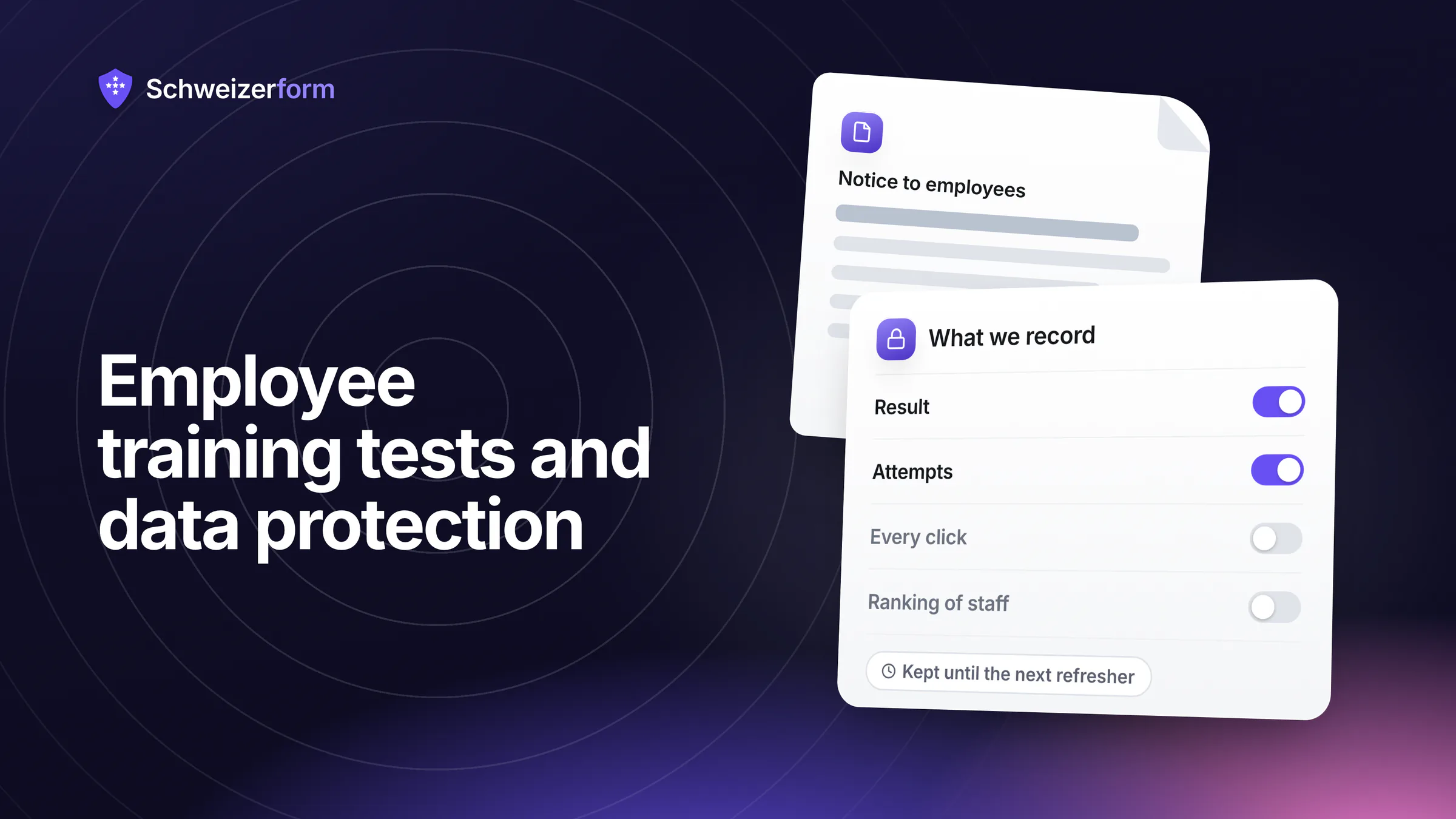
You have instructed your staff: fire safety, food hygiene, how to handle client data. Now someone asks the obvious question: how do we show that people understood it? A short test after the session is the usual answer. It is also where employers quietly start collecting more about their employees than they need: every wrong answer, every attempt, how long each person took, a ranking by team.
This article is about employee training tests and data protection in Switzerland: what the law frames, what a sensible employer records, how long it is kept, and how to set the test up so that it checks the training instead of watching the person. The second half shows how this looks in practice with Schweizerform Assessments, including what the tool does not do.
What you will learn
Which rules apply (Art. 328b CO, the nFADP principles, Art. 26 ArGV 3, staff participation rights), what to record and for how long, six habits for a fair test, and how to set it up without turning the result into a file on the person. For employers, HR leads and safety officers of small Swiss organisations. General information, not legal advice.
What Swiss Law Says About Employee Training Tests and Data Protection
There is no single statute on staff tests. Three layers apply at once: the employment-law limit on employee data, the general principles of data protection, and the rules on workplace monitoring. Each of them points the same way: test the training, keep the result, leave the rest.
Art. 328b CO: only what the job or the contract requires
Under Art. 328b CO, an employer may process data about an employee only to the extent that it concerns the employee's suitability for the job or is necessary to perform the employment contract. Otherwise the nFADP applies in full. Proof that someone was instructed and understood a safety rule clearly belongs to performing the contract: the employer owes protection of health and personality (Art. 328 CO, Art. 6 ArG), and instruction is part of that. A league table of who answered fastest does not. Art. 328b CO is one of the rules that cannot be changed by agreement to the employee's detriment (Art. 362 CO). The prevailing view is therefore that an employee's consent does not, as a rule, widen this limit, and in an employment relationship consent is rarely truly free anyway.
The nFADP principles: purpose, proportionality, transparency
Art. 6 nFADP sets the principles that decide most practical questions about a training test:
- Purpose: you collect results to document that the instruction was understood, and you do not reuse them for performance appraisal or promotion decisions unless you have said so and it is lawful.
- Proportionality: a pass or fail, or a score band, usually documents the purpose; a log of every click usually does not.
- Transparency: staff know beforehand that there is a test, why, what is recorded and who sees it (Art. 19 nFADP, duty to inform).
- No longer than needed: data is deleted or anonymised once it is no longer required for the purpose (Art. 6 para. 4 nFADP).
Art. 26 ArGV 3: a knowledge test is not behaviour monitoring, but it can drift
Art. 26 para. 1 of Ordinance 3 to the Labour Act prohibits systems that are intended to monitor the behaviour of employees at the workplace. A knowledge test taken once after a course does not fall under this: it checks what a person knows about the course content, not how they behave at work. The picture changes when the test turns into a measuring tool for individuals: timing every answer, counting attempts per person, repeating short tests every week and feeding the results into a ranking or a manager's dashboard. At that point the purpose has shifted from documenting understanding to observing people, and Art. 26 becomes a real question. Where in doubt, ask the safety officer or an employment-law adviser before you roll it out.
Where a test starts to look like monitoring
Frequency, granularity and a link to a named person are the three signals. One test per training, a result per person and a short retention is on the safe side. Weekly pulses, per-answer timings and individual rankings are not. The same reasoning is explained for surveys in Anonymous Employee Surveys.
Staff Rights Around the Test: Information, Participation and Access
In matters of occupational health and safety, employees have information and consultation rights: Art. 48 ArG for health protection, and the Participation Act (SR 822.14), whose Art. 10 gives employees or their representation participation rights in occupational safety. In practice, this means: if you introduce a systematic test as part of a safety programme, tell the staff or their representation how it works and ask what they think before you start. Employees who understand the point treat the test as part of the training, not as an exam. How far these rights go in a given business depends on its size and its representation, so check with your adviser or your association.
Can an employee see their own result?
Yes. Under Art. 25 nFADP, anyone can ask what personal data a controller holds about them, and employee data held in a personnel file is no exception. If you keep test results next to the name, they belong in the answer to such a request. That is one more reason to keep the record small: what you do not record, you cannot be asked for, and cannot get wrong. It is also good practice to show people their score straight after the test, with the right answers, so the test teaches.
Can a failed test lead directly to a sanction?
Art. 21 nFADP covers decisions based exclusively on automated processing that have legal effects on a person or significantly affect them. The person must be informed and can ask for a human to review the decision. A pass mark computed by a tool is an automated assessment; if a failed quiz alone triggered a warning, a pay consequence or exclusion from a task, you would be close to that territory. The sound approach is simple: a failed test means "repeat the training", and a person, not the software, decides about anything beyond that.
What You Record, Whether You Need It, and How Long You Keep It
The table below is a starting point, not a rule. The longer you keep something, the better your reason must be. Where a statute, an insurer or a collective agreement requires proof of instruction for a specific period, that period wins; ask your adviser which one applies to your trade.
| What you record | Do you need it? | How long |
|---|---|---|
| Name, course, date | Yes: it proves who was instructed and when | While the instruction is current and the person works for you, then per your personnel-file schedule |
| Passed / not passed, or score band | Usually yes: it shows the content was understood | Until the next refresher; no longer than the training record |
| Exact score and percentage | Rarely: pass or fail is enough for most purposes | Same as the result, or delete earlier |
| Each individual answer | Only to improve the training, not per person | Evaluate, then delete the individual responses within weeks |
| Time taken, number of attempts | Attempts only to apply a limit you announced; time: no | Delete together with the responses |
| Rankings, comparison between colleagues | No | Do not create them |
| Free-text remarks about private matters | No: do not ask | Not collected |
Training record versus quiz answers
Keep these apart in your head. The training record (who, what, when, passed) is a document you may need for years. The raw answers are working material: useful to see which question nobody understands, and not needed afterwards. Retention for form data in general is covered in Form Data Retention.
Good Practice: Test the Training, Not the Person
These six habits cost nothing and make the legal questions above much smaller.
- 1
Announce the test and its purpose
Say before the training that there is a short test, that it checks whether the instruction worked, and what happens with the result. Put it in the invitation or the staff handbook.
- 2
Test what was taught
Every question comes from the training content. Trick questions and general knowledge turn a check into an exam and a result into a verdict on the person.
- 3
Allow repeats
Someone who fails reads the explanation and tries again. The goal is that everyone ends up knowing the rule, not that someone fails once and stays on record.
- 4
Store the result, not every click
Record who passed and when. Delete individual answers once the evaluation of the training is done.
- 5
Limit who sees the results
HR or the safety officer, not every line manager by default. Decide the group in writing before the first test.
- 6
Never publish rankings
No team league tables, no names on a wall, no "slowest" list. If you share anything, share an aggregate without names, for example "x of y passed on the first attempt".
A short notice in your training invitation is enough. A wording you can adapt:
After the training you take a short knowledge test. It checks whether the content was clear, not how well you perform. We record only your name, the date and whether you passed. You may repeat the test. Only HR and the safety officer see the result, and individual answers are deleted after the evaluation.
- Do not make the test a hidden element of a performance review.
- Do not collect more identity data than you need to record who passed.
- Do not copy results into private chat groups, e-mail threads or spreadsheets with wider access.
How Schweizerform Assessments Handles a Staff Knowledge Test
Schweizerform Assessments are scored forms: you write the questions, mark the right answers (or give points per option), set a pass mark, and the person sees their result when they submit. Thirteen ready templates are included, among them Fire safety briefing quiz, Food hygiene staff quiz and Data protection (nFADP) staff quiz, which you can adapt in four languages. What matters for this article:
- The score is encrypted. Scoring runs in the respondent's browser; score, band and pass or fail are stored inside the encrypted answers. The server never sees a score. You read it only after entering your Vault key.
- Personalised links (Pro and Business): one link per person labels each response, so you see whose link a result came through without asking for more than a name. Maximum attempts per link (1 to 10) and a time limit are also Pro and Business.
- Result per person, on every plan: score, pass mark, bands and one result page are on Free. A result page per band, band colours and the time limit are Pro and Business.
- Export columns: Score, Max score, Percent, Band and Passed. CSV is on every plan; Excel, JSON and ZIP are Pro and Business. Take what you need for the training record, then delete the responses.
- Who sees it: inviting members to a workspace is a Business feature; in a team workspace, every member, viewers included, can see the results of its tests. Run staff tests in a workspace whose members are only the people who should see them, such as HR and the safety officer.
- Deletion: by hand, one response at a time or in bulk. The automatic deletion rule of Business covers plain forms, not assessments, so put the deletion date in your own calendar.
What is and is not protected
What a person answers and their score are encrypted in the browser. The questions, the pass mark and, importantly, the correct answers are not secret: the answer key ships to the browser with the form, so a technically skilled person can read it. That is fine for a training check and wrong for an exam. The stored result also contains the time taken; do not use it to compare people.
What it does not do
- No exam security: no proctoring, no identity check, nothing that stops someone looking up an answer.
- No certificate or diploma PDF.
- No learning management system, no SCORM, no learner accounts and no course content: it checks understanding, it does not deliver the training.
- No "save and finish later": a started test is completed in one go.
- No automatic sanction or reminder logic: what happens after a failed test stays a human decision.
Common Questions From Employers
Do we need the employees' consent for a training test?
Consent is the wrong foundation. The test serves the employer's duty to instruct and the performance of the contract, so the basis is Art. 328b CO and the nFADP principles, not a tick box. What you owe instead is transparency: say what is tested, why, and what is recorded.
Can we keep every wrong answer by person to see who struggles?
You can see which questions are missed often, and that is the useful part: it tells you where the training failed. Keeping each person's wrong answers indefinitely is rarely needed for any purpose you can name, and that makes it hard to justify under the proportionality principle. Aggregate, then delete.
Can the result influence pay, promotion or dismissal?
A training test is not an appraisal tool. Using the result for such decisions changes the purpose, requires that you said so in advance, and moves you closer to the territory of Art. 26 ArGV 3 and Art. 21 nFADP. If you need an appraisal, design one, with its own notice and its own rules.
Do we need a test at all?
Not by law as a general rule. Some trades and insurers expect proof of instruction, and a test is a convenient form of proof. If a signed attendance list is enough for your purpose, the lighter record is the more proportionate one.
Check the Training, Keep the Record Small
A training test is legitimate and often useful, because it shows where the instruction did not land. It stays that way as long as it is announced, limited to what was taught, repeatable, visible only to the people who need it, and stored for no longer than the record is useful.
For a practical walk-through of an actual setup, see Staff Training and Compliance Tests. If you also test applicants, the rules differ: Recruiting Aptitude Tests and Data Protection covers that case.
First step
Pick one training you already run, write the three-sentence notice, and list who may see the result. Then build the test on the Free plan from a template, and read how scoring works before you share it. Details on encryption are on the security page, plan limits on pricing.
Disclaimer
This page is general information and marketing content, not legal, HR or occupational-safety advice. It simplifies the Swiss Code of Obligations (Art. 328, 328b and 362 CO), the nFADP (Art. 6, 19, 21 and 25), the Labour Act (Art. 6 and 48 ArG), Art. 26 of Ordinance 3 to the Labour Act and the Participation Act (SR 822.14); cantonal practice, collective agreements and case law may differ. Responsibility for lawful handling of employee data stays with your organisation. Consult a qualified Swiss employment or data-protection adviser before you rely on any of it.