HR is the hardest form category in this market, and the reason is structural rather than technical. In every other use case, «who can read the data» means the vendor and your own IT. In HR it also means the manager named in the grievance, the HR business partner whose department is the subject of the exit interview, and the administrator who happens to sit two desks from the person filing the report. A tool can be enterprise-grade, certified and beautifully encrypted and still fail an HR deployment because it has no answer to that.
So this page evaluates Formstack and five alternatives on five criteria only: who on the vendor side can read submissions, how finely access can be separated inside your own organisation, what retention controls exist for grievance and exit-interview data, whether hosting is EU or Swiss, and whether there is an audit trail of who looked at what. Feature breadth, templates and integrations are deliberately not on the list.
Status: July 2026 — and a name change worth knowing
Formstack's own security page now redirects to intellistack.com, and the company describes the move as Formstack evolving into an AI-native workflow automation business under the Intellistack name, with security and compliance detail consolidated in an Intellistack Trust Center. For HR procurement that matters in a dull but real way: the contracting entity named in your processing agreement, and the location of the security documentation you cited in your assessment, may both have changed. Re-check both before your next audit.
The Five Criteria That Decide an HR Deployment
- Who on the vendor side can read submissions. For an anonymous reporting channel this is the difference between a promise and a property. Encryption at rest with vendor-held keys means the vendor can decrypt; end-to-end encryption means it cannot.
- Role separation inside your organisation. Can the person who administers the account be prevented from reading a specific form's responses? Can an investigator get read access without gaining edit rights? Most form tools answer «no» and «no».
- Retention controls. Grievance files, exit interviews and investigation records have defined lifetimes. The question is whether the tool helps you enforce them or whether deletion depends on somebody remembering.
- Hosting and jurisdiction. For a Swiss employer with EU staff, or an EU employer under the Whistleblowing Directive, where the data sits determines which authority and which transfer mechanism you are dealing with.
- Audit logging. After an investigation concludes, «who opened this file, and when» is a question you may have to answer to a court, a works council or a supervisory authority.
One legal point sits underneath all five, and it is the reason Swiss employees hesitate before filing anything. Under Art. 336a CO an abusive dismissal remains valid — the employment ends — and compensation is capped at six months' salary, with awards in practice usually well below that. An employee weighing whether to report their manager is weighing that number. Anything in your process that leaves identity discoverable is read against it. We set the Swiss position out in full in whistleblowing in Switzerland.
Formstack — and What Changed with Intellistack
Formstack has been the default answer for enterprise HR forms for a long time, and the reasons are real: deep workflow and approval routing, document generation and e-signature in the same family of products, conditional logic, and an enterprise sales and support motion that procurement departments recognise. If your HR intake is a multi-step process with approvals and generated documents, it does that work well.
Three things to have clearly in view before an HR deployment. First, hosting is in the United States: Formstack's own data-security material identifies AWS in the US as its hosting provider, and we found no published EU or Swiss data-residency option. For a Swiss controller that is an Art. 16 nDSG disclosure abroad requiring a documented mechanism — frequently available via the Swiss–U.S. Data Privacy Framework, but it has to be written down. Second, the strongest compliance features sit at the top of the price list: HIPAA coverage and a BAA come with enterprise-level agreements, and the product is modular, so a workflow that spans forms, documents and signature accumulates several subscriptions. Third, the encryption is at-rest with vendor-held keys — good practice, and not a barrier to the vendor itself.
The «formstack china» searches that show up around this product are, in our reading, not really about China. They are the question every HR buyer eventually asks in some form: where does this data go, and who — including support and engineering staff — can reach it? That question is answered by a sub-processor list and a support-access policy, not by a country guess. Ask for both in writing; a vendor that produces them quickly is telling you something useful. Our per-feature view of the product is in the Formstack comparison.
The Five Alternatives
Jotform — breadth, with HIPAA behind a tier
Jotform is the closest like-for-like replacement on features and considerably cheaper: thousands of templates, approvals, PDF generation, integrations. For HR the plan gating is what matters — HIPAA features start at the Gold tier at USD 129 per month, and configurable data residency is an Enterprise-only option, with response data otherwise on Google Cloud in Iowa and Frankfurt. Jotform also now runs respondent-facing AI agents; if you deploy those on an HR channel you have added a model provider to the path, which we work through in AI form builders compared.
Microsoft Forms — free, already deployed, and usually the wrong choice here
It is in the tenant, it costs nothing extra, and for an internal pulse check it is fine. For confidential HR intake it usually fails on the second criterion before you reach the others: tenant administrators can reach response data, and in most organisations the tenant administrators sit inside the same company as the manager being reported. Add that a Swiss (EFTA) tenant lands in the European macro region and that Forms carries no specific data-residency commitment, so an Advanced Data Residency approval for Exchange, SharePoint and Teams does not extend to it. Detail in is Microsoft Forms compliant with Swiss data protection law.
Tally — EU-hosted and cheap, with no HR-specific controls
Tally BV is Belgian, form data is encrypted in transit and at rest and stored in Europe, a processing agreement is accepted at account creation, and the free plan is unusually generous. For ordinary HR administration — a training sign-up, an equipment request, a benefits enrolment — it is a sensible, inexpensive answer that keeps the data in the EU. It is not built for confidential intake: read its sub-processor list, which runs past sixteen entries, and note that the vendor can read submissions like any conventional platform.
Self-hosted (Nextcloud Forms, LimeSurvey) — sovereignty without confidentiality
Running the tool yourself removes the vendor entirely, which is genuinely valuable — and for HR it relocates the problem rather than solving it. Responses sit in clear text in a database your own IT administers, and Nextcloud's server-side and end-to-end encryption do not cover Forms responses at all, because those are app data rather than files. For a grievance channel, «only our own IT can read it» is frequently the objection, not the reassurance. The detail is in Schweizerform vs Nextcloud Forms and Schweizerform vs LimeSurvey.
Schweizerform — built for the case where the reader is the risk
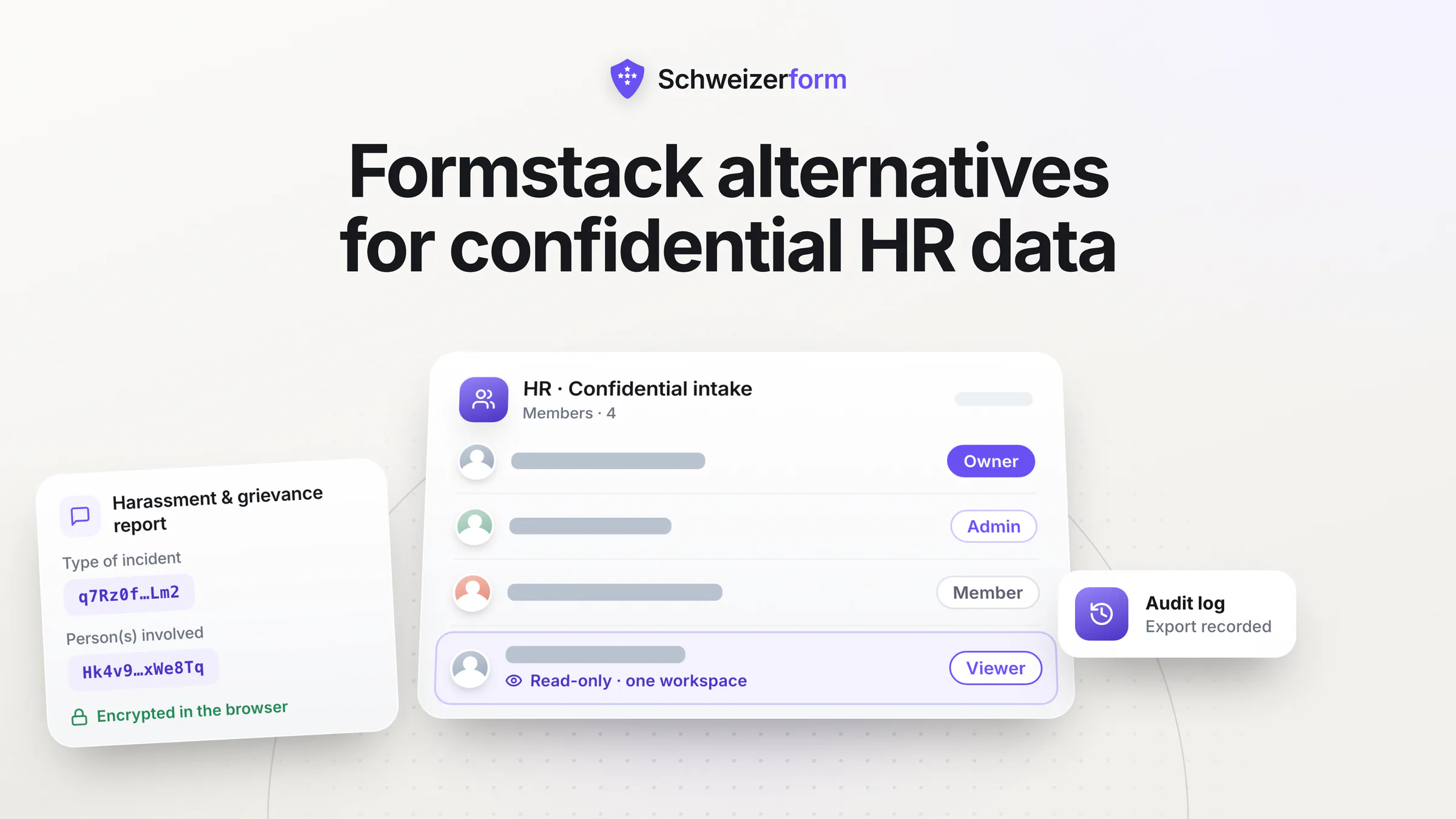
Responses are encrypted in the employee's browser; the server stores ciphertext and decryption happens in the browser of whoever holds the Vault key. That is the property an anonymous channel actually needs: not a policy that HR will not look, but an architecture in which we cannot, and in which only the named key holders can. Access inside your organisation is separated by workspace roles — owner, admin, member and viewer, with viewer read-only — so an investigator can be given access to one workspace without gaining rights over the rest. Encrypted submissions are stored in Switzerland, the form page carries no trackers or cookies, and one form definition publishes in EN, DE, FR and IT, which matters for any employer with staff across the language regions.
Head-to-Head on the HR Criteria
| Vendor can read submissions? | Internal role separation | Hosting | Audit trail | |
|---|---|---|---|---|
| Formstack (Intellistack) | Yes — at-rest encryption, vendor-held keys | Enterprise user and permission management | AWS in the United States; no published EU/CH residency | Enterprise-grade logging |
| Jotform | Yes | Team and folder permissions on paid tiers | Google Cloud Iowa and Frankfurt; residency at Enterprise only | Available on higher tiers |
| Microsoft Forms | Yes — Microsoft and your tenant admin | Tenant-level only; admins reach the data | EU/EFTA macro region for Swiss tenants; no residency commitment | Via Microsoft 365 audit, at tenant level |
| Tally | Yes — plus a long sub-processor list | Team seats on paid plans | Europe — Google Cloud in Belgium | Limited |
| Nextcloud Forms / LimeSurvey, self-hosted | No vendor — your own administrators can read everything | Whatever your instance enforces | Yours — Swiss if you chose it | Whatever you configure and retain |
| Schweizerform | No — encrypted in the browser, only the Vault key decrypts | Workspace roles: owner, admin, member, viewer (read-only) | Encrypted submissions stored in Switzerland (Infomaniak) | Append-only audit log incl. logins, exports and deletions |
The first column is the one that separates an HR channel from an HR form. Everything else on this table can be bought or configured; the first column is a property of the architecture and cannot.
Retention — the Criterion Everyone Under-Specifies
Grievance records, investigation files and exit interviews have lifetimes, and the lifetime is rarely «forever». Employment law, works-council agreements and your own policy set the period; the practical failure is that nothing enforces it, so a folder of exit interviews from 2019 is still readable in 2026 by whoever inherited the account. Ask any vendor two questions: can a retention period be set per form, and does deletion remove the data from backups and exports as well as from the interface?
Our own honest position, stated the same way we ask vendors to state theirs: we do not currently offer an automatic per-form retention rule. Deletion is something you carry out — individually or in bulk — and when you do, it is a hard delete of the rows and of the stored objects, not a hidden flag. What we will not do is imply an automation that does not exist. Set the period in your policy, diarise it, and use bulk deletion; the framework for choosing defensible periods is in form data retention, and what «deleted» actually means across platforms is in exporting, moving and deleting form data.
The export question that reveals lock-in
Ask each vendor whether the export contains attachment bytes or just links back to the platform. Links authenticate against the system you are leaving, which means your «archive» of investigation evidence stops working the day the contract ends. It is the fastest lock-in test there is, and it matters more in HR than anywhere else, because these files are exactly the ones you may need years later.
Anonymity: What HR Forms Actually Require
Two different things get called anonymous, and conflating them is how HR promises get broken. Anonymous means nothing collected can identify the person, including metadata and free text. Pseudonymous means identity exists but is separated — a case number, a reply channel, an ability to follow up. Whistleblowing channels usually need the second, because a report that cannot be clarified frequently cannot be investigated; employee surveys usually need the first. Get the choice wrong and you either cannot act on reports or cannot honour your promise. The distinction is set out in anonymous vs pseudonymous forms.
Whichever you choose, three things break anonymity in practice, in order of frequency: demographic breakdowns in reporting, where small teams crossed by tenure and function produce cells of one; free text, where people describe incidents only they experienced; and metadata, where a timestamp and an IP address are enough to identify who filed at 23:14 from the office network. The arithmetic is in how many responses before anonymity holds, and the metadata question — including what we store per submission and what we deliberately do not — is in IP addresses and form metadata.
Pricing — and Why HR Is Where Modular Pricing Hurts
Formstack is positioned well above the general form-builder market and is sold modularly, so an HR workflow that spans forms, generated documents and signature can end up with several subscriptions; HIPAA coverage and the strongest enterprise controls sit at the top of the range and are quoted rather than listed. Verify the current structure directly, particularly given the Intellistack transition. Jotform's HIPAA features start at Gold at USD 129 per month with data residency reserved for Enterprise. Tally is USD 24 for Pro and USD 74 for Business. Microsoft Forms is included in a subscription you already hold. Self-hosting costs infrastructure plus the staff time to operate it safely.
Schweizerform is Free, Pro at CHF 29 per month and Business at CHF 69 per month, with end-to-end encryption, Swiss storage of encrypted submissions and the workspace role model available without an enterprise negotiation. We are not the more capable workflow product — we are the one where the confidentiality property is not a tier. Current limits are on the pricing page.
Which Alternative Fits Which HR Job
Stay on Formstack when
- The value is the workflow: multi-step approvals, generated documents, e-signature and integration into an HRIS
- The forms are administrative rather than confidential — onboarding paperwork, equipment, benefits enrolment, training
- US hosting is documented and accepted in your transfer assessment, and the contract with the new entity name is in place
Move to Jotform or Tally when
- Cost is the driver and the data is ordinary HR administration
- You want EU hosting without an enterprise negotiation — Tally in particular
- You have read the sub-processor list and are comfortable that the vendor can read the submissions
Move to Schweizerform when
- The channel is a grievance line, a whistleblowing intake, a harassment report, an exit interview or a health declaration
- The person the form protects employees from could plausibly have administrative access to the tool
- You want employees to believe the anonymity promise — and «encrypted in your browser; nobody here can read it» is the sentence that makes them believe it
- You need the same channel live in EN, DE, FR and IT across the language regions
- Encrypted submissions in Switzerland matter for your works council, your DPO or your legal team
The Realistic Answer: Split the Estate
Nobody should migrate an entire HR form estate to satisfy three forms, and nobody should run a whistleblowing channel on the same tool as the parking-permit request because consolidation looked tidy. Keep the workflow product for the workflow — onboarding, approvals, documents, signature — and put the confidential intake on a platform where the confidentiality is structural. In most organisations that is three to six forms out of sixty, and it is the cheapest risk reduction available in HR technology. The vertical view is in the HR and whistleblower use case, and the EU-side obligations — 7-day acknowledgement, 3-month feedback, multilingual intake — are in the EU Whistleblowing Directive.
A practical split for an HR department. Administrative forms stay where they are. The grievance line, the whistleblowing channel and the exit interview move to a platform where responses are encrypted in the employee's browser, encrypted submissions are stored in Switzerland, access is separated by workspace role, and every export and deletion is written to an append-only audit log. The Free plan is enough to run one real channel before you commit — or see how the encryption works.
Disclaimer: This comparison is general information and marketing content, not legal, regulatory or compliance advice. Product behaviour, hosting locations, plan gating, certifications and corporate naming for Formstack/Intellistack, Jotform, Microsoft, Tally, Nextcloud and LimeSurvey reflect each vendor's publicly available documentation as checked on 25 July 2026 and may change — verify current details directly with the vendor before making procurement or compliance decisions. References to the DSG, to Art. 336a CO and to Directive (EU) 2019/1937 are summaries, not a substitute for advice from qualified counsel on your specific situation, and employment-law obligations vary by canton, jurisdiction and collective agreement. All product and company names are trademarks of their respective owners and are used here for factual comparison only.