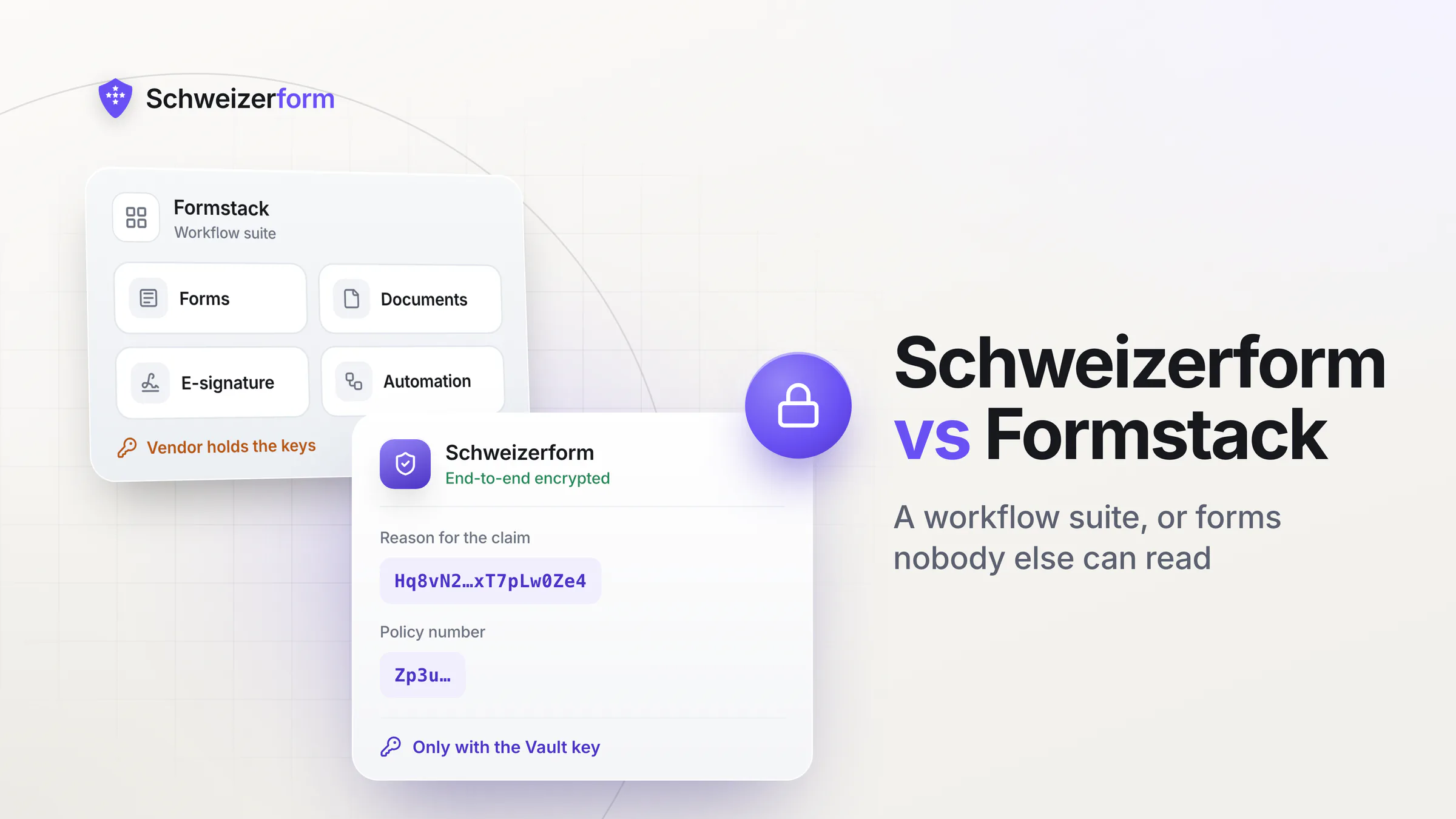
Formstack is one of the heavyweights of the form-builder world. It is not really a form builder anymore — it positions as a workflow automation suite for enterprises, with forms, documents, e-signature, and integrations all under one roof. Compared to that, Schweizerform looks deliberately narrow: a Swiss-hosted, zero-knowledge form builder, focused on confidential data flows. Whether one is the right answer depends on what problem you are actually trying to solve.
This page tries to be honest about both products. Formstack does several things genuinely well — and several things its size and US-anchored architecture make awkward when the workload is European, regulated, and confidentiality-first. Schweizerform makes the opposite trade. We are smaller, more focused, and we have made architectural choices Formstack cannot retrofit without rebuilding from scratch.
Our bias, declared
We build Schweizerform, so we are not neutral. But Formstack is a serious, established product, and we will credit it where credit is due. The point of this page is to help you choose correctly, not to claim Formstack is bad — it is not.
How Formstack and Schweizerform position themselves
Formstack — US enterprise workflow platform
Formstack is a US-based product (Indianapolis) that has grown well beyond forms. Today it markets a "workflow automation" suite covering Formstack Forms, Formstack Documents, Formstack Sign, and a broader Formstack Suite that ties them together with Salesforce-grade integrations. Its sweet spot is mid-market and enterprise teams that want to replace several siloed tools — form intake, document generation, e-sign, basic CRM workflow — with a single vendor. Pricing reflects that ambition: starting plans are low, but real-world enterprise deployments quickly land in the hundreds to low thousands of dollars per month.
Schweizerform — Swiss, zero-knowledge, focused
Schweizerform is a Swiss-built form builder with a single, opinionated design choice at its centre: end-to-end encryption with zero-knowledge architecture. Form data is encrypted in the respondent's browser before transmission. We physically cannot read submissions. Hosting is in Switzerland. The product is native EN / DE / FR / IT. Pricing is flat and predictable. We do not do document generation or e-signature; we do confidential data collection, very seriously.
If you need a one-vendor workflow suite (forms + documents + e-sign + Salesforce orchestration) and your data is not extremely sensitive, Formstack is genuinely a strong fit. If your data is genuinely sensitive — health, legal, HR, finance, citizen-facing — and you want the form provider to be unable to read it, that is a different requirement, and it is the one Schweizerform is built for.
The Encryption Story — Where the Two Products Genuinely Differ
Both products talk about encryption. The interesting difference is what "encrypted" actually means in each case, and what each architecture protects against.
Formstack: TLS in transit, encryption at rest, with a HIPAA tier
Formstack uses TLS for transit, encrypts data at rest in its database, and offers a higher-tier HIPAA-compliant plan with a Business Associate Agreement (BAA). This is a perfectly normal SaaS posture and is sufficient for most non-confidential B2B intake. But the cryptographic property is important to understand: Formstack holds the keys. Submissions are stored on Formstack's infrastructure in a form Formstack's systems can read. Authorised staff, integrations, and any party with a lawful demand can technically reach the plain-text data.
Schweizerform: end-to-end, zero-knowledge
Schweizerform encrypts every submission in the respondent's browser before it leaves the device. The server stores ciphertext only. Decryption keys live with the form owner — not on our servers, not in our database, not retrievable through any support flow we could perform. The provider — us — physically cannot read the submission. This is what "zero-knowledge" means as a load-bearing property, not as a slogan.
Why this matters in practice
If you want "the vendor cannot read this even if they want to", encryption at rest is not the right primitive — the vendor still has the keys. End-to-end zero-knowledge is the correct primitive. Formstack does not offer it on any tier. Schweizerform does, on every tier including the free one.
Jurisdiction and Sub-Processors
Where data is processed, by which company, and under which government's legal authority is one of the harder parts of any vendor decision — especially in 2026, with a maturing nFADP regime in Switzerland, ongoing EU–US adequacy debate, and active extraterritorial production frameworks like the US CLOUD Act.
Formstack: US-headquartered, US cloud, CLOUD Act exposed
Formstack is a US company hosting on US-based cloud infrastructure (primarily AWS). Even where European data residency options exist, the parent entity is subject to US jurisdiction and the CLOUD Act, which can compel a US provider to produce data regardless of where it is stored. Formstack offers contractual data-protection terms and EU representation, but it cannot opt its parent company out of US legal exposure — no US-headquartered SaaS can.
Schweizerform: Swiss-operated, Swiss hosting, no US sub-processors
Schweizerform is operated from Switzerland and stores encrypted submissions on Swiss data-centre infrastructure. Switzerland has its own data-protection regime (nFADP) and is not subject to the CLOUD Act. We have no US sub-processors. For European and Swiss buyers, this matters in a procurement file — and it matters even more if the data is encrypted such that no one (us included) can produce a readable copy under any legal demand, anywhere. The combination of Swiss jurisdiction and zero-knowledge architecture is the load-bearing claim, not either property alone.
Honest caveat
Jurisdictional exposure is not, by itself, a reason to avoid a vendor — for many workloads it is fine. It becomes load-bearing when (a) the data is sensitive, (b) the data subjects are European, and (c) a regulator or auditor is going to ask. For routine non-sensitive intake, it is mostly a paperwork question. For health, HR, legal, finance, and citizen-facing data, it is often the deciding question.
Pricing Models
Pricing is one of the most visible differences. Formstack lists tiered plans starting low but climbing quickly as features (HIPAA, Salesforce, document generation, e-sign, advanced workflow) are added. The realistic enterprise total — Forms + Documents + Sign + Salesforce integration + premium support — is several hundred to several thousand dollars per month. Schweizerform is flat, predictable, and includes encryption and Swiss storage of encrypted submissions on every tier including the free one.
| Aspect | Formstack | Schweizerform |
|---|---|---|
| Free tier | Limited trial; no production-grade free tier comparable to ours | Free tier with full E2E encryption: 3 forms, 100 submissions/month |
| Encryption | TLS + at-rest; HIPAA tier on higher plans | Zero-knowledge end-to-end encryption — every plan, including free |
| Hosting | US (AWS-based), with limited regional options | Switzerland, no US sub-processors |
| Realistic enterprise total | Hundreds to thousands per month once Documents/Sign/Salesforce/HIPAA are added | Flat, predictable Schweizerform pricing — no encryption upcharge, no jurisdiction upcharge |
| Hidden costs | Tier gates: HIPAA, advanced logic, Salesforce, document generation often require upgrades | No tier gates on encryption, hosting, or core form features |
Feature Breadth — Where Formstack Is Genuinely Strong
It would be dishonest to pretend Schweizerform matches Formstack's feature breadth. Formstack has invested heavily in territory we deliberately do not occupy.
- Document generation — Formstack Documents (formerly WebMerge) generates contracts, certificates, and personalised documents from form submissions. Schweizerform does not do this.
- E-signature — Formstack Sign is integrated into the suite. Schweizerform does not include e-signature; integrate with a dedicated tool if you need it.
- Salesforce-grade workflow — deep CRM integrations, conditional routing, multi-step approvals, audit trails wired into Salesforce objects. We are not in that part of the market.
- Pre-built integration library — Formstack has long invested in integrations with the broader US SaaS ecosystem. We integrate via standard channels (CSV export, webhook patterns once decryption is performed agency-side).
- Mid-market sales motion — Formstack has account managers, professional services, and an enterprise procurement playbook. We are leaner and self-service-first.
If "replace four tools with one suite" is your buying criterion, Formstack is built for that and we are not. We focus on the form-collection step itself, especially when the data is confidential. After decryption, you bring your own document/sign/CRM tooling.
Where Schweizerform Is Genuinely Strong
Conversely, there are several areas where the architectural difference flips the comparison.
- Encryption depth — zero-knowledge end-to-end on every form, every plan, every submission. No "upgrade for HIPAA" gate.
- Swiss jurisdiction — encrypted submissions stored in Switzerland, no US sub-processors. Direct answer to procurement, DPA, and constitutional-data questions.
- Native four-language UX — every label, error, and confirmation in EN / DE / FR / IT, not machine-translated. Formstack is English-first with bolt-on translation.
- Predictable pricing — flat plans without security upcharges. The thing you most want — confidentiality — is the default, not the upsell.
- Confidential file uploads — encrypted file uploads up to 100 MB per file and 1 GB per submission, decrypted only by the form owner.
- Privacy-preserving AI and team workspaces — generate a form from a plain-language prompt (the AI only ever sees your form definitions, never a submission) and share work across team workspaces with role-based access.
- Audit-friendly posture — DPOs and auditors can describe "the vendor cannot read submissions" as a structural property, not as a contractual promise.
Compliance — HIPAA vs nFADP / GDPR Realities
Compliance is one of the easiest places to oversimplify. Formstack and Schweizerform both intersect with multiple frameworks, but in different ways.
| Framework | Formstack | Schweizerform |
|---|---|---|
| HIPAA (US health) | HIPAA-compliant plan with BAA on higher tiers | Not US-anchored; HIPAA BAA is not our positioning. The architectural property ("vendor cannot read PHI") tends to satisfy HIPAA technical-safeguard expectations far above what TLS+at-rest provides — but US healthcare buyers should evaluate carefully and may legitimately prefer Formstack's HIPAA-tier paperwork |
| nFADP (Swiss) | Contractually addressable; not architecturally aligned to Swiss data-residency expectations | Native — Swiss-built, Swiss-hosted, Swiss-jurisdiction; designed around nFADP from day one |
| GDPR (EU) | Compliant via DPA + EU representation; underlying CLOUD Act exposure remains a buyer's-due-diligence question | Compliant; Swiss adequacy + zero-knowledge architecture combine to shrink the DPA assessment surface |
| Data minimisation | Possible but not enforced | Architecturally encouraged: vendor cannot read fields, so over-collection has no provider-side use |
| Sub-processor chain | Significant — typical US SaaS dependency tree | Minimal — Swiss-only, no US sub-processors |
When Formstack Is the Right Choice
- You are a US-based mid-market or enterprise buyer and your jurisdictional exposure is acceptable.
- You want one vendor for forms, documents, and e-signature, ideally tied into Salesforce.
- Your data is not in the highest-confidentiality bracket — internal HR forms, sales intake, customer onboarding, marketing operations.
- You need HIPAA paperwork (BAA) and your buyer expects a US healthcare-compliance posture.
- You have IT and procurement bandwidth to manage a multi-product SaaS contract and integration project.
- Predictable English-first UX is fine; multilingual expansion is secondary.
These are real, legitimate criteria — and Formstack is genuinely good at this profile of buyer. Use it.
When the workflow suite is the wrong trade
- Your data is genuinely sensitive — health, legal, HR-with-grievances, financial-advisory, citizen-facing, journalist sources, whistleblower channels.
- You are European or Swiss-anchored and the procurement file demands non-US jurisdiction.
- You want "the vendor cannot read submissions" as a structural property, not a contractual one.
- You operate in EN / DE / FR / IT and want native multilingual UX, not machine translation.
- You want predictable pricing without security upcharges.
- Forms are the use case — you have, or will integrate, separate tools for documents, e-signature, and CRM.
If three or more of those points fit your situation, Schweizerform is likely the better choice — and the free tier is enough to validate it without procurement involvement.
Side-by-Side Reference
| Dimension | Formstack | Schweizerform |
|---|---|---|
| Encryption model | TLS + at-rest; HIPAA tier | Zero-knowledge end-to-end on every plan |
| Provider can read submissions | Yes — keys are server-side | No — keys are with the form owner |
| Hosting | US-based cloud | Switzerland |
| Jurisdiction | United States (CLOUD Act) | Switzerland (no CLOUD Act) |
| Sub-processors | Multiple, primarily US-based | Swiss-only, no US sub-processors |
| Native languages | English-first | EN / DE / FR / IT native |
| Document generation | Yes — Formstack Documents | No — out of scope |
| E-signature | Yes — Formstack Sign | No — out of scope |
| Salesforce integration | Deep, native | None — export the decrypted data and import it yourself |
| Free tier | Trial-style | Production-grade with full E2EE: 3 forms, 100 submissions/month |
| Pricing posture | Tiered, with feature gates | Flat, predictable, no encryption upcharge |
| File uploads | Yes, in cloud | Yes, encrypted (100 MB / file, 1 GB / submission) |
| Best fit | US enterprise workflow buyers | European confidential-data buyers |
| AI form creation | Yes — AI drafts a form from a prompt | Yes — draft from a prompt; the AI never sees responses |
| Automatic form translation | No built-in automatic translation; manual per-field language or Google Translate add-on | Yes — DE / FR / IT / EN; only form text is translated, never responses |
| Team workspaces & roles | Yes — workspaces, folders, and role-based permissions | Yes — shared workspace, still end-to-end encrypted, role-based |
If You Are Considering Migrating from Formstack
Migration usually starts narrowly. Pick one form where confidentiality is the dominant requirement — typically a HIPAA-adjacent intake, an HR grievance channel, a legal client-intake form, or a citizen-facing complaint portal — and run it on Schweizerform's free tier in parallel with the Formstack version. Compare submission UX, decryption flow, retention behaviour, and DPA paperwork. Once that one form proves out, the rest of the migration is a calendar-driven rollout, not a product evaluation.
- 1
Identify the right pilot form
Pick a form where the value of confidentiality is concrete and load-bearing — health intake, grievance channel, whistleblower, legal client-intake, or citizen-facing complaint. Avoid starting with a marketing form: it does not stress the property you are evaluating.
- 2
Run both in parallel
Keep the Formstack version live, route a sub-segment to Schweizerform, and compare end-to-end: respondent UX, decryption workflow, downstream pipeline, DPO documentation. The free tier is enough.
- 3
Document the processor relationship
Add Schweizerform to your record of processing activities. Set down the Swiss storage location, the zero-knowledge design, and the absence of a US sub-processor. For DPOs, this typically simplifies the assessment compared to the existing Formstack file.
- 4
Decide what stays on Formstack
If document generation, e-sign, and Salesforce orchestration are the value you are getting from Formstack, keep them — and use Schweizerform specifically for the confidential-intake step. Not everything has to move.
- 5
Roll out by sensitivity, not by alphabet
Migrate forms in order of confidentiality risk, not in order of convenience. Highest-risk forms move first; low-risk marketing forms can stay on Formstack indefinitely if that is what your stack already does well.
Formstack or Schweizerform
Formstack and Schweizerform are not the same shape of product, and that is the point. Formstack is a US enterprise workflow suite that includes forms; Schweizerform is a Swiss zero-knowledge form builder that does one thing seriously. Pick by problem, not by feature checklist.
If your problem is "replace four tools with one and connect it to Salesforce", Formstack is the right answer. If your problem is "collect confidential data such that the form vendor physically cannot read it, under Swiss jurisdiction, in four languages", Schweizerform is the right answer. Many organisations use both — Formstack for breadth, Schweizerform for the forms where confidentiality is the requirement.
Try the free tier on a single high-stakes form. Encrypted submissions stored in Switzerland, no US parent in the storage path, and a free tier with the same cryptography as the paid plans.
Disclaimer: This page is general information and marketing content, not legal, regulatory, or procurement advice. Product features, pricing, and compliance posture for both Schweizerform and Formstack change over time. References to nFADP, GDPR, HIPAA, the US CLOUD Act, and similar frameworks are summarised at a conceptual level and are subject to jurisdictional interpretation. Verify current product details and consult a qualified data-protection or procurement specialist before relying on any summary here for compliance or purchasing decisions. Competitive details were last verified on 25 July 2026. All product and company names are trademarks of their respective owners and are used here for factual comparison only.