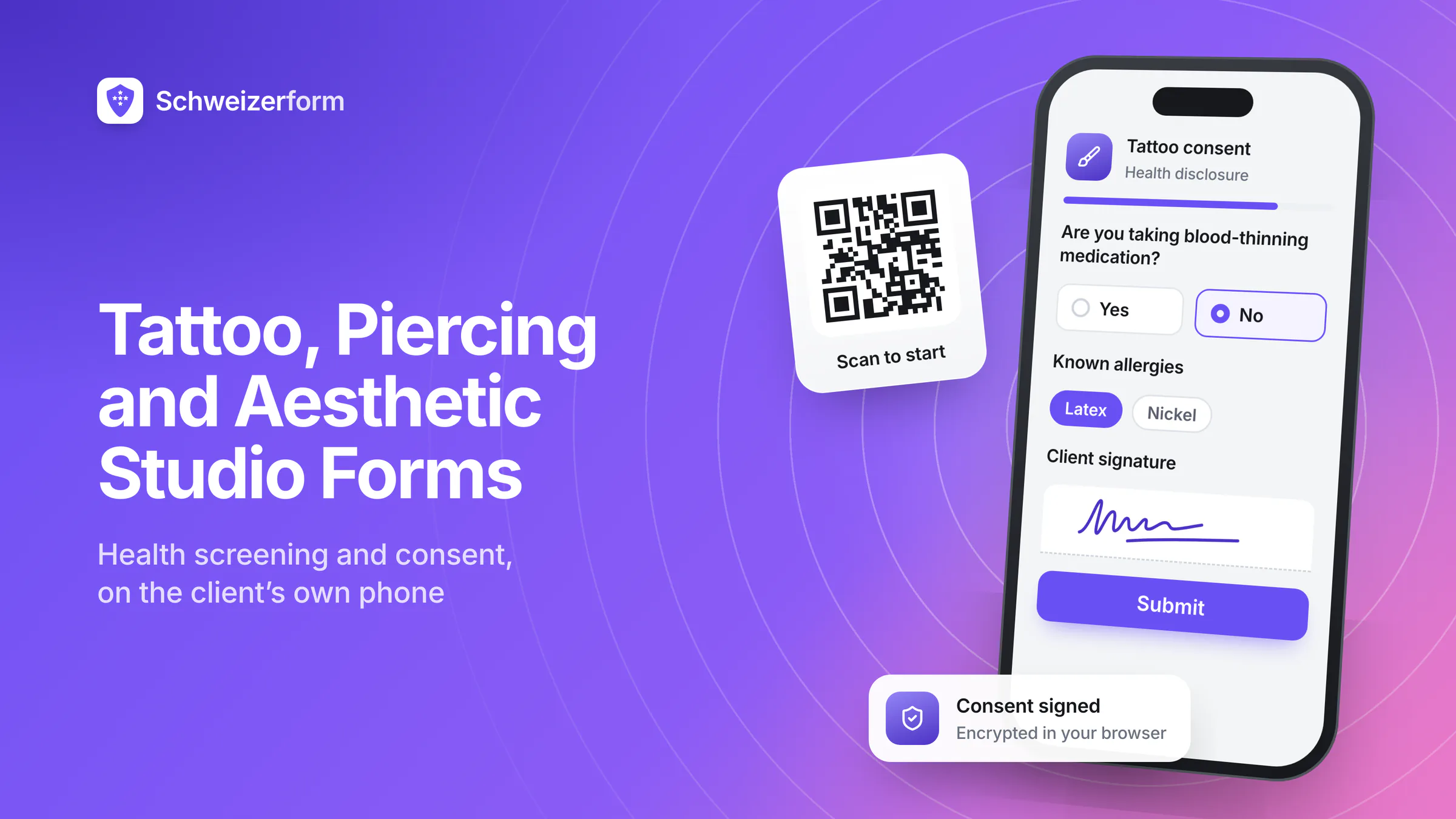
Look at what a tattoo studio asks before it starts work. Are you taking blood thinners. Do you have a latex or nickel allergy. Are you pregnant or breastfeeding. Do you have epilepsy, diabetes, a heart condition, a skin condition. Have you had hepatitis or any blood-borne infection. Which medication are you on. Have you drunk alcohol today. Every one of those is a health question, and in most Swiss studios the answers live in a ring binder behind the counter, in a shared tablet that keeps the previous client's form on screen, or in a chat message.
Schweizerform is an encrypted intake layer for exactly that paperwork. The client fills the form in their own browser, the answers are encrypted on their device before anything leaves it, and only a holder of the Vault key can decrypt them. We are based in Switzerland, encrypted submissions are stored in Switzerland with Infomaniak, and we cannot read a submission — not for support, not for analytics, not under legal process, because we do not hold the key. The form exists in German, French, Italian and English, which in this trade is not a formality: a walk-in client on holiday is a routine occurrence, and a health screening answered in a language the client half-understands is not a screening.
Who this page is for
Tattoo and piercing studios, permanent make-up and dermapigmentation artists, laser hair-removal and tattoo-removal providers, cosmetic and beauty institutes, and any studio offering treatments that break the skin or apply energy to it. If you work under medical supervision or give injectables, read the healthcare use case as well — that is a different legal world with a different set of duties.
You Are Running a Health Questionnaire, Whether or Not You Call It One
Art. 5 lit. c nFADP treats data on health as sensitive personal data. A screening form that asks about anticoagulants, blood-borne infections, pregnancy, epilepsy or a medication list is health data by any reading, and the fact that it is being collected by a studio rather than a practice changes nothing about the classification. Sensitive data raises the standard on security under Art. 8 nFADP, on the information duty under Art. 19, and on whether express consent is required for the processing under Art. 6 para. 7. The rest of this page is what that means in a room with a counter, a tablet and a queue.
You are not bound by professional secrecy — and that is not good news
Art. 321 SCC binds a defined list of professions — physicians, dentists, pharmacists, midwives, psychologists, nursing and several therapy professions, lawyers, clergy and others, plus their auxiliary persons. Tattooists, piercers and beauticians are not on that list. What that removes is the criminal backstop, not the duty: your obligation of discretion rests on the contract with the client, on personality protection under Art. 28 CC and on data protection law, all of which apply in full. The distinction and why it matters is set out in professional secrecy and online forms in Switzerland.
| What the studio collects | Status under Swiss law | Who genuinely needs to read it | What drives retention |
|---|---|---|---|
| Medication, anticoagulants, allergies, diabetes, epilepsy, heart or skin conditions | Sensitive — health data (Art. 5 lit. c nFADP) | The artist doing the work that day, and nobody else in the studio | The screening detail has a short life; the fact that screening happened belongs in the long-lived consent record |
| Blood-borne infection status (hepatitis, HIV) | Sensitive, and among the most stigmatising data a small business can hold | The artist, if you ask it at all — universal precautions apply regardless of the answer | Delete with the appointment record; ask yourself first whether the answer changes what you do |
| Pregnancy or breastfeeding | Sensitive — health data, and often not yet known to the client's own family | The artist deciding whether to proceed | Delete promptly; this is the field most likely to cause harm if seen by the wrong person |
| Consent to the procedure, with the risks explained | Ordinary data, but it is the document that makes the intervention lawful | The studio owner; produced only if there is a dispute | The limitation period for personal-injury claims — see below. This is the long file |
| Assessment of a minor's capacity of judgement and any guardian declaration | Ordinary data about the client plus identifying data about the guardian | The studio owner and the artist | As long as the consent record, and for the same reason |
| Photographs of the work, and of the client | Ordinary data, but personality rights under Art. 28 CC and a separate consent question | Whoever publishes — with a findable record of who said no | Withdrawal of consent must actually work, so the source record has to remain findable |
| Aftercare follow-up and complications reported afterwards | Sensitive — health data, and directly relevant evidence if anything goes wrong | The artist and the studio owner | Attach it to the consent record; a complication report is exactly what a later claim turns on |
The Swiss Rules That Actually Apply to a Studio
- A notification duty since 1 May 2017. Businesses offering tattooing and piercing must register with the competent cantonal authority — and this applies whether you work from a studio, privately or mobile. It is a registration, not a licence.
- Inks and instruments are regulated products. Tattoo and permanent make-up inks and piercing apparatus and instruments fall under the ordinance on objects for human contact, with federal requirements on their safety: inks must be manufactured and packed so that they remain germ-free until first use, and first-time studs must be sterile on first insertion.
- A hygiene plan that every member of staff knows. Cantonal authorities inspect studios much as they inspect food businesses, and a voluntary annual inspection with a hygiene quality label exists for studios that want to demonstrate it.
- Cosmetic laser work needs a certificate of competence. Since 1 June 2024, non-medical laser applications — hair removal, skin rejuvenation, tattoo removal — may only be performed by people holding the certificate of competence under the ordinance on protection against non-ionising radiation and sound. If you added a laser to a tattoo studio, this applies to you.
- Injectables are a different legal world entirely. Botulinum toxin is a prescription medicine and fillers are medical devices; that work sits under medicines and medical-device law, not under this page. Nothing here should be read as saying otherwise.
An inspection reads your paperwork, not only your autoclave
Hygiene inspections look at process as well as surfaces: the hygiene plan, the sterilisation records, the batch traceability of inks and needles, and the client documentation. A screening and consent process you can produce on demand, complete and dated, in the client's own language, is part of what a good inspection looks like — and it is much easier to produce from an encrypted archive than from a binder that three people have reorganised.
Minors: the Question Is Capacity, Not Age
Switzerland has no federal minimum age for a tattoo or a piercing, and studios are often surprised by that. The legal test is capacity of judgement under Art. 16 CC — whether the person can act reasonably in the specific situation, grasp the consequences of what they are doing and behave accordingly — combined with Art. 19c CC, under which a person capable of judgement exercises strictly personal rights themselves. Consent to an intervention on one's own body is such a right. Capacity is assessed for the specific decision and the specific person; it is not conferred by a birthday.
Two practical consequences. First, a studio may set its own policy — many set eighteen, and that is a legitimate business decision, not a legal requirement. Second, where you do work with a minor, what protects you is not a guardian's signature on its own but a record of the assessment: who explained what, in whose presence, which identity documents were seen, and on what basis the studio concluded the client understood the permanence, the pain, the healing and the removal costs. A signature proves someone signed. A record proves you thought about it.
What a minors form should actually capture
The client's own confirmation, in their words, of what they understood; the guardian's identity, relationship and contactability, verified rather than asserted; a note of which documents were seen; the presence of the guardian at the appointment if your policy requires it; and the artist's own short note on the capacity assessment. Keep that as part of the consent record, and keep it for as long as the consent record — a decision about a seventeen-year-old is exactly the one that gets revisited years later.
Consent Is What Makes It Lawful — So the Consent Record Is a Defence File
An intervention on someone's body requires their valid consent; without it, the act is unlawful, whatever the aesthetic result. Valid means informed: the risks explained, the permanence understood, the aftercare given, questions answered. This is why the consent record is not administrative overhead but the single document that decides a dispute — and why its retention logic runs the opposite way to almost everything else we advise on this site.
Twenty years, not two
The revised Swiss limitation law in force since 1 January 2020 extended the absolute limitation period for personal-injury claims to twenty years from the harmful act, with a relative period of three years from the moment the injured person learns of the damage and the liable party. A scarring, infection or allergy claim arising from work you did can therefore surface long after the appointment is forgotten. If your consent forms are shredded at the end of the year — or sit on a phone that was replaced — you are undefended precisely in the cases that matter.
The design answer is to split the file rather than to keep everything forever. Two records, two lifespans:
- The consent record — long. Who consented to what, on which date, with which risks explained, by which artist, plus the aftercare given and any complication reported afterwards, plus the confirmation that a health screening was carried out and cleared. This is the evidence, and its life is measured against the limitation period rather than against your filing habits.
- The screening detail — short. The medication list, the infection status, the pregnancy answer. You needed it to decide whether and how to work; you rarely need the detail afterwards. Delete it on a fixed schedule and keep the fact that screening happened in the consent record.
- Write both rules down, and diarise them. Deletion here is an action someone takes, individually or in bulk, not an automatic per-form rule — so put a date in the calendar and assign it to a person. Form data retention sets out how to write rules you can actually follow.
On signatures: our signature field captures a drawn signature and renders it into the PDF of a submission, which is exactly what a consent record needs. It is not a qualified electronic signature in the sense of Swiss signature law — but consent to a bodily intervention is not subject to a legal form requirement in the first place. What matters evidentially is a complete, dated, unaltered record of what was explained and agreed, and that is what you get.
The Tablet at the Counter, and Why the Client's Own Phone Is Better
The standard studio workflow is a house tablet handed across the counter. It is convenient and it is the weakest link in the whole process: the browser remembers, the previous client's answers are one back-button away, autofill offers somebody else's name, and the person answering «are you pregnant» is doing so in a shop with other clients within reading distance.
- Put a QR code on the counter and let people use their own phone. Better hygiene, better privacy, no shared device state, and the client answers honestly because nobody is watching the screen.
- If you must use a house tablet, use a fresh private window per client and never leave a completed submission on screen. Nothing in any form product protects against a device handed over with the last answer still visible.
- Send the link ahead of the appointment for longer sessions. A full-day piece deserves a screening answered at home rather than in the two minutes before the needle.
- Publish in four languages. A holiday walk-in answering a German-only medical questionnaire is a screening in name only, and an incorrect answer about a blood thinner is a clinical problem before it is a legal one.
Aftercare, Follow-Up and Complaints
The aftercare follow-up is the most under-used form in this trade. A short encrypted check-in a week or two after the appointment — healing normally, any redness or swelling, any questions — does three things at once: it catches complications early, it demonstrably shows that aftercare was provided, and it produces exactly the contemporaneous record that a later claim turns on. Complaints deserve the same treatment: a dedicated form that routes to the owner rather than a comment on a social-media post, answered from a record rather than from memory.
Photos: a Separate Consent, and a Withdrawal That Works
Portfolio and social-media photographs are a different processing with a different purpose, and they belong in a separate question with a separate answer — not bundled into the treatment consent. Personality protection under Art. 28 CC covers a person's image; consent given for a portfolio is not consent for paid advertising, and consent can be withdrawn. Which means the answer has to stay findable: a withdrawal you cannot act on because you no longer know who agreed to what is worse than never having asked. Where a client sends reference images or a photo of the placement area, those are attachments handled the same way as the rest of the submission — the mechanics are in secure file uploads in online forms.
What We Can Count Without Reading Anything
The public form page loads no analytics provider and no beacon, and a submission carries no IP address, user agent, referrer, geolocation or cookie identifier. What remains is counting: how many people opened the form, how many completed it, how long the median took, and — per question — how many of those who saw a question answered it. For a studio that is enough to see that your screening form is too long, or that the question everyone abandons is the one you added after an incident three years ago. Counters are flat and never cross-tabulated, receive-time and never decremented, with no retroactive backfill. The reasoning is in form analytics without tracking.
Getting Started as a Studio
- 1
Separate the screening from the consent
Two forms or two clearly separated sections, because they have different lifespans. The screening decides whether you work today; the consent is the record you may need in fifteen years.
- 2
Cut every question whose answer would not change what you do
Universal precautions apply regardless of an infection-status answer. A diagnosis is rarely what you act on — the accommodation is. Asking less is both the proportionality rule of Art. 6 nFADP and, in a small studio, the practical way to hold less that could hurt somebody.
- 3
Write the minors policy before you need it
Your own age policy, what the artist must assess and record, what the guardian must produce, and who in the studio may make the call. A policy decided at the counter with a client waiting is not a policy.
- 4
Set up the Vault key and decide who can decrypt
In a two-person studio that is both of you; in a studio with guest artists it is deliberately not all of them. Two named custodians and an offline copy — if the key is lost, the records are unrecoverable, and that is the same property that keeps everyone else out. Read how the Vault key works first.
- 5
Write the Art. 19 information text onto the form
Who the controller is — the studio, with its address — why you ask health questions, who reads them, how long each part is kept, and how a client can ask for a copy or a correction. Three sentences, in the client's own language, on the form itself.
- 6
Put a QR code on the counter and publish in four languages
One form, four language versions. Starting from a form template makes this an afternoon rather than a project, and a small studio fits comfortably in the free plan; the signature field and file uploads are on the paid plans, with Pro at CHF 29 and Business at CHF 69 per month — see the plan comparison.
One Appointment End to End
- 1
Send the screening link when the appointment is booked
Answered at home, in the client's language, without a queue behind them. For a walk-in, the QR code on the counter and their own phone.
- 2
Read the screening before the client is in the chair
The artist doing the work decrypts and reads. Anything that changes the plan — anticoagulants, a skin condition, a medication interaction — is discussed before anything is opened or drawn.
- 3
Explain, then take consent as a record and not a formality
Risks, permanence, healing, aftercare, removal costs, and the client's own questions. The signature field closes it; the PDF of the submission is the file you keep.
- 4
Handle the minors case by the written policy, if you take it at all
Capacity assessment noted by the artist, guardian identity verified rather than asserted, documents seen, presence recorded. All of it into the consent record.
- 5
Follow up on healing a week or two later
A short encrypted check-in. It catches complications early and produces the contemporaneous record that a later dispute turns on.
- 6
Run the two deletion rules
Screening detail deleted on its short schedule; consent record kept against the limitation period. Same calendar entry every quarter, one named person responsible.
Common Objections — and Realistic Answers
We have used paper forms for fifteen years and nothing has gone wrong.
Paper has genuine advantages — no device, no dependency, works when the internet does not — and a locked cabinet is not a scandal. The realistic problems are the ones studios actually report: the binder that cannot be searched when a client from 2019 gets in touch about scarring, the folder that moved when the studio moved, water damage, the pile behind the counter that a delivery driver can read, and the twenty-year limitation period sitting behind all of it. If paper stays, the fix is a locked cabinet, an index, and a rule about what gets destroyed when. Most studios that look at that honestly conclude the digital version is less work.
Our booking system already has an intake form.
Then check two things. Where does it store the answers, and can the vendor read them? Most booking platforms are ordinary SaaS, often hosted outside Switzerland, with staff and sub-processors able to access production data under controls. For an appointment time that is unremarkable. For a page listing medication, infection status and pregnancy, it is worth a deliberate decision — and using the booking system for the calendar and an encrypted form for the health screening is a perfectly sensible split. We do not do calendars, reminders or payments; we are not trying to replace that tool.
We are two people in one room. Does data protection really apply to us?
Yes, in full. Swiss data protection law has no small-business exemption; the size of the studio affects the effort that is proportionate, not whether the rules apply. Most small studios sit inside the exemption from keeping a formal register of processing activities, but that exemption falls away where sensitive data is processed on a large scale — and a busy studio processing health questionnaires all day is closer to that line than it feels. For a studio, proportionate looks like: two forms, one Vault key held by two people, a written deletion rule, and three sentences of information text on the form.
Clients send us photos and questions on WhatsApp anyway.
They do, and no form product stops that. What you can control is where the record lives. Answer the chat, then send the link: «I need the health questions in the form, it takes two minutes and I cannot keep this in a chat.» Clients accept that readily when the reason is their own privacy. What you should not do is copy chat messages into a screening record — a screenshot of a conversation is not a screening, and it drags a chat history into your evidence file.
The cantonal inspection wants to see our documentation.
Then show it. Nothing here prevents you producing records for an inspection — the point of encryption is that only you can, not that nobody can. You decrypt, you export what is asked for, and the export is a file you consciously produced rather than a permanent readable copy on a platform. CSV is available on every plan; the per-submission PDF, which is what a consent record wants to look like, is on the paid tiers.
Where Schweizerform Is Not the Right Answer
- We are not a booking system. No calendar, no appointment reminders, no deposits, no payments, no no-show handling. Keep the tool you have for that.
- We are not a client-management system. No client history view across appointments, no automatic linkage of a returning client's forms, no loyalty or marketing features.
- The signature field is a drawn signature, rendered into the submission PDF. It is not a qualified electronic signature under Swiss signature law — which for consent to a bodily intervention is not required, but you should know which one you have.
- No automatic per-form retention rule. Deletion is an action someone takes. With two different lifespans to manage, that means two diary entries.
- Key loss is unrecoverable, so in a small studio that means two people with the key and an offline copy, agreed before the first client fills anything in.
The Bottom Line for Studio Forms
A body-art studio runs a health questionnaire under Art. 5 lit. c nFADP every working day, without the criminal-law backstop of professional secrecy and usually without anyone whose job is compliance. Around it sit a cantonal notification duty in force since 1 May 2017, federal safety requirements for inks and instruments, hygiene inspections that look at documentation as well as surfaces, a certificate of competence for cosmetic laser work since 1 June 2024, a consent requirement that is what makes the whole intervention lawful, and a twenty-year limitation period for personal-injury claims sitting quietly behind all of it.
The intake is the part you can fix this week. Encrypt in the client's browser, let them answer on their own phone in their own language, ask only what changes what you do, split the short-lived screening from the long-lived consent record, and put both deletion dates in a calendar. What we do not do — bookings, payments, client management — we would rather you knew before your next appointment than after.
Start with your screening and consent form on the free plan — encrypted in the client's browser, stored in Switzerland, published in German, French, Italian and English, and readable only by the artists who need it — and put the QR code on the counter instead of the tablet.
Disclaimer: this page is general information and marketing content, not legal or medical advice. References to the nFADP/nDSG, Art. 16, 19c and 28 CC, Art. 321 SCC, the revised limitation rules in force since 1 January 2020, the notification duty for tattoo and piercing businesses, the ordinance on objects for human contact and the certificate of competence for non-medical laser applications are summarised at a conceptual level, reflect the position as of July 2026, and are subject to cantonal practice and judicial interpretation. Responsibility for the lawful processing of client data, and for the lawfulness of the treatment itself, remains with the studio. Consult a qualified Swiss adviser before relying on any summary here — in particular before working with minors.