Ask three people in Swiss education whether a school may use Google Forms and you will get three answers, all delivered with confidence. The IT coordinator says yes, we have a Workspace for Education tenant. The cantonal data protection officer says it depends, and sends a PDF. A parent says absolutely not, and forwards a newspaper article. All three are describing different parts of a real answer, and the part that decides it is usually the one nobody asks about: what the specific form collects.
The short version
Public schools are governed by cantonal data protection law, not the federal nFADP — which is why guidance differs between cantons and why a national answer does not exist. Several cantons and school agencies have assessed Google Workspace for Education and permitted it with conditions: configuration requirements, restrictions on data categories, and often an explicit exclusion of sensitive data. So the practical rule is not «Google Forms is banned» or «we have a contract, so anything goes». It is: check your canton's current position, then check what the form asks. A trip-planning form and a special-needs assessment are the same tool and completely different decisions.
This article aggregates the questions schools actually ask. If you want the general nFADP analysis for a private organisation, that is in can I use Google Forms legally in Switzerland; if you want the security-level answer, is Google Forms secure.
Which Law Applies to a Swiss School
This is the step most discussions skip, and it explains almost all of the confusion. The federal nFADP governs private persons and federal bodies. Cantonal and communal bodies — which is what a public school is — are governed by their cantonal data protection act, supervised by the cantonal data protection authority. Those acts are broadly similar to the federal one in structure but differ in detail, and the guidance on cloud services differs more than the statutes do.
- Public compulsory school (primary, secondary I): cantonal law, cantonal supervisory authority, plus any school-office directives and municipal rules.
- Cantonal upper-secondary and vocational schools: cantonal law, sometimes with their own institutional rules.
- Private schools: the federal nFADP applies, since they are private persons — the analysis is closer to that of a company, though the pupil-protection reasoning stays the same.
- Universities and universities of applied sciences: their own cantonal or institutional regime, plus research-specific rules where studies are involved.
One further layer for public bodies is worth naming because it is the sharpest external reference point on cloud services: the privatim resolution of November 2025 on international cloud services — privatim being the conference of Swiss data protection commissioners. It treats the use of providers exposed to foreign access as permissible only in narrow cases, with a notable exception where the public body itself encrypts the data and the provider holds no key. That exception is worth reading closely by any school weighing a cloud tool for sensitive content.
What Cantonal Assessments Typically Say About Google Workspace
The picture is not «approved» or «forbidden». Where cantons and educational agencies have looked at Google Workspace for Education, the pattern of the answer is remarkably consistent, even where the conclusions differ.
| Recurring condition | What it means in practice |
|---|---|
| A managed education tenant, not personal accounts | Pupils use school-issued accounts under an education agreement — not a teacher's private Google account, which is the single most common breach of the rule |
| Specific configuration | Additional services switched off, advertising features disabled, sharing restricted, region settings applied where available |
| Data categories restricted | Typically: no health data, no assessments of special needs, no disciplinary or child-protection records, no data about a pupil's family situation |
| Transparency to parents and pupils | Which tools are used, what is stored, where, and for how long — communicated, not buried in a general terms document |
| A documented processing basis | The processing agreement located and filed, sub-processors listed, and the cross-border situation recorded |
| A named responsible person at the school | Because the conditions above only hold if somebody owns them; the most common failure is that the assessment exists and nobody applies it |
Verify your own canton, and verify the date
Cantonal positions are revised, sometimes after a change in the vendor's offering and sometimes after a supervisory review. Do not rely on a colleague's summary, a two-year-old PDF, or this article: look up your cantonal data protection authority's current guidance and your school office's directive, note the date, and diarise a re-check. A tool assessment written before a provider changed its regional options can be silently out of date.
One vendor fact worth having at hand for that conversation: Google Workspace data regions cover Forms, and the available choices are «no preference», the United States, or Europe. Switzerland is not on the list. Google Cloud has operated a Zurich region since 2019, but that is Google Cloud Platform infrastructure, not Workspace, and it gives Google Forms no Swiss residency option. If your cantonal condition says data must remain in Switzerland, Forms cannot satisfy it — and that is a factual statement rather than a criticism.
Who Consents for a Pupil — and When Consent Is the Wrong Question
Two corrections make this section shorter than schools expect. First: most school data processing does not rest on consent at all. A public school processes pupil data to fulfil its statutory task, and that legal basis is stronger and more appropriate than asking parents to agree to something that will happen regardless. Asking for consent where you would proceed anyway creates a false choice and undermines the consent you genuinely need elsewhere.
Second: where consent is required — photographs for a school website, an optional activity, participation in a voluntary survey — the person who gives it is not automatically the parent. Under Swiss civil law, rights closely tied to the person are exercised by a minor who is capable of judgement, and capacity of judgement is assessed relative to the specific decision rather than by a fixed birthday. In practice:
- Young children: the holders of parental responsibility decide, and in a shared-custody situation you may need both — a question that becomes very concrete in a separation.
- Older pupils capable of judgement: they decide about their own personal rights, including a photograph of themselves. A parental signature does not override a capable pupil's refusal.
- The middle band: ask both, and make the pupil's own position visible on the form rather than assuming agreement.
- Withdrawal: consent must be as easy to withdraw as to give. A photo consent collected in year one and never revisited is not a durable basis for publishing that photograph in year five.
Photo and media consent is its own problem
It is separable, revocable, and it must be specific about the channel: the class wall, the school website, a printed report, social media and a press photograph are five different decisions with five different reach profiles. Bundling them into one tick box means the least acceptable use invalidates the whole consent. Keep the list granular, record who consented and when, and make sure someone can actually act on a withdrawal — including removing an image already published.
What Teachers Can Collect — and the Fields That Change the Answer
The most useful reframing for a school is that the tool question depends on the field list. The same Google Form is unremarkable for one purpose and inappropriate for another, and nothing about the platform changes between the two.
| Form | Generally acceptable in a managed education tenant? | Why |
|---|---|---|
| Parents' evening slot booking, excursion headcount | Yes | Administrative data, low sensitivity, no health or assessment content |
| Lending returns, library requests, lunch orders | Yes | Operational; keep the retention short and delete after the term |
| Class feedback on a lesson or project | Yes, with care | Fine if genuinely anonymous — but in a class of 18, free text plus any demographic detail is not anonymous |
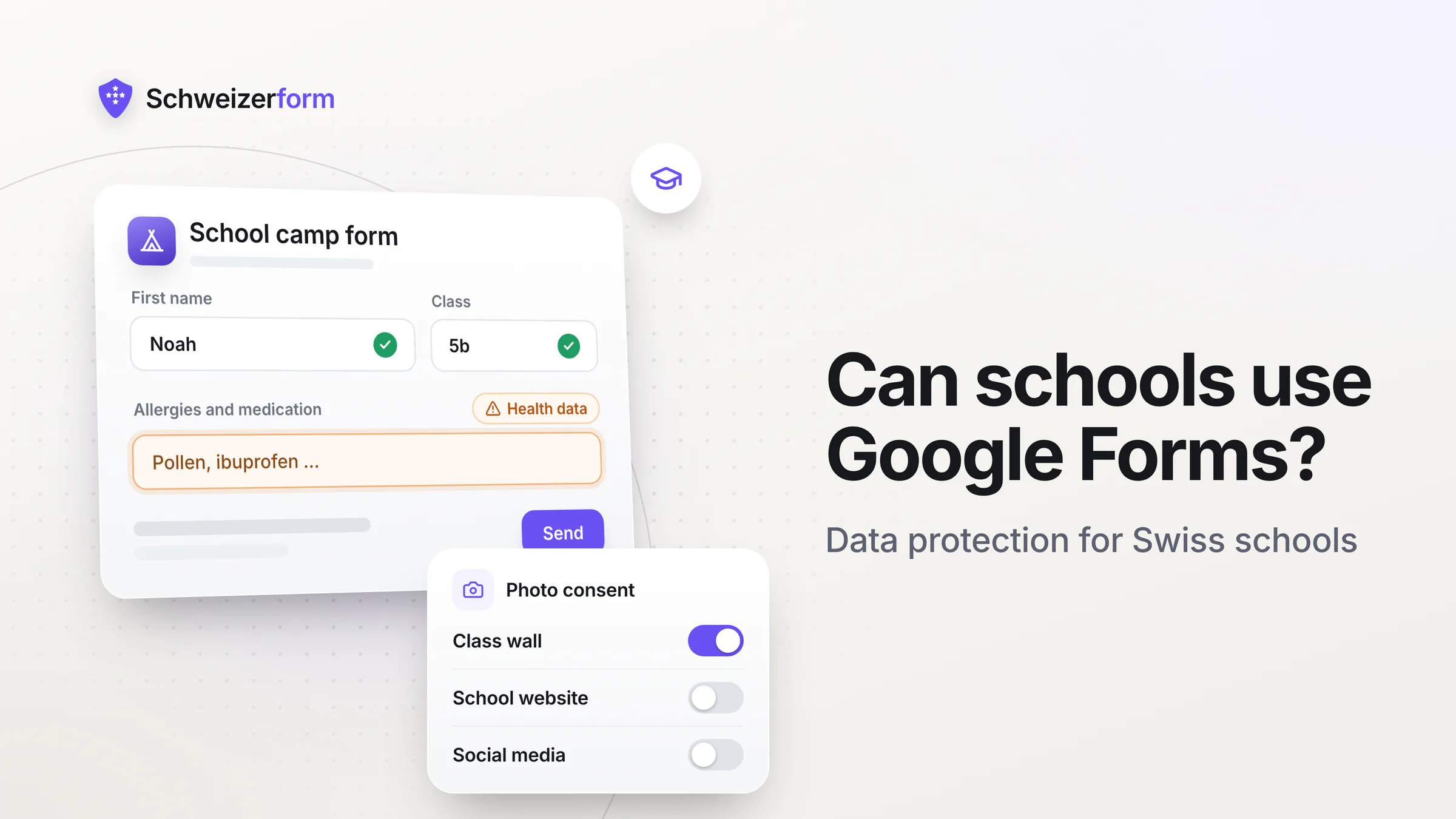
| School camp form with allergies and medication | Usually not | Health data under sensitive-data rules and typically excluded by cantonal conditions; use a channel approved for it |
| Special-needs assessment, learning-support referral | No | Sensitive data with lifelong consequences for the pupil; belongs in the school's own governed systems |
| Child-protection concerns, disciplinary records | No | Highly sensitive, sometimes subject to professional secrecy through the specialists involved |
| Family circumstances, income, hardship applications | No | Financial and family data about pupils and parents; see our scholarship and grant use case |
The camp form is the row that matters most in practice, because it is the one every school runs and the one that most often lands in whatever tool the class teacher already had open. Allergies, medication, dietary needs and emergency contacts are health data; our guide to collecting health data in forms covers how to ask for less of it and who should be able to read the rest.
A Workable Setup for a School
- 1
Find and read your cantonal guidance, with the date
Your cantonal data protection authority and school office. Note what it permits, what it excludes and what configuration it requires. Put the date and the link in your own documentation so the next person does not repeat the search.
- 2
Write a one-page rule everyone can follow
«Use the school tenant for administrative forms. Never collect health, assessment, child-protection or family-circumstance data in it. For those, use X.» A rule that fits on a page gets followed; a fifteen-page policy does not.
- 3
Ban private accounts explicitly
The most common real breach in Swiss schools is not the tool — it is a teacher using a personal account for a class form. Say it in the rule, and give people a working alternative so the shortcut is unnecessary.
- 4
Split the camp form in two
Administrative details in the ordinary channel; medical and emergency information in the channel approved for sensitive data, visible to the two staff who need it, deleted after the trip. This single change removes most of a school's real exposure.
- 5
Fix the notification problem
If responses arrive by e-mail, allergy and medication lists live permanently in staff mailboxes and on phones. Alerts without content, read in the tool.
- 6
Set retention per form, per school year
Most school forms have no purpose after the term or the trip. Write the deletion date on the form's own documentation and give it to a named person — see form data retention.
- 7
Tell parents and pupils in plain language
One page: which tools the school uses, what is collected, where it is stored, how long, and who to contact. Transparency is a legal duty, and it is also the cheapest way to prevent the newspaper-article conversation.
What to Use Instead for the Sensitive Forms
The realistic answer for most schools is not to replace their whole suite, which is neither affordable nor necessary. It is to move a small number of forms — camps, medical and accessibility information, support referrals, hardship applications, anonymous pupil-wellbeing surveys — to something that satisfies the conditions the general tool cannot.
- Data stored in Switzerland, so a cantonal condition requiring it can actually be met, and the cross-border paragraph disappears from your documentation.
- No provider-side access to content. With end-to-end encryption, responses are encrypted in the browser and readable only by the key holder — which is precisely the shape of the privatim exception for public bodies, and the answer to «who else can read my child's medical information».
- Access limited to the staff who need it, rather than to everyone with a login, with removal when someone changes role.
- Multilingual forms, which matter more in Swiss schools than in most other settings — a consent question that a parent does not understand is not consent.
- A short, describable sub-processor chain, so the answer to a parent's question fits in a sentence.
Whatever you choose, apply the same discipline you would apply to Google: check the current cantonal position, document the storage location, name the processor to parents, and keep the field list to what the school will actually act on. The vendor-by-vendor picture for Swiss hosting is in our roundup of form and survey tools hosted in Switzerland.
Bottom Line
Can schools use Google Forms? In most cantons, in a managed education tenant, for ordinary administrative forms, and subject to the conditions your canton has published — yes. For health data, special-needs assessments, child-protection matters and family circumstances, the answer is no in most cantonal frameworks, and it would be no on the merits even where a framework is silent, because those forms carry information that follows a child for years.
The two questions worth putting to any school discussion are therefore not about Google at all. What does this specific form collect? And who, beyond the teacher, can read it? Answer those honestly and the tool decision follows by itself.
For the small set of school forms that carry sensitive content, Schweizerform encrypts responses in the respondent's browser, stores those encrypted responses in Switzerland on every plan, and builds forms in German, French, Italian and English so parents can answer in their own language. See the educational institution use case and collecting health data in forms.
Disclaimer: This article is general information and marketing content, not legal advice. Swiss public schools are governed by cantonal data protection law, which differs by canton and is revised over time; nothing here replaces your cantonal data protection authority's current guidance or your school office's directives. References to Swiss civil law on minors, the nFADP, the privatim resolution of November 2025 and Google Workspace data regions are simplified summaries reflecting the position in July 2026 and may change — verify vendor details directly with the provider. All product and company names are trademarks of their respective owners, used here for factual comparison only. Competitive details were last verified on 25 July 2026.