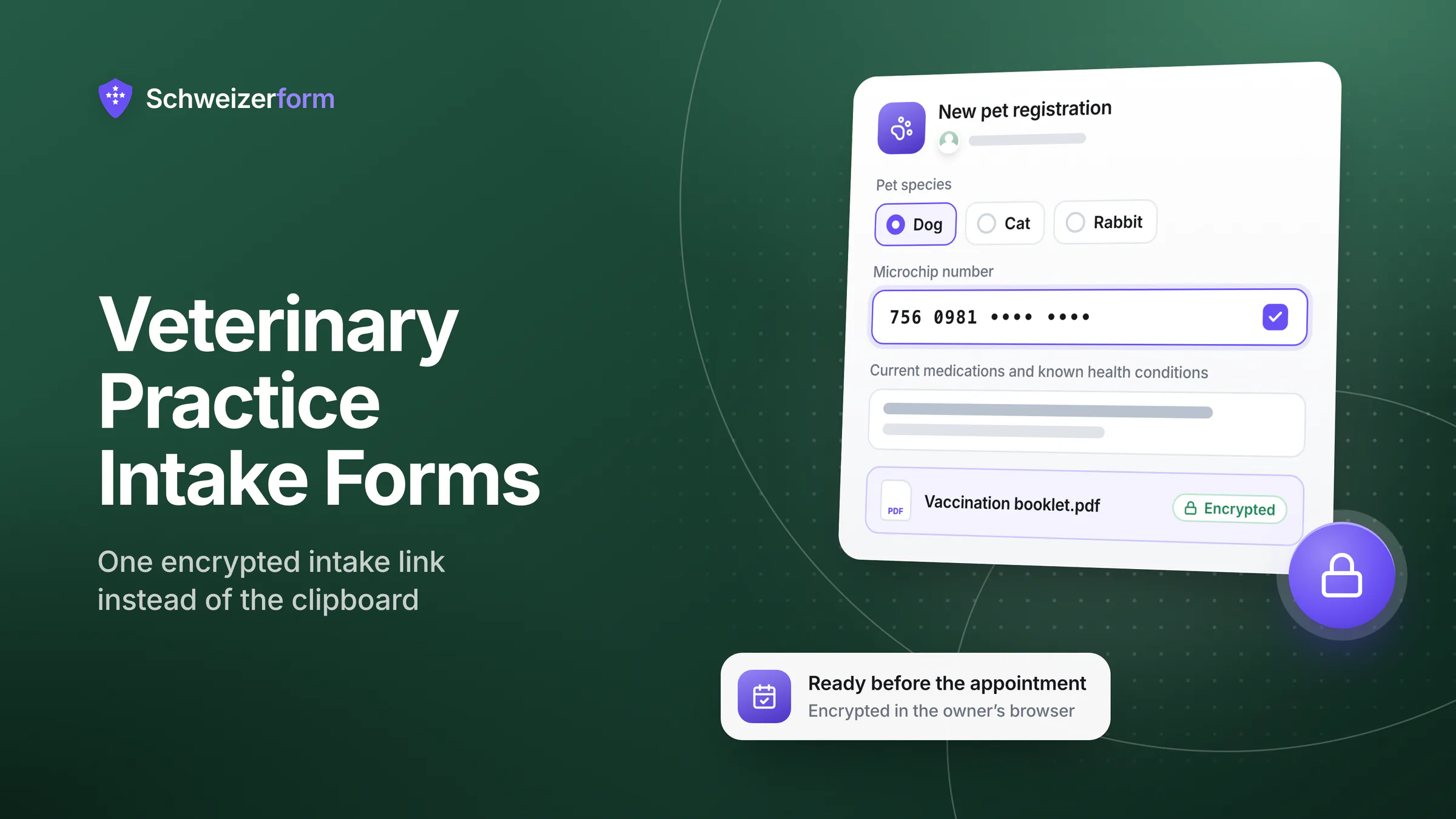
Veterinary practice is one of the more underestimated PII-handling sectors in healthcare. A typical small-animal clinic, equine practice, exotic animal hospital, or mixed rural practice routinely collects the full owner's identity (name, address, phone, email, sometimes employer or workplace), payment and bank details, pet microchip numbers (which are linked to the owner in national registries), full medical history of the animal, behavioural notes that often touch on the owner's home life and other household members, and high-stakes consent paperwork — anaesthesia, surgical, breeding, and end-of-life. The volume is real; the data-protection profile is treated as if it were not.
Schweizerform is built for exactly this kind of small but data-rich practice. Every submission is encrypted in the owner's browser before it leaves the device. We physically cannot read intake forms, surgical consents, behavioural questionnaires, or insurance claim packets. Hosting is in Switzerland, the four UI languages (EN / DE / FR / IT) are native — important in a country where pet owners speak every Swiss language plus several others — and retention can be set per form to match the realistic lifespan of each document type. This page is for vet practice owners and managers who already feel that the clipboard plus email PDF model is showing its age.
Who this page is for
Practice owners, principals, practice managers, head nurses, and IT consultants supporting small-animal, exotic, equine, mixed rural, referral specialty (oncology, ortho, derm, neuro), emergency, and large-animal veterinary practices — particularly in Switzerland and the EU, where veterinary professional secrecy (in Switzerland, Art. 321 of the Penal Code applies to veterinarians as well as physicians) sits alongside nFADP / GDPR obligations.
Why Veterinary Practices Have a Larger Data-Protection Profile Than Often Assumed
Veterinary data sits at the intersection of several categories that each carry serious protection obligations — and the volume across a typical practice book is far larger than most owners realise:
- Owner PII — full name, residential address, phone numbers, email, sometimes employer, ID for cross-border travel paperwork; the standard PII surface of any small business
- Payment data — IBAN for direct debit, card details for online payment, sometimes pet-insurance policy numbers tied to the owner's bank — financial data with all the obligations that come with it
- Microchip-linked identity — the chip number is a unique identifier resolvable to the owner via national pet registries (ANIS in CH, TASSO/IFTA in DE, I-CAD in FR, ANAGRAFE CANINA in IT); leaking a chip number with breed and address is meaningfully identifying
- Animal medical history — vaccinations, surgeries, current medications, allergies, prior diagnoses, lab results, imaging — clinical data covered by veterinary professional secrecy in jurisdictions where that exists
- Behavioural and household context — bite history, anxiety triggers, household composition (children, other pets), sometimes notes that touch on the owner's mental health or relationship status when relevant to the animal's care
- End-of-life and serious-procedure consent — euthanasia consents, do-not-resuscitate decisions, surgical consents — emotionally heavy paperwork that you must be able to retrieve cleanly years later if a dispute arises
- Insurance claims — full medical narrative plus owner financial details, sometimes routed to multiple insurers across the lifetime of the animal
Most vet practices today handle this through a clipboard at reception, an emailed PDF for new clients who book online, or a generic SaaS form embedded on the practice website. The first leaves illegible handwriting and slow front-desk turnover; the second copies the data across owner inbox, practice inbox, multiple staff laptops, and the practice management system; the third hands a readable copy of every word to a third-party form vendor. None of these are catastrophic on their own — but together, they describe a quietly accumulating compliance gap.
The professional-secrecy angle
Veterinarians sit just outside Art. 321 of the Swiss Penal Code: that provision names physicians, dentists, pharmacists, lawyers, clergy and a long list of health professionals — but not vets. The duty of discretion is no weaker in practice, it simply rests on the mandate relationship with the client, professional-conduct rules, and data protection law rather than on criminal secrecy. Across the EU, equivalent professional-conduct rules apply at member-state level, and animal medical data is unambiguously personal data of the owner under GDPR / nFADP because it can be linked back via microchip and address. A form tool that can read intake creates an analytical question you would prefer not to defend: have you preserved the secrecy expectation when a readable copy exists on a third-party server you do not control?
What Changes With Zero-Knowledge Intake in a Vet Practice
The technical shift is simple. Owner and patient form data is encrypted in the owner's browser before transmission and sealed in a vault only the practice can open. The server stores ciphertext. Only the practice — using the practice's vault key — can open the vault and decrypt the submission. The vault key never touches our servers, so the form provider becomes a courier of unreadable data, not a custodian of owner PII, payment details, or animal medical history.
- 1
Owner fills in the intake form before the appointment
The owner opens a secure link (sent with the appointment confirmation by email or SMS, or shown on the practice website), completes the structured form for their pet, uploads the previous vet's records, vaccination booklet, or insurance card. Everything is encrypted in their browser before transmission.
- 2
Transmission and storage
The sealed submission travels over HTTPS and rests in a Swiss data centre. The server stores ciphertext only — no plain-text copy of any owner identity, payment data, or animal medical record exists anywhere on our infrastructure.
- 3
Practice retrieves the submission at the consult
The treating veterinarian, head nurse, or front-desk staff opens the submission in their browser before or during the appointment. The practice's vault key opens the vault and decrypts the data on the device. Reading and entry into the practice management system happen practice-side.
- 4
Treatment, retention, deletion
Once the data is in the practice management system (PMS), the form-side submission can be retained for the time you've configured (typically a defined window after case closure for source-document reconciliation) and then deleted. Holding no key, we leave nothing recoverable once the practice deletes a record.
The waiting-room speed advantage
Owners who fill the intake at home arrive ready. The vet sees the medical history, current medications, and behavioural notes before the consultation starts — fewer minutes spent at the desk transcribing handwriting, faster start to the actual examination, and significantly less stress for the animal who would otherwise be waiting in a noisy reception. Practices report a measurable reduction in waiting-room time per new patient.
Where Vet Practices Use Schweizerform
New patient (pet) intake
The flagship use. A structured form covers owner details, contact, pet details (species, breed, age, sex, neuter status, microchip), prior vet contact, vaccination status, current medications, known allergies, behavioural notes, insurance details, and preferred communication method. Sent before the first appointment; arrives encrypted; opens in the practice's browser at consult.
Pre-visit medical history updates
Recurring annual or semi-annual update questionnaires keep the medical history current without requiring a paper update at every visit (any new diagnoses since last visit? change in medications? new symptoms? change in living situation?). Owners fill in 90 seconds before arriving; the vet reviews while the nurse weighs the animal.
Surgical and anaesthesia consent
Surgical consents, anaesthesia disclosures, dental procedure approvals, sterilisation consents — paperwork that is legally meaningful and historically lived in the practice's filing cabinet. Encrypted digital consent gives a tamper-evident, time-stamped, retrievable record without exposing the owner's signature and pet's clinical context to a SaaS provider. Particularly valuable for high-cost or complications-prone procedures.
End-of-life and euthanasia consent
Euthanasia consent is among the most emotionally weighted paperwork the practice handles, and disputes — though rare — are particularly painful when they happen. A clean, time-stamped, encrypted record (typically completed in the consult room or sent home with the owner before the procedure) gives the practice defensible documentation without forcing the owner to fill out a form on a public-facing reception clipboard during one of the worst days of their pet-owning life.
Behavioural questionnaires
Behavioural intake (for aggression workups, anxiety treatment, behavioural medicine consults) often touches sensitive household context: who lives in the home, presence of children, prior bite incidents, the owner's own emotional response to the animal's behaviour. This is not standard small-talk material; the encrypted channel matches the discretion the case calls for.
Insurance claims intake
Pet insurance claims combine full medical narrative with owner financial details and routing to one or more insurers. A structured intake form on the practice side captures the claim cleanly; the practice then forwards what the insurer needs through normal channels, with the form-side copy retained per the practice's documented retention policy.
Boarding, kennel, and daycare intake
Boarding and daycare intake collects emergency contact information, authorisation for treatment in the owner's absence, dietary and medical requirements, and behavioural notes. The form is short; the data is sensitive (an unattended animal in the practice's care is a high-stakes responsibility). Encrypted intake removes the "sticky note in the kennel office" risk.
Referral case workups
Specialist referral practices (oncology, orthopaedic, dermatology, neurology, soft-tissue surgery) receive workups from primary-care vets and case histories from owners. A structured referral form captures both sides cleanly, with file uploads for prior imaging, lab results, and operative notes — all encrypted from the moment of submission.
Equine and large-animal field-call requests
Mobile equine and large-animal practices receive field-call requests that include owner location, paddock access details, herd information, suspected condition, urgency, and sometimes prior treatment notes. A structured intake captured on the owner's phone is faster than a phone call and produces a record that is searchable and retrievable when the same yard calls again next month.
What Owners, Regulators, and Insurers Actually See
Three audiences notice the difference between paper / email PDF / generic SaaS intake and a zero-knowledge intake form: the owners who hand over their identity, payment, and pet's medical history; the cantonal or national data-protection authority that supervises the practice; and the cyber- or professional-liability insurance underwriter that assesses the practice's risk profile.
| Perspective | Paper / email PDF / generic SaaS | Schweizerform |
|---|---|---|
| Owner submitting intake and consent | "This goes on a clipboard or to a server somewhere — I'm told it's safe" | "The practice's form encrypts my data in my browser; only the practice can read it" |
| Cantonal / national DPA | Has to assess clipboards, mailboxes, and the form provider's full readable copy | Provider holds no readable copy — analysis collapses to the practice's own systems |
| Cyber- or professional-liability insurance underwriter | Standard SaaS / paper risk profile (plain-text owner PII, payment, and clinical data) | Materially reduced breach-impact profile for intake-tier records |
| Practice's professional-conduct lens (mandate, professional rules) | Readable third-party copy or proliferating paper complicates the secrecy analysis | No readable third-party copy — analysis is cleaner |
Features That Matter for Veterinary Practices
- End-to-end encryption on every form — owner PII, payment data, and animal medical history protected by default, no paid upgrade required
- Swiss hosting in Swiss data centres — direct answer to where owner financial and pet medical data lives
- Encrypted file uploads — covers vaccination booklets, prior records, imaging, insurance cards, ID for cross-border pet travel paperwork
- Native EN / DE / FR / IT — every label, error, and confirmation in the owner's language; matters in DACH and Swiss-French/Italian regions where pet owners cross language regions regularly
- Mobile-first owner experience — most owners fill the form on their phone, often while waiting for the practice to confirm an appointment
- Multiple administrators with role-scoped access — front-desk staff see appointment-relevant submissions; clinical staff see clinical content; the practice owner sees everything
- Audit logging of administrator actions and submission access — documentation for DPA inquiries and for insurance audits
- Defined retention per form — set source-document retention windows aligned to the practice's SOP and the realistic lifespan of each document type
- No third-party trackers on public forms — the owner's browser is not pinging marketing analytics with their pet's medical history
What veterinary practices ask
"We're a small practice — this is overkill"
Veterinary data protection is not proportional to practice size. A solo vet collecting owner IBANs, microchip numbers, and full pet medical histories holds the same kind of data as a multi-clinic group, just at lower volume. The compliance posture should match the data, not the staff count. The free tier of Schweizerform is sized for exactly this kind of practice, and even paid tiers are typically a few CHF per month for a small clinic.
"Older owners will not use online forms"
Some won't, and they should not have to — keep paper as a documented fallback at reception. The benefit is in the 70 to 90 percent of owners who do fill in online intake, the time saved at the desk, and the protection given to those submissions. A blended workflow with digital as default and paper as fallback is the standard pattern; the mistake is treating the minority as the default.
"Our practice management system already collects this data"
Most veterinary PMS products were designed for the consult-room workflow — appointment booking, dispensing, billing, clinical notes — not for cryptographically protected first-touch intake. They typically encrypt in transit and at rest, but the PMS vendor still holds a readable copy of every owner and patient record. Schweizerform is a specialised intake layer that can sit in front of any vet PMS — encrypted intake, then standard transcription or export into the practice's system of record.
"What if we lose the key to the vault?"
This is the honest trade-off of genuine zero-knowledge security: the vault key never touches our servers, so we never see it and cannot reset it. Lose the vault key and the recovery code and even we cannot open the vault — that is precisely what makes Schweizerform truly end-to-end encrypted. We support a recovery-key flow: a second key set up in advance and stored separately (typically a printed copy in the practice safe). Most practices treat the vault key the same way they treat the controlled-drug cabinet key — formal procedure, two trusted custodians (e.g. principal and practice manager), regular review.
"What about insurance claim integrations?"
Insurance claim workflows happen practice-side after decryption. Authorised staff decrypt the claim packet in the browser, extract what the insurer requires, and submit through normal channels (insurer portal, secure email, or whatever the insurer specifies). The point of the zero-knowledge layer is that the form vendor never sees the full medical narrative or owner banking; once decrypted on the practice side, the data flows like any other input.
"We do home visits and rural calls — what about offline use?"
Brief connectivity gaps are absorbed by the local form (data submits when the connection returns). For genuine field practice with no reception, owners can fill the form before the visit on their own connection, or the practice can switch to its documented paper fallback for those calls. The hybrid posture is the right answer; an all-or-nothing rejection of digital intake is not.
Getting Started in a Veterinary Practice
- 1
Pilot with the new patient intake form
The most common starting point. The free tier (3 forms, 100 submissions/month) is enough for a single-vet practice's pilot, or a controlled rollout in a multi-vet clinic. Send the form link from your existing appointment-confirmation email or SMS for new clients only.
- 2
Build the intake to match the current paper form
Replicate your existing new-patient questionnaire field-by-field. Use page breaks so it does not arrive as one long scroll, and a conditional rule on species so an equine owner is not asked feline questions. Keep genuinely different contexts as their own forms — end-of-life consent especially: that belongs in a separate, deliberate send, not behind a rule on a routine intake. Add file upload for vaccination booklets and prior records. Translate to the languages your client base actually speaks (the platform ships native EN / DE / FR / IT).
- 3
Set up the Vault Key and recovery key
Two custodians, written procedure, recovery key stored separately (the practice safe is a common choice). About 15 minutes for a small practice. This is what makes the encryption real — without it, the zero-knowledge property is theoretical.
- 4
Document the processor relationship
Add Schweizerform to your record of processing activities. Note the Swiss storage, the absence of provider read access, and that no US sub-processor is involved. For DPOs and external compliance consultants, this typically simplifies the analysis compared to US-hosted intake tools.
- 5
Define retention per form
Once data has been transferred to the PMS, the form-side submission rarely needs to live forever. A 30 to 90-day form-side retention plus permanent storage in the PMS is a clean pattern for routine intake; longer windows for surgical and end-of-life consents per practice SOP.
- 6
Add forms over time
Once the new-patient intake is steady, add pre-visit history updates, surgical consents, behavioural questionnaires, insurance-claim intake, boarding intake, and referral workups as they come up for review. Most practices reach a fully digital intake surface within three to six months without big-bang disruption.
Owner data, patient records, and what to do first
Veterinary practices handle full owner identity, payment data, microchip-linked patient records, animal medical history covered by professional secrecy, and emotionally weighted consent paperwork — every day, at small-practice volumes that are still meaningful in compliance terms. The historical defaults of clipboard, email PDF, and generic SaaS form leave a quietly accumulating exposure that is fine until a regulator, an insurer, or a disputed end-of-life case asks the obvious question.
Schweizerform offers a direct answer at the intake layer: zero-knowledge end-to-end encryption on every form, Swiss hosting, native four-language support, encrypted file uploads sized for the documents vet practices actually exchange, and retention configurable per form. The practice management system remains the system of record for clinical and financial data; the intake layer becomes something the practice owner can defend cleanly to the cantonal authority, the insurer, and the owner who entrusted the practice with their pet's medical record and their own banking details.
Start with a single new-patient intake form on the free plan — encrypted submissions stored in Switzerland, zero-knowledge encryption, native EN / DE / FR / IT — and replace the next clipboard at reception with an encrypted intake link.
Disclaimer: This page is general information and marketing content, not veterinary, regulatory, legal, or compliance advice. References to nFADP, GDPR, Art. 321 of the Swiss Penal Code, microchip registries, veterinary professional-conduct frameworks, and pet-insurance practice are summarised at a conceptual level and subject to jurisdictional interpretation. Responsibility for owner- and patient-data protection remains with the practice. Consult a qualified data-protection or veterinary-law specialist in your jurisdiction before relying on any summary here for compliance or procurement decisions.