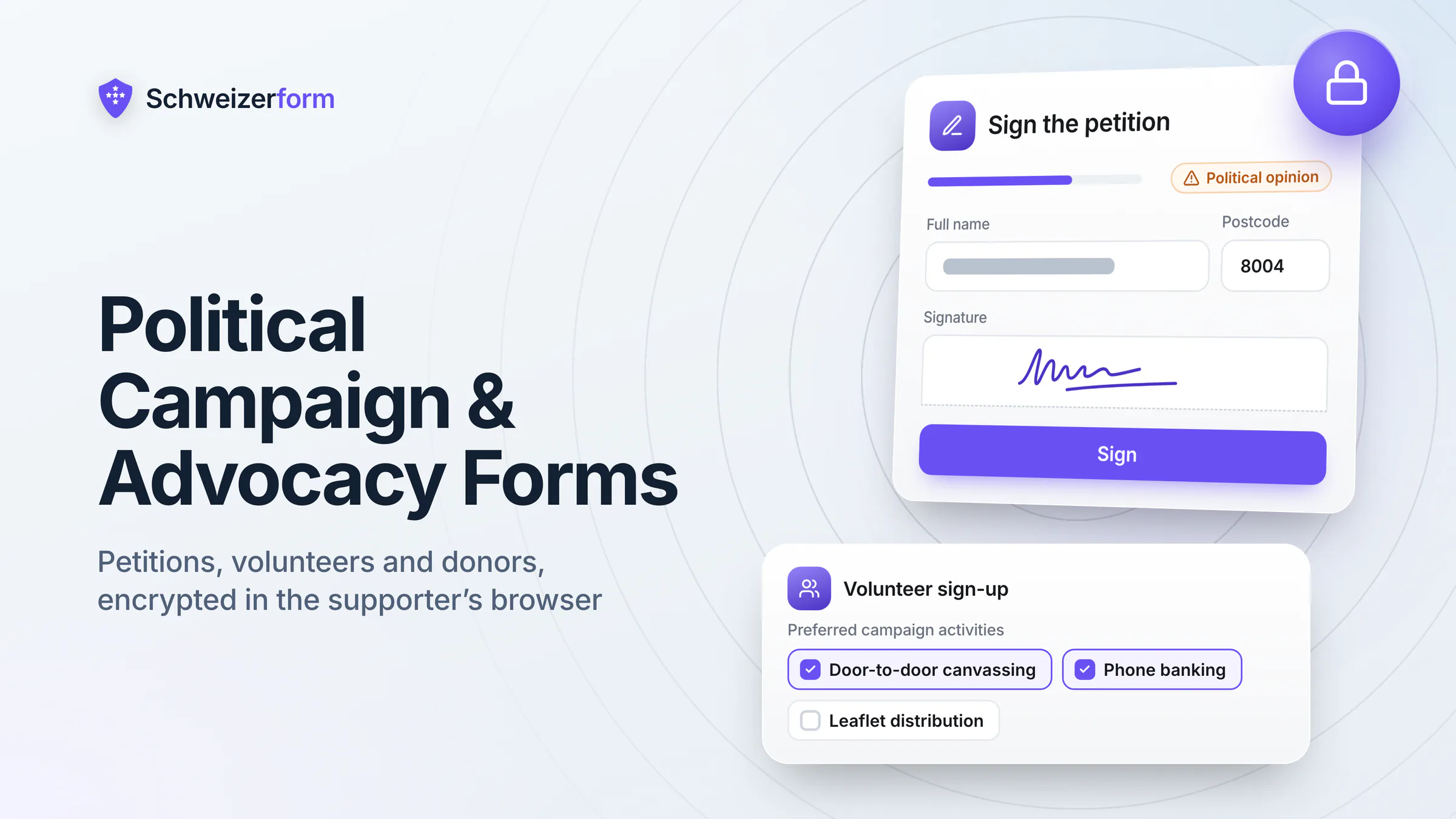
Political campaigns, parties, advocacy organisations, and constituent-service offices handle a category of personal data with one defining characteristic: a leak has real-world consequences for the people who shared it. Donors with employer-required disclosure may face workplace pressure; volunteers for controversial causes can face harassment campaigns; petition signatures have been weaponised historically to target signers; constituents who seek help with sensitive matters (immigration, benefits, family disputes) hand over information they would never put in a public channel. The data is, by GDPR's own definition, special-category — political opinions sit in Article 9 alongside health and ethnic origin.
Schweizerform was built for channels exactly like these. Every submission is encrypted in the supporter's browser before it leaves the device. We physically cannot read donation forms, volunteer signups, petition signatures, constituent service requests, or campaign integrity reports. Hosting is in Switzerland, the four UI languages (EN / DE / FR / IT) are native — essential for Swiss federal politics, multilingual cantons, and European advocacy operating across language regions — and retention can be set to age out cleanly when the campaign closes or the petition window expires. This page is for campaign managers, party operations leads, and advocacy directors who already know that the standard SaaS form is a poor match for the data they handle.
Who this page is for
Campaign managers, party operations and membership leads, advocacy and NGO directors, parliamentary and constituent-service offices, ballot-initiative committees, referendum campaigns, single-issue advocacy groups, political fundraising directors, and digital strategists supporting any of the above — particularly in Switzerland and the EU, where political opinion is unambiguously special-category personal data under GDPR Art. 9 and nFADP Art. 5, and where party-finance and disclosure rules vary by canton, member state, and election type.
Why Political and Advocacy Work Has an Outsized Data-Protection Profile
Political and advocacy data sits at the intersection of several categories that each carry serious obligations — and a fourth dimension (real-world retaliation risk for the people behind the data) that ordinary commercial intake does not face:
- Political opinion as special-category data — under GDPR Art. 9 and nFADP Art. 5, political views, party affiliation, trade-union membership, and similar are explicitly elevated; processing requires a stronger legal basis and tighter safeguards than ordinary personal data
- Donor data — name, address, employer, occupation (often required by party-finance disclosure), donation amount, payment details; in some jurisdictions, disclosure thresholds make small donors private and large donors public, but the practical implementation often leaks both
- Volunteer and member data — full contact, availability, skills, sometimes prior political involvement, sometimes ID for membership verification; the population of volunteers for any cause is, by definition, a target list for opposition research
- Petition signatures — name, address, sometimes signature image; petition data has been weaponised historically (notable cases include leaks targeting signers of LGBTQ+ ballot initiatives in the US, abortion-rights petitions in restrictive jurisdictions, anti-corruption petitions in authoritarian states)
- Constituent service requests — sensitive personal matters routed to a parliamentarian or party office (immigration, benefits, family disputes, housing emergencies); the office is informally trusted with information that would never go through a public channel
- Campaign integrity and harassment reports — internal channels for staff, volunteers, or candidates to report ethics concerns, financial irregularities, or harassment; structurally similar to whistleblower channels and inheriting the same protection requirements
- Foreign interference exposure — political data sets are high-value targets for foreign intelligence services, opposition campaigns, and well-resourced adversaries; the threat model is not theoretical
Most political and advocacy organisations today handle this through generic SaaS form tools (Google Forms, Typeform, JotForm) embedded on the campaign website, or through dedicated political-tech CRMs that store everything in plain text on US-headquartered cloud infrastructure. Both expose every donor's employer, every volunteer's contact, every petition signer's name, and every constituent's plea to the form vendor's full readable copy. For a category of data where leaks have named victims, that is a wider exposure surface than most campaign managers would defend in a post-mortem.
The Article 9 angle
GDPR Art. 9 (and nFADP Art. 5) explicitly elevates political opinion to special-category personal data — alongside health, ethnic origin, religious belief, and trade-union membership. The legal bar for processing is higher, the documentation burden is heavier, and the breach notification stakes are larger. A standard SaaS form that processes Article 9 data with the same posture as a marketing newsletter is a defensible analytical position only if you have never had to defend it.
What Changes With Zero-Knowledge Intake in a Campaign or Advocacy Org
The technical shift is simple. Donor, volunteer, signer, and constituent data is encrypted in the supporter's browser before transmission and sealed in a vault only the campaign can open. The server stores ciphertext. Only the campaign — using the campaign's vault key — can open the vault and decrypt the submission. The vault key never touches our servers, so the form provider becomes a courier of unreadable data, not a custodian of donor employers, volunteer contacts, petition signatures, or constituent pleas.
- 1
Supporter opens the secure form link
A donor, volunteer, petition signer, or constituent reaches a campaign form (linked from the campaign website, social media, candidate communications, or a constituent service letter). They fill in the structured form. Everything is encrypted in their browser before transmission.
- 2
Transmission and storage
What travels is ciphertext, and it stops on Swiss infrastructure. The server stores ciphertext only — no plain-text copy of any donor's employer, volunteer's address, signer's name, or constituent's request exists anywhere on our infrastructure.
- 3
Campaign team retrieves and processes submissions
Authorised staff open submissions in their browser. The campaign's vault key opens the vault and decrypts the data on the device. Donations are reconciled with the payment processor; volunteers are matched to opportunities; petition signatures are tallied; constituent requests are routed to the right caseworker — all starting from data the form provider could not read at rest.
- 4
Campaign close, retention, deletion
When the campaign closes, the petition window expires, or the disclosure obligation is fulfilled, the form-side submission can be deleted on a defined schedule. With no key on our side, deleting a supporter record leaves nothing recoverable behind it. The campaign's CRM or system of record retains what it must under party-finance, disclosure, and election rules; the intake layer ages out cleanly.
The supporter-trust advantage
Supporters — particularly those donating publicly to controversial causes, signing high-profile petitions, or volunteering for stigmatised campaigns — are more likely to engage when the channel visibly protects them. A form that encrypts in the browser before submission, hosted under recognisable jurisdiction, is a measurable trust signal in a sector where supporter confidence is the entire conversion funnel.
Where Campaigns and Advocacy Organisations Use Schweizerform
Donation forms with disclosure capture
The flagship use. A structured donation form captures donor details, employer and occupation where required by party-finance law, donation amount, payment routing, and consent for ongoing communications. The campaign reconciles the donation with the payment processor (Stripe, etc.) on the campaign side, with the form vendor never seeing the donor's employer or address in plain text.
Volunteer signup with skill matching
Volunteer intake captures contact, availability, languages, skills (canvassing, phone banking, data entry, IT, legal, design), prior involvement, and any background-check consent the role requires. Keep the signup short — either by sending the role-specific follow-up as its own form, or with a conditional rule that reveals the canvassing or legal-volunteer questions only to the people who picked that role. A volunteer who never sees those questions leaves no answer to them: answers to conditionally hidden questions are stripped before the submission is encrypted. The campaign matches volunteers to opportunities; the form vendor never sees who volunteered for what.
Petition signature collection
Petition forms capture name, address, citizenship or residency status (where required for the petition's legal weight), signature, and consent for follow-up. The campaign uses the data for verification and submission to the relevant authority; the form vendor sees only ciphertext. For petitions on controversial issues, this is not theoretical privacy — it is the protection that decides whether marginalised supporters sign at all.
Constituent service request intake
Parliamentary offices, councillors, and party constituency teams receive requests for help on immigration, benefits, housing emergencies, family disputes, and other sensitive matters. The intake form captures the constituent's contact, situation, and consent for follow-up; encrypted intake means the office can route the case to the right caseworker without the form vendor reading the constituent's circumstances.
Party member intake and dues
New-member applications, membership renewals, and dues collection capture the same kind of identity and payment data as a small business — plus party affiliation as Article 9 special-category data. A unified encrypted intake form replaces the email PDF and clipboard processes most local party branches still use.
Event RSVP for closed-door or sensitive gatherings
Closed-door donor briefings, candidate strategy sessions, member-only meetings, and similar events generate a guest list that is itself sensitive. An encrypted RSVP form gives the campaign a clean attendance record without exposing the participant list to the SaaS form vendor.
Campaign integrity and harassment reports
Internal channels for staff, volunteers, candidates, or members to report ethics concerns, financial irregularities, harassment, or policy violations. The structural and protection requirements mirror corporate whistleblower channels (cf. EU Directive 2019/1937 in scope where applicable). Encryption that the campaign vendor cannot read is the appropriate posture.
Endorsement and coalition partner intake
When campaigns gather endorsements from public figures, civic organisations, or coalition partners, the intake captures the endorser's identity, the scope of the endorsement, and any conditions attached. For endorsements that carry political risk for the endorser, an encrypted intake channel matches the discretion the relationship calls for.
What Supporters, Regulators, and Auditors Actually See
Three audiences notice the difference between a generic SaaS form and a zero-knowledge intake form: the supporters who hand over their identity, beliefs, and payment data; the data-protection or election authority that supervises the campaign; and the internal compliance or external auditor who tests the campaign's processes against party-finance and election rules.
| Perspective | Generic SaaS / political-tech form | Schweizerform |
|---|---|---|
| Donor / volunteer / petition signer / constituent | "This goes to a server somewhere — I'm trusting the campaign with my employer, address, or political view" | "The form encrypts my submission in my browser; only the campaign can read it" |
| Cantonal / national DPA, election commission | Has to assess the form provider's full readable copy, sub-processor chain, cross-border transfer mechanism | Provider holds no readable copy — analysis collapses to the campaign's own systems and DPA |
| Internal compliance / party-finance auditor | Standard SaaS exposure footprint plus an additional processor in scope for special-category data | Materially reduced exposure footprint; encryption posture documentable in the campaign's processor register |
| Supporter exercising data subject rights (GDPR Art. 15 / 17) | Campaign must trace each copy across vendor and any sub-processors | Single deletion at the form-side store; campaign's CRM remains the system of record per disclosure rules |
Features That Matter for Political and Advocacy Organisations
- End-to-end encryption on every form — Article 9 special-category data and donor disclosure protected by default, no paid upgrade required
- Swiss hosting in Swiss data centres — direct answer to where political-opinion data lives, particularly important for foreign-interference threat modelling
- Encrypted file uploads — covers ID for petition verification, signed pledge cards, candidate documentation, endorsement letters
- Native EN / DE / FR / IT — every label, error, and confirmation in the supporter's language; essential for Swiss federal politics, multilingual cantons (BE, FR, GR, VS), and EU advocacy operating across languages
- Defined retention per form — set retention to expire at campaign close, petition deadline, or election certification; the system enforces what the SOP states
- Audit logging of administrator actions and submission access — documentation for DPA inquiries, election-commission audits, and internal post-mortem
- Multiple administrators with role-scoped access — separate donor data from volunteer data from constituent service requests, each visible only to the relevant team
- Mobile-first supporter experience — most supporter conversions happen on phones, often immediately after a candidate appearance, social-media post, or canvassing conversation
- No third-party trackers on public forms — the supporter's browser is not pinging marketing analytics with their political opinion, donation amount, or petition signature
What campaign teams ask
"Our political-tech CRM already handles this"
Most political-tech CRMs (NationBuilder, NGP VAN, Action Network, ECanvasser, etc.) are systems of record for the campaign's relationship management, not zero-knowledge intake layers. They typically encrypt in transit and at rest, but the vendor still holds a readable copy of every donor employer, volunteer contact, and petition signer. Schweizerform is a specialised intake layer that can sit in front of any CRM — encrypted intake, then export of the campaign-side decrypted record into the system of record.
"Disclosure rules require us to publish donor data anyway"
Disclosure rules typically require publication above defined thresholds (varies by jurisdiction and election type). Below those thresholds, donor data is private and subject to standard data-protection rules; above them, only the disclosed fields are public — not the donor's full address, payment details, or routing information. Encrypted intake gives you a single defensible store; you decrypt and publish what disclosure requires, and protect the rest. The disclosure obligation does not require the form vendor to be able to read the entire donor record.
"What if the key is lost during a campaign?"
This is the honest trade-off of genuine zero-knowledge security: the vault key never touches our servers, so we never see it and cannot reset it. Lose the vault key and the recovery code and even we cannot open the vault — which is exactly the property that lets you promise supporters that no one but the campaign can read their submissions. We support a recovery-key flow: a second key set up in advance and stored separately (typically with the campaign treasurer or split between the campaign manager and a senior officer). Most campaigns treat the vault key with the same procedural rigour as the campaign bank account credentials — formal procedure, two trusted custodians, regular review, and a planned hand-off when the campaign closes.
"Will the form slow down conversion?"
It does not, in measurable practice. Encryption happens in the browser during submission, in well under a second. Donors, volunteers, and signers see a clean, structured form, fill it in, and submit. The supporter-trust signal of visible encryption (especially on controversial-cause forms) tends to improve conversion rather than depress it.
"What about Stripe and payment processing?"
Donation forms can integrate with Stripe in the standard way — the payment-processor flow happens directly between the supporter and Stripe (the form vendor never sees the card data), and the donation metadata is captured in the encrypted submission. Reconciliation between Stripe and the encrypted submission happens campaign-side after decryption, exactly like in any other payment-form workflow.
"Our supporters are activists — they expect everything to work on their phones"
The forms are mobile-first by design. Donors can complete a donation on a phone in under a minute; volunteers can sign up in even less; petition signers can complete the form during a single street-conversation. Mobile experience is not the trade-off; the trade-off (such as it is) is the discipline of campaign staff to set up the vault key and recovery key properly at the start.
Getting Started in a Campaign or Advocacy Organisation
- 1
Pilot with the highest-stakes form
Pick the single form where a leak would do the most damage — typically the donation form (with employer disclosure) or the petition form (for a controversial cause). The free tier (3 forms, 100 submissions/month) is enough for a small pilot or a low-volume petition; paid plans cover production campaign volumes.
- 2
Build the form to capture exactly what is needed
Replicate your current intake fields. The ones that only apply to some supporters can either sit behind a conditional rule or move to a separate short form — for a campaign collecting under a disclosure threshold, keeping them off the main form entirely is the safer default. Add file upload for petition ID where required. Translate to the languages your supporters actually speak (the platform ships native EN / DE / FR / IT — essential in multilingual Swiss cantons and across EU advocacy).
- 3
Set up the vault key and recovery key
Two custodians (typically the campaign manager and the treasurer), written procedure, recovery key stored separately. About 15 minutes of setup; then it lives alongside the other campaign credentials. Plan the hand-off for when the campaign closes or staff change.
- 4
Define retention to match the campaign lifecycle
Set form-side retention to age out at campaign close, petition deadline, or election certification (whichever applies). The CRM holds what disclosure rules require; the intake layer ages out cleanly per cryptographically final deletion.
- 5
Document the processor relationship
Add Schweizerform to your record of processing activities. Document the Swiss storage, the provider's lack of read access, and the absence of US sub-processors. For DPOs, party-finance auditors, and election commissions, this typically simplifies the analysis compared to US-hosted political-tech tools.
- 6
Roll out across additional channels
Once the pilot form is stable, add volunteer signup, constituent intake, member dues, event RSVPs, and integrity reports as they come up. Most campaigns reach a fully digital intake surface within the first few weeks of an active cycle; advocacy organisations typically migrate over one to two quarters.
Campaign data you can defend after the election
Political and advocacy organisations handle a category of personal data — political opinions, donor disclosure, volunteer commitments, petition signatures, constituent pleas — where leaks have named victims. The standard practice of running everything through generic SaaS forms or US-hosted political-tech CRMs leaves a readable copy at every stage, and treats Article 9 special-category data with the same posture as a marketing newsletter. That gap is fine until it is not — and when it is not, the consequences land on the supporters who trusted the channel.
Schweizerform offers a direct answer at the intake layer: zero-knowledge end-to-end encryption on every form, Swiss hosting, native four-language support, encrypted file uploads sized for the documents campaigns actually exchange, and retention configurable to age out cleanly at campaign close or petition deadline. The campaign CRM remains the system of record for what disclosure and election rules require. The intake layer becomes something the campaign manager can defend cleanly — to the data-protection authority, the election commission, and the supporters who depend on the channel.
Start with the highest-stakes form on the free plan — encrypted submissions stored in Switzerland, zero-knowledge encryption, native EN / DE / FR / IT — and replace the next donation, volunteer, or petition page with an encrypted intake link before the next campaign cycle.
Disclaimer: This page is general information and marketing content, not legal, election-law, party-finance, or compliance advice. References to GDPR Art. 9, nFADP Art. 5, EU Directive 2019/1937 (whistleblower protection), party-finance disclosure thresholds, and election authorities are summarised at a conceptual level and subject to jurisdictional interpretation. Responsibility for political and donor-data protection remains with the campaign or organisation. Consult a qualified election-law, party-finance, or data-protection specialist in your jurisdiction before relying on any summary here for compliance, disclosure, or procurement decisions.