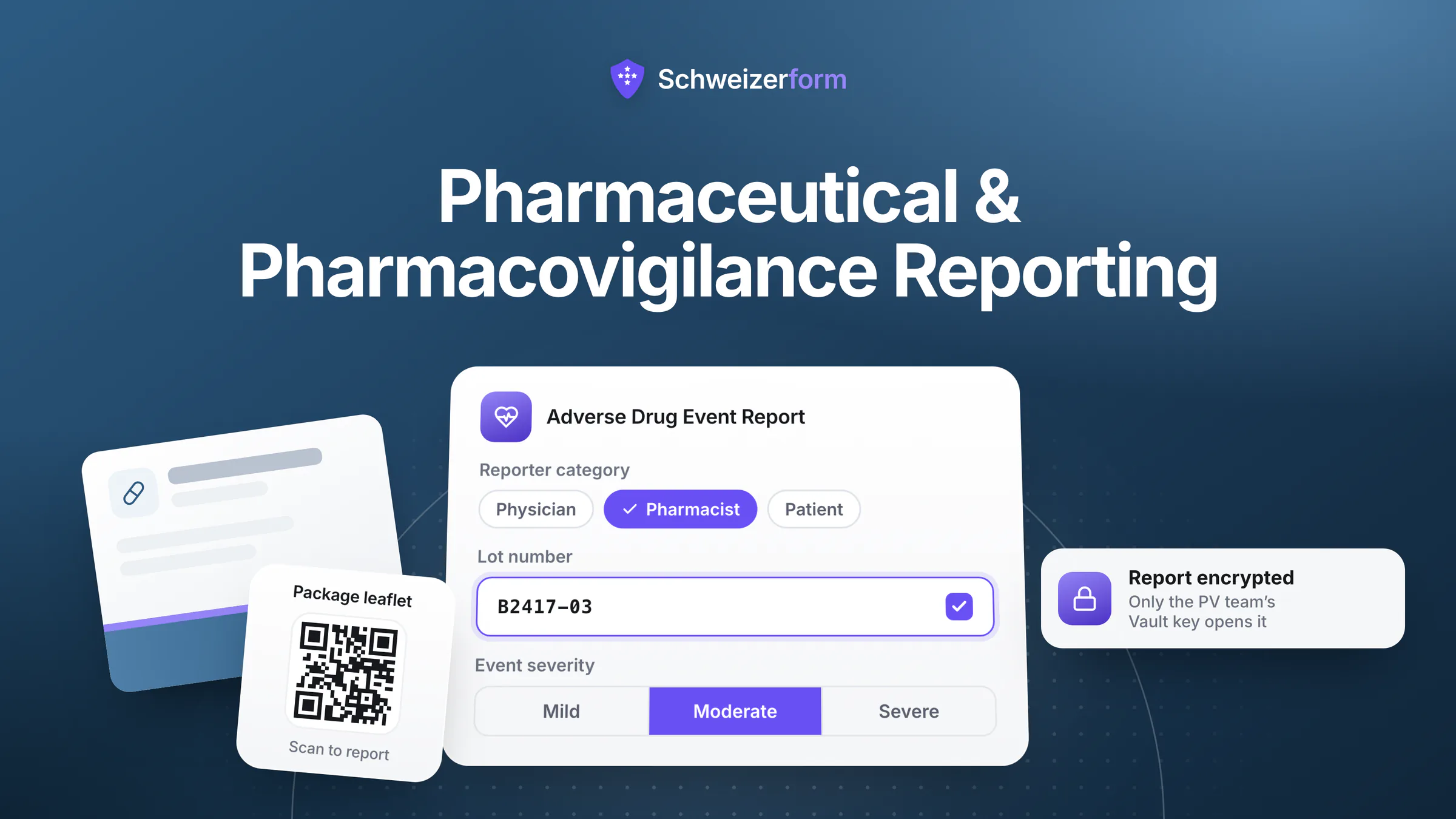
A pharmacovigilance team — whether at a Marketing Authorisation Holder (MAH), a distributor, a generics manufacturer, a contract research organisation, or a specialised PV service provider — processes some of the most regulated and most personally identifying data of any industry. A single adverse event report can contain a patient's age, sex, weight, full medication list, comorbidities, indication, the verbatim description of what went wrong, the reporter's identity (often a healthcare professional), the brand and batch of the suspect product, and the reporter's contact details for follow-up. The data is, by regulation, highly identifying — and the obligation to retain it stretches well beyond a typical product lifecycle.
Schweizerform was built for exactly this kind of channel. Every submission is encrypted in the reporter's browser before it leaves the device. We physically cannot read adverse event reports, product quality complaints, medical information requests, or patient support program safety triggers. Hosting is in Switzerland, the four UI languages (EN / DE / FR / IT) are native — which matters for European MAHs that operate across language regions and for direct patient reporting in the patient's actual language — and retention can be set per form to match GVP / Swissmedic / equivalent obligation windows. This page is for PV leads and quality teams already aware that the standard "web form for AE reporting" leaves more exposure on the table than most QPPVs would defend out loud.
Who this page is for
Qualified Persons for Pharmacovigilance (QPPV / EU-QPPV / national-equivalent), Heads of Drug Safety, PV operations leads, Medical Information teams, Quality Assurance and Complaints teams, Patient Support Program managers, Medical Affairs, and CRO / PV-vendor leads — particularly in Switzerland and the EU, where the combination of GVP, GDPR, nFADP, and country-specific pharmacovigilance ordinances makes the data-protection question in PV channels unusually load-bearing.
Why Pharmacovigilance Has an Outsized Data-Protection Profile
PV data sits at the intersection of multiple regimes that each carry strict, sometimes conflicting, expectations:
- Patient health data — age, sex, weight, indication, full medication list, comorbidities, verbatim reaction description; even pseudonymised cases are often re-identifiable from context (rare disease, paediatric case, named hospital)
- Reporter identity data — the HCP's name, profession, institution, contact for follow-up; sometimes a competitor-product report from a hospital pharmacist who would prefer not to be visible to the MAH's commercial team
- Direct patient-reported outcomes — patient name, DOB, contact, narrative — increasingly common with patient-direct reporting and patient support programs
- Reporter-as-whistleblower scenarios — off-label use observations, suspected serious AE patterns, quality concerns reported by an HCP outside their institution's official channel
- Long retention obligations — GVP and most national PV regulations require retention for the entire authorised lifetime of the product plus 10 years (or longer); the data outlives most other corporate records
- Multi-stakeholder access — internal PV ops, QA, regulatory, sometimes outsourced case-processing CROs, sometimes the global parent's PV database; every additional party multiplies the controllership question
- Cross-border transfers — global PV databases (often US-headquartered) pull EU/Swiss-collected data into broader regulatory regimes, requiring explicit safeguards under GDPR Chapter V
Most online AE-reporting forms today run on conventional SaaS form tools or on the MAH's web infrastructure with standard at-rest encryption. The provider — whether a generic form vendor or the MAH's web team — can read every word of every submission. So can their staff, their integration partners, anyone who compromises their infrastructure, and any authority that serves a lawful order. For a regulated PV channel, that is a wider exposure surface than the formal data-flow mapping usually shows.
The reporter-trust angle
Reporters — particularly HCPs reporting AEs from competitor products, pharmacists noting quality concerns, or patients describing serious reactions — are more likely to file a complete report when the channel feels confidential. A form that visibly encrypts in the browser before submission, hosted under recognisable jurisdiction, is a measurable trust signal. This is not just compliance theatre — it has a documented effect on report completeness and willingness to re-report.
What Changes With Zero-Knowledge Intake in a PV Channel
The technical shift is simple. Reporter data — patient details, reaction narrative, suspect product information, reporter identity — is encrypted in the reporter's browser before transmission and lands in a vault only the PV team can open. The server stores ciphertext. Only the PV team — using the team's vault key, which never touches our servers — can open the vault and read the submission. The form provider becomes a courier of unreadable data, not a custodian of patient health information or reporter identity.
- 1
Reporter opens the secure intake link
A patient, HCP, pharmacist, or other reporter reaches the MAH's AE reporting page (linked from the product website, package leaflet QR code, medical information line, or PSP communication). They fill in the structured form: patient details, reaction description, suspect and concomitant products, reporter information. The report is sealed on the reporter's own device before it is sent.
- 2
Transmission and storage
The sealed report crosses HTTPS into Swiss storage. The server stores ciphertext only — no plain-text copy of any AE narrative, patient identifier, or reporter contact exists anywhere on our infrastructure.
- 3
PV ops team triages and processes the case
The on-call case processor opens new submissions in their browser. The PV team's vault key unlocks the vault and decrypts the data on the device. Triage, seriousness assessment, MedDRA coding, and entry into the global safety database happen team-side — exactly as today, but starting from a record that no third party could read.
- 4
Onward submission to authorities
The case flows from the safety database to Swissmedic, EudraVigilance, FAERS, MHRA, and other competent authorities through the existing E2B(R3) workflow. The form-side submission can be retained for the configured period (typically aligned to internal SOPs and the regulatory minimum) and then deleted — and because we hold no keys, deletion is cryptographically final.
The QA and inspection-readiness advantage
When a regulator or internal QA reviews the AE reporting channel, the conversation about "who else can read these reports" collapses to a much shorter answer: a Swiss-hosted intake provider that holds no readable copies, a single vault key held by the PV team, a configurable retention window, and an audit log of access events. Inspection responses become shorter, not longer.
Where MAHs and PV Service Providers Use Schweizerform
Spontaneous AE intake forms
The flagship use. A structured form covering reporter type (patient / HCP / other), patient details (with appropriate minimisation), suspect product (with batch capture for product-quality cross-flagging), reaction description with seriousness criteria, concomitant medications, medical history, and reporter contact for follow-up. Sized to capture E2B(R3)-relevant fields without overcollecting.
Product Quality Complaint (PQC) intake
Quality complaints frequently overlap with AE reports — a patient reporting that a tablet looked discoloured may also be reporting a reaction. The workable pattern is a single combined PQC / AE intake form with clearly labelled sections — one link for the reporter, one queue for PV / QA cross-flagging — or two separate short forms where the two paths rarely overlap. That recommendation is unchanged. Conditional rules are available on top of it if you want them: a rule can keep the AE block out of view until the reporter indicates a reaction. Keep the sections labelled and the queue single either way; the rule shortens what a reporter reads, it does not replace the structure.
Medical Information request intake
Medical Information lines receive enquiries that frequently include unsolicited AE information ("my doctor prescribed X for Y, and I had Z reaction"). A structured intake with explicit AE-trigger questions ensures safety information is captured properly even when the enquiry itself is non-safety. Encrypted intake means the enquirer's identity and clinical context are protected by default.
Patient Support Program safety triggers
PSPs (adherence programs, copay assistance, nurse-educator programs) interact with patients on a regular cadence and routinely surface AE-reportable information. A structured PSP intake with embedded AE / PQC trigger logic ensures the program operator captures and forwards safety data in compliance with the MAH's PV agreement, without exposing the patient's identity to the SaaS form vendor.
Investigator-initiated study and compassionate-use safety reporting
IIS and named-patient / compassionate-use programs operate outside the MAH's primary clinical-trial database but generate safety data the MAH must collect and forward. A dedicated encrypted intake form per program gives the medical-affairs team a clean channel without forcing the investigator to use the central trial EDC.
Literature and signal-detection follow-up forms
When literature surveillance or signal detection identifies a case requiring follow-up, the team often needs to contact the original reporter for additional information. A secure follow-up form sent to the HCP or institution preserves confidentiality of the case and the new information without an email PDF round-trip.
Distributor and partner safety-data exchange forms
MAHs with distribution partners, co-marketing arrangements, or licensing partners must exchange safety data within tight reconciliation windows under their PV agreements. A defined intake form per partner avoids the email PDF problem and produces a clean audit trail for the next PV-agreement audit.
What Reporters, Authorities, and Auditors Actually See
Three audiences notice the difference between a generic SaaS / web form and a zero-knowledge intake form: the reporters who file AE / PQC submissions, the competent authority that may inspect the PV system, and the internal QA / external auditor who tests the PV processes against GVP and the MAH's own SOPs.
| Perspective | Generic SaaS / web AE form | Schweizerform |
|---|---|---|
| Patient or HCP filing an AE report | "This goes to a server somewhere — I'm told the company will see it" | "The form encrypts my report in my browser; only the PV team can read it" |
| Competent authority inspection (Swissmedic, EMA, FDA, MHRA) | Has to assess the form provider's full readable copy, sub-processor chain, cross-border transfer mechanism | Provider holds no readable copy — analysis collapses to the MAH's own systems and DPA |
| Internal QA / GxP auditor | Standard SaaS exposure footprint plus an additional processor in scope | Materially reduced exposure footprint; encryption posture documentable in the PSMF |
| Patient exercising data subject rights (GDPR Art. 15 / 17) | MAH must trace each copy across vendor and sub-processors | Single deletion at the form-side store; the PV database remains the primary record per GVP |
Features That Matter for Pharmacovigilance Teams
- End-to-end encryption on every form — patient health data and reporter identity protected by default, no paid upgrade required
- Swiss hosting in Swiss data centres — direct answer to the cross-border transfer question for EU/Swiss-collected reports
- Encrypted file uploads — covers labels of suspect product, packaging photos, lab reports, supporting clinical documents
- Native EN / DE / FR / IT — every label, error, and confirmation in the reporter's language; essential for direct patient reporting where reporter trust drives report completeness
- Conditional rules look only at earlier answers — no jump-to-page routing, no calculated fields, and at most five rules per question — so seriousness criteria and pregnancy-exposure follow-up may still be better as their own short forms, sent only to the reporters they apply to
- Retention configurable per form — align to internal PV SOPs, GVP minimums, and Swissmedic / national-equivalent expectations; the system enforces what the SOP states
- Audit logging of administrator actions and submission access — documentation for inspection responses and internal QA
- Multiple administrators with role-scoped access — separate AE intake from PQC intake from MedInfo intake, each visible only to the relevant team
- Mobile-first reporter experience — most patient-direct reports start on a phone, often immediately after the reaction
- No third-party trackers on public forms — the patient's browser is not pinging marketing analytics with their health complaint
Pushback from pharmacovigilance teams
"Our global safety database is the system of record — why add another step?"
Schweizerform is not the system of record. It is the intake layer in front of it. The case still flows into the global safety database (Argus, ARISg, Veeva Vault Safety, in-house equivalents) for processing, MedDRA coding, expedited reporting, and PSUR generation. What changes is the intake step: the patient or HCP submits to an encrypted form, the PV team decrypts and enters the case in the safety database, and the form-side copy is retained per SOP and then deleted. The safety database remains exactly what it is today.
"We have a PV vendor — they handle the intake page"
Many MAHs do, and many of those vendors run conventional readable-copy intake forms. Schweizerform can sit alongside or replace that intake layer; the case-processing vendor continues to do their work, just starting from data the form provider could not read at rest. For MAHs reviewing PV vendor relationships under their next contract cycle, this is a useful question to put on the table.
"What about the long retention obligation — does form-side deletion compromise that?"
No. The long retention obligation is on the regulated record (the safety database case), not on the intake-layer copy. The form-side submission can be retained for as long as the SOP requires for source-document reconciliation (typically a defined window after case closure) and then deleted, while the safety database holds the regulated case for the full lifetime-plus-10-years window. This is a standard pattern in PV documentation.
"Can the form support E2B(R3) field structure?"
The form captures structured fields aligned to E2B(R3)-relevant data points (patient demographics, suspect product with batch, reaction description with seriousness, concomitant medications, medical history, reporter information). Direct E2B export is not the form's job — the case is entered into the safety database, where E2B(R3) generation lives. The form's job is to capture clean, structured intake from the reporter without exposing it to a third party in plain text.
"What if the key is lost mid-reporting-period?"
This is the honest trade-off of zero-knowledge architecture. Because the vault key never touches our servers, we cannot reset it — lose it and your recovery code, and even we cannot open the vault. We support a recovery-key flow: a second key set up in advance and stored separately (typically in the QPPV's safe or split between two senior PV team members). Most teams treat the vault key with the same procedural rigour as any GxP-relevant credential — formal SOP, two custodians, regular review, change-on-departure rule.
"Patients won't bother with a structured form — they want to email or call"
Direct patient reporters are increasingly digital-native and often prefer a clear web form to an email or call. The form does not replace the phone line for the patients who want to call; it is the alternative for those who do not. In published PV experience, a well-designed web intake increases overall report volume, particularly for non-serious AEs that would otherwise be unreported.
Getting Started in a Pharmacovigilance Function
- 1
Pilot with one channel — typically the AE intake form
Pick the highest-volume reporter channel (often the patient-direct AE form, or the HCP intake on the medical information line) and replace the existing intake page with a Schweizerform link. The free tier is enough for a closed pilot; paid plans cover production volumes.
- 2
Build the form to align with the PSMF and current SOP
Replicate the current intake fields, organised by E2B(R3)-relevant data points. Keep the main form to the fields every report needs, and put seriousness criteria, pregnancy exposure and paediatric subgroups either behind conditional rules or into separate follow-up forms. For E2B(R3) traceability the separate-form route is often cleaner: one record per report, with its own timestamp and audit entry. Translate to the patient's language (the platform ships native EN / DE / FR / IT).
- 3
Set up the Vault Key and recovery key
Two custodians in the PV team (typically the QPPV and a senior PV operations lead), written procedure in the relevant SOP, recovery key stored separately. About 15 minutes of process work; then it lives in the SOP like any other PV credential.
- 4
Define retention to match the source-document window
Set form-side retention to your SOP's source-document reconciliation window after case closure. The regulated case in the safety database holds the long retention; the intake-side copy ages out cleanly per cryptographically final deletion.
- 5
Document the processor relationship in the PSMF
Add Schweizerform to the relevant PV processor list and PSMF Annex. Capture Swiss hosting, zero-knowledge architecture, the absence of US sub-processors for submission storage, and the retention configuration. For QPPVs and external GxP auditors, this typically simplifies the analysis compared to US-hosted intake tools.
- 6
Roll out across additional channels
Once the AE intake is stable, add PQC intake, MedInfo intake, PSP safety triggers, IIS / compassionate-use forms, and partner safety-data exchange forms as the next contract or SOP refresh cycle reaches them. Most MAHs take six to twelve months to migrate the full intake surface; the AE form alone delivers the bulk of the compliance benefit.
An intake channel the safety database can use
Pharmacovigilance channels collect highly identifying patient health data and reporter identity data, retain it for periods that outlast most other corporate records, and route it through internal teams, external case-processing vendors, and global safety databases. The standard "web form for AE reporting" leaves a readable copy at the intake layer that complicates every conversation with regulators, internal QA, and reporters who would prefer to be confident their report stays inside the regulated workflow.
Schweizerform offers a direct answer at the intake layer: zero-knowledge end-to-end encryption on every form, Swiss hosting, native four-language support, encrypted file uploads sized for the documents PV teams actually receive, and retention configurable to align with PV SOPs. The safety database remains the regulated system of record. The intake layer becomes something the QPPV can defend cleanly — to authorities, to auditors, and to the reporters who depend on the channel.
Start with one channel on the free plan — encrypted submissions stored in Switzerland, zero-knowledge encryption, native EN / DE / FR / IT — and replace the next AE intake page with an encrypted form before the next inspection cycle.
Disclaimer: This page is general information and marketing content, not pharmacovigilance, regulatory, legal, or compliance advice. References to GVP modules, ICH E2D, E2B(R3), Swissmedic and EMA expectations, GDPR, nFADP, and PV retention obligations are summarised at a conceptual level and subject to jurisdictional and SOP-specific interpretation. Responsibility for PV system design, PSMF accuracy, and patient-data protection remains with the MAH or its delegated PV provider. Consult a qualified QPPV, regulatory specialist, or data-protection counsel in your jurisdiction before relying on any summary here for compliance, contracting, or inspection-readiness decisions.