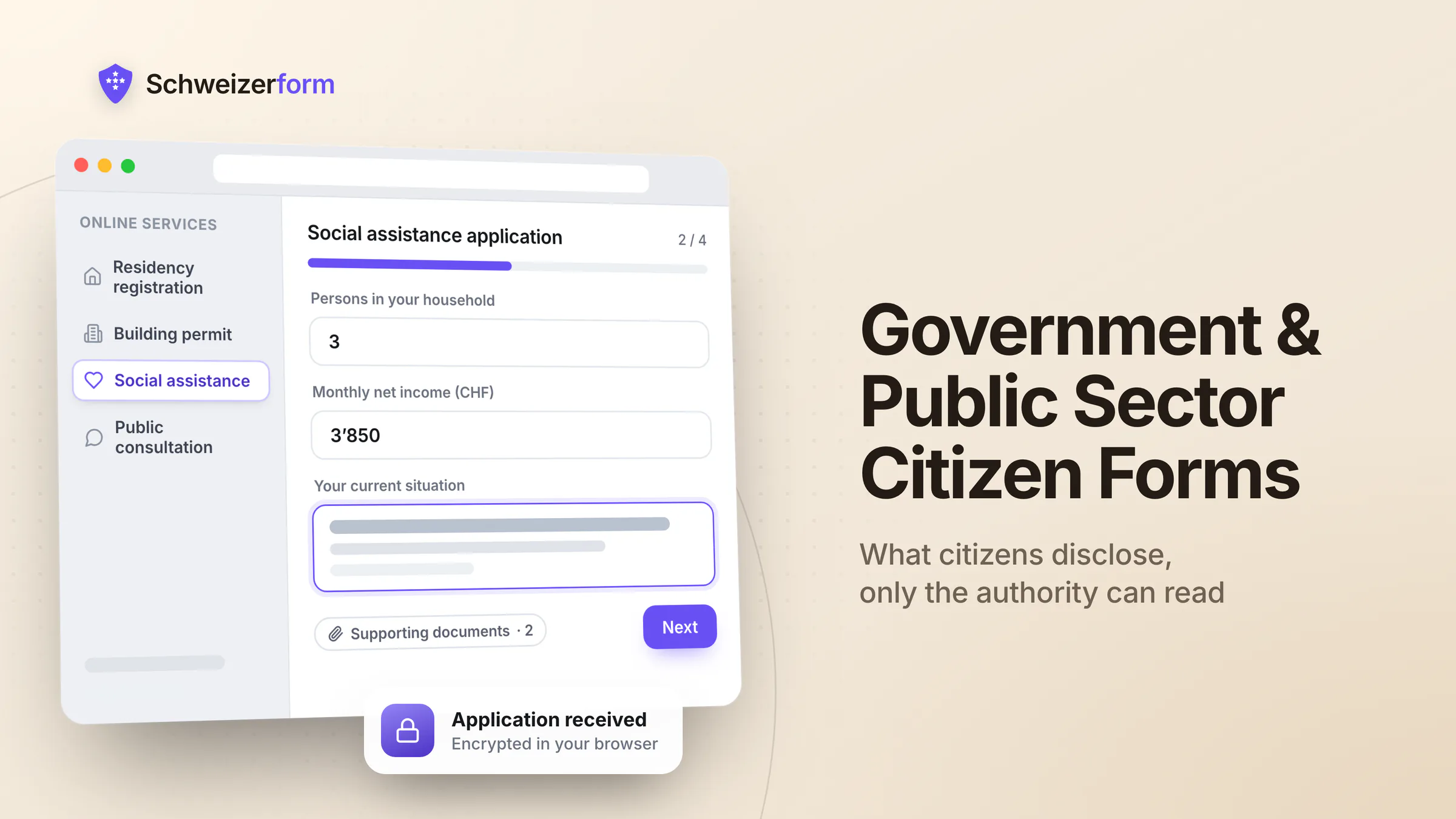
Public-sector forms touch every part of a citizen's life: residency registration, building permits, social welfare applications, tax declarations, complaints against officials, public-consultation submissions, anti-corruption tip-offs. Unlike private-sector intake, citizens often have no choice — if you want a parking permit, a residency document, or a hardship benefit, you fill in the form the authority gives you. That asymmetry creates a duty: governments owe a measurably higher standard of confidentiality precisely because participation is not optional.
Schweizerform was built for that asymmetry. Every submission is encrypted in the citizen's browser before it leaves the device. We physically cannot read benefit applications, complaints, public-consultation responses, or whistleblower disclosures. For Swiss municipalities, cantons, and federal agencies — and for European public bodies operating under similar expectations — that property combines with Swiss hosting and a posture aligned with nFADP, GDPR, and public-sector accountability frameworks.
Who this page is for
Municipal clerks, cantonal department heads, federal agency CIOs, public-sector data protection officers (DPOs), digital-transformation leads, and procurement teams across local, regional, and national administrations — particularly in jurisdictions where citizen data is governed by constitutional or treaty-level privacy guarantees.
Why Public-Sector Data Demands a Higher Bar
Citizen data is qualitatively different from customer data. People disclose information to the state they would never disclose to a business: family relationships, immigration history, mental-health diagnoses tied to disability claims, financial hardship narratives, criminal records, complaints against named officials. They disclose it because they have to. That involuntary nature converts ordinary form data into something closer to a fiduciary record.
Most public administrations still gather this material through tools designed for marketing intake — Google Forms, Microsoft Forms, JotForm, SurveyMonkey, or proprietary in-house portals running on US-cloud infrastructure. Those tools store plain-text submissions on servers the provider can read. Provider staff, sub-processors, foreign authorities under extraterritorial legal process, and any attacker who breaches the infrastructure all sit between the citizen and the agency. For governments under written transparency duties and constitutional privacy obligations, that exposure is increasingly hard to justify.
- A resident applies for a hardship benefit, disclosing income, household composition, and health-related disability details; the readable record sits on a US-hosted server before any official has reviewed it
- A citizen lodges a formal complaint against a named police officer; the provider's database holds the complainant's identity in plain text alongside the accusation
- A whistleblower reports procurement fraud through an agency intake form; the report — and the reporter's IP and device — sits readable on third-party infrastructure
- A public consultation collects opinions on a contentious zoning decision; respondents' names, addresses, and political positions are stored as plain text under foreign jurisdiction
The accountability angle
Public bodies are subject to FOI-like transparency, parliamentary oversight, ombudsperson review, and judicial supervision. Every one of those mechanisms is easier when the agency can credibly demonstrate that no third party — including the form vendor — could have read sensitive citizen disclosures. Zero-knowledge architecture turns a defensive footnote into a structural answer.
What Changes With Zero-Knowledge Forms in Government
The technical shift is simple. Form data is encrypted in the citizen's browser before transmission and sealed in a vault only the agency can open. The server stores ciphertext. Only the agency — using its vault key — can open the vault and decrypt the submission. The vault key never touches our servers, so the provider becomes a courier of unreadable data, not a custodian of it.
- 1
Citizen fills in the form
They open a public link (or a tokenised one for restricted-access intake), complete the fields, and attach any required documents — proof of residence, ID copies, medical certificates, photos. Everything is encrypted in their browser before transmission, including names, addresses, narrative fields, and file contents.
- 2
Transmission and storage
The sealed submission crosses HTTPS and comes to rest on Swiss infrastructure. The server stores ciphertext only — there is no plain-text copy of the citizen's submission anywhere on our infrastructure, and no foreign sub-processor can be compelled to produce one.
- 3
Agency retrieves the submission
Authorised civil servants (case officer, registrar, DPO) open the submission in their browser. The agency's vault key opens the vault and decrypts the data on the device. Reading, triage, and case-management happen agency-side, inside the institutional perimeter.
- 4
Retention, transfer, and deletion
Submissions can be archived, exported into the agency's case-management system, or deleted in accordance with statutory retention schedules. Because we hold no keys, deletion is cryptographically final — there is no recoverable plain-text copy to disclose later under records requests.
Where Public Bodies Use Schweizerform
Civic intake, permits, and registrations
Residency registrations, building permits, parking authorisations, business licences, marriage notifications, civil-status changes — high-volume forms that aggregate identity, address, family, and sometimes financial information. Encrypting client-side keeps that mosaic inside the agency, not the vendor.
Social welfare and hardship applications
Unemployment benefits, housing assistance, disability support, emergency hardship grants, child-protection allowances. These forms collect deeply private financial and medical information from people in fragile circumstances. Zero-knowledge intake means the citizen's vulnerability is visible only to the case officers who actually decide the file.
Complaints, grievances, and ombudsperson channels
Complaints against agencies, officials, or police; grievances about service delivery; ombudsperson submissions — communications where the complainant is structurally weaker than the institution they are challenging. Provider-readable storage adds a third party the complainant did not consent to inform. Zero-knowledge architecture removes that party.
Whistleblower and anti-corruption intake
Procurement fraud reports, conflict-of-interest disclosures, internal misconduct tip-offs, anti-corruption hotlines under EU Whistleblower Directive transposition or analogous Swiss frameworks. These channels exist precisely because reporters fear retaliation. A form provider that can read the report — and that may operate under foreign legal process — is a weakness the channel cannot afford.
Public consultations and citizen participation
Vernehmlassungen, public-comment periods, participatory-budgeting submissions, citizen-initiative collections. Respondents' identities, addresses, and political positions are sensitive in any participatory democracy. Encrypted intake protects free expression at the technical layer, not just in the privacy notice.
FOI requests and access-to-information forms
Public records requests, access-to-information petitions, archive consultations — including from journalists and researchers whose investigations may be of interest to the very institutions they are filing against. Encrypting the request itself prevents the form vendor from learning what is being asked, and from whom.
What Citizens, Auditors, and Regulators Actually See
Three audiences notice the difference between a generic form and a zero-knowledge intake: the citizens who submit, the data-protection authorities and ombudspersons who supervise, and the parliamentary or audit-court bodies that periodically review agency systems and procurement.
| Perspective | Generic form tool | Schweizerform |
|---|---|---|
| Citizen submitting a benefit application | "My financial and medical details are stored by [tool] — I'm told it's secure" | "The agency's form encrypts my entry in my browser; only the agency can read it" |
| Whistleblower reporting procurement fraud | Plain text held by a third-party provider, potentially subject to subpoena or extraterritorial legal process | Ciphertext only on the third-party server; the agency holds the keys |
| Cantonal or national DPA inspection | Has to assess the provider's full readable copy and sub-processor chain across jurisdictions | Provider holds no readable copy — analysis collapses to the agency itself |
| Audit court / parliamentary committee | Citizen records exist in vendor systems outside the agency's direct technical control | Citizen records exist only in encrypted form outside the agency's domain |
Features That Matter for Public-Sector Teams
- End-to-end encryption on every form, every plan, every submission — no paid upgrade for protecting citizen data
- Swiss hosting in Swiss data centres — direct answer to constitutional and procurement-policy questions about where citizen data lives
- Encrypted file uploads up to 100 MB per file and 1 GB per submission — covers ID scans, proof-of-residence documents, medical certificates, building plans
- Native EN / DE / FR / IT — every label, error, and confirmation in the citizen's official language, not machine-translated
- Forms behind an unlock code for restricted-access channels (whistleblower intake, internal complaints, named-stakeholder consultations)
- Response caps, scheduling windows, and hard deadlines for consultation and grant-application periods
- Audit logging of administrator actions and submission views — documentation for ombudsperson reviews, audit-court reviews, and ISMS audits
- No third-party trackers on public forms — the citizen's browser is not pinging marketing analytics with the contents of their benefit claim
- Clear, plain-language privacy disclosures citizens can read in their own language — required by nFADP/GDPR transparency duties and good administrative practice
What authorities raise
"Our agency already runs Microsoft 365 / Google Workspace under a public-sector tier"
Vendor-led public-sector tiers (Microsoft 365 Government, Google Workspace for Public Sector) sign data-protection addenda, accept stricter contractual terms, and may even offer regional residency. They do not, however, encrypt form data so the vendor cannot read it. The vendor still holds plain-text submissions, can be compelled to produce them under foreign legal process where applicable, and has staff and sub-processors with technical access. Zero-knowledge forms close that gap regardless of which workspace tier the agency is on.
"We need open-data and FOI compatibility — encryption seems to fight transparency"
It does not. Citizen submissions are confidential by default in every public-administration framework — FOI applies to agency decisions and aggregated data, not to the personal disclosures of individual applicants and complainants. Encryption protects the citizen-side input. Agencies remain free, and obliged, to publish their decisions, statistics, and aggregate consultation outcomes through entirely separate channels.
"What if a case officer loses the vault key?"
This is the honest trade-off of genuine zero-knowledge security: the vault key never touches our servers, so we cannot reset it and cannot open the vault on your behalf. Lose the vault key and the recovery code and even we cannot recover the submissions — that is precisely what makes the architecture trustworthy. We support a recovery-key flow: a second key set up in advance and stored separately, typically in a sealed envelope held by the agency's records office or DPO. Most public bodies treat the vault key the same way they treat the master key to the registry archive — formal procedure, multiple trusted custodians, regular review.
"We need integration with our existing case-management system"
Authorised case officers decrypt submissions in the browser, then export to the case-management system through standard channels (CSV, structured forwarding, manual transfer through approved interfaces). The point of the zero-knowledge layer is that decryption happens agency-side; once decrypted, the data flows into your existing pipelines like any other input. Many agencies use Schweizerform for the citizen-facing intake stage specifically, then hand off to deeper internal systems for processing.
"We are bound by national procurement rules — can we use a Swiss-private vendor?"
Public procurement frameworks in Switzerland and the EU typically allow off-the-shelf SaaS where the security, residency, and processor terms are demonstrable. Schweizerform's Swiss storage of encrypted submissions, zero-knowledge architecture, and standard processor agreement are designed to be evaluable inside the usual procurement file. As with any vendor choice, the agency's procurement and DPO functions remain the deciding parties.
Getting Started in a Public-Sector Body
- 1
Pilot with one citizen-facing form
Most agencies begin with a single high-stakes form — typically a complaints intake, a benefit application, or a whistleblower channel. The free tier (3 forms, 100 submissions/month) is enough to validate the workflow end-to-end without procurement involvement.
- 2
Document the processor relationship
Add Schweizerform to the agency's record of processing activities. Record the Swiss storage location, the provider's lack of read access, and the absence of US sub-processors. For DPOs, this typically simplifies the data-protection impact assessment compared to US-hosted citizen-facing tools.
- 3
Train custodians on the vault key
Designate two or three custodians (department head, DPO, IT lead). Establish a recovery-key procedure analogous to the agency's other critical credentials and align with internal information-security policy.
- 4
Roll out across the citizen-services portfolio
Once the pilot proves out, paid plans lift form and submission caps. Agencies typically migrate complaint channels, hardship applications, public consultations, and whistleblower intake first — the channels where the asymmetry between citizen and state is sharpest.
- 5
Set retention to match statute
Public-sector retention is governed by archive law, not by vendor convenience. Use submission deletion to enforce the statutory schedule once data has been transferred to the agency's archive of record. With no key held by the provider, a deletion by the authority is final.
What a municipality can put in place this quarter
Public bodies are entrusted with the most involuntary form of data disclosure in modern society: information citizens give the state because they have to, often at moments of vulnerability or risk. A form tool that can read those disclosures creates an avoidable weakness in the agency's accountability posture — and an unnecessary explanation to citizens, ombudspersons, audit courts, and parliamentary committees.
Schweizerform offers a direct answer: zero-knowledge end-to-end encryption on every form, Swiss hosting, native four-language support, and a posture designed around the heightened expectations of public-sector data processing. No paid upgrade for protection. No US cloud dependency for citizen-facing intake. No readable third-party copy of complaint records, hardship applications, or whistleblower disclosures sitting on a server the agency cannot control.
Start with a single citizen-facing form on the free tier. Encrypted submissions stored in Switzerland, four national languages, and a free tier to pilot one service before procuring.
Disclaimer: This page is general information and marketing content, not legal, regulatory, or procurement advice. References to nFADP, GDPR, FOI/transparency frameworks, and public-sector accountability mechanisms are summarised at a conceptual level and are subject to jurisdictional interpretation. Responsibility for citizen-data protection and procurement compliance remains with the public body and its DPO. Consult a qualified data-protection or administrative-law specialist in your jurisdiction before relying on any summary here for compliance or procurement decisions. Competitive details were last verified on 25 July 2026. All product and company names are trademarks of their respective owners and are used here for factual comparison only.