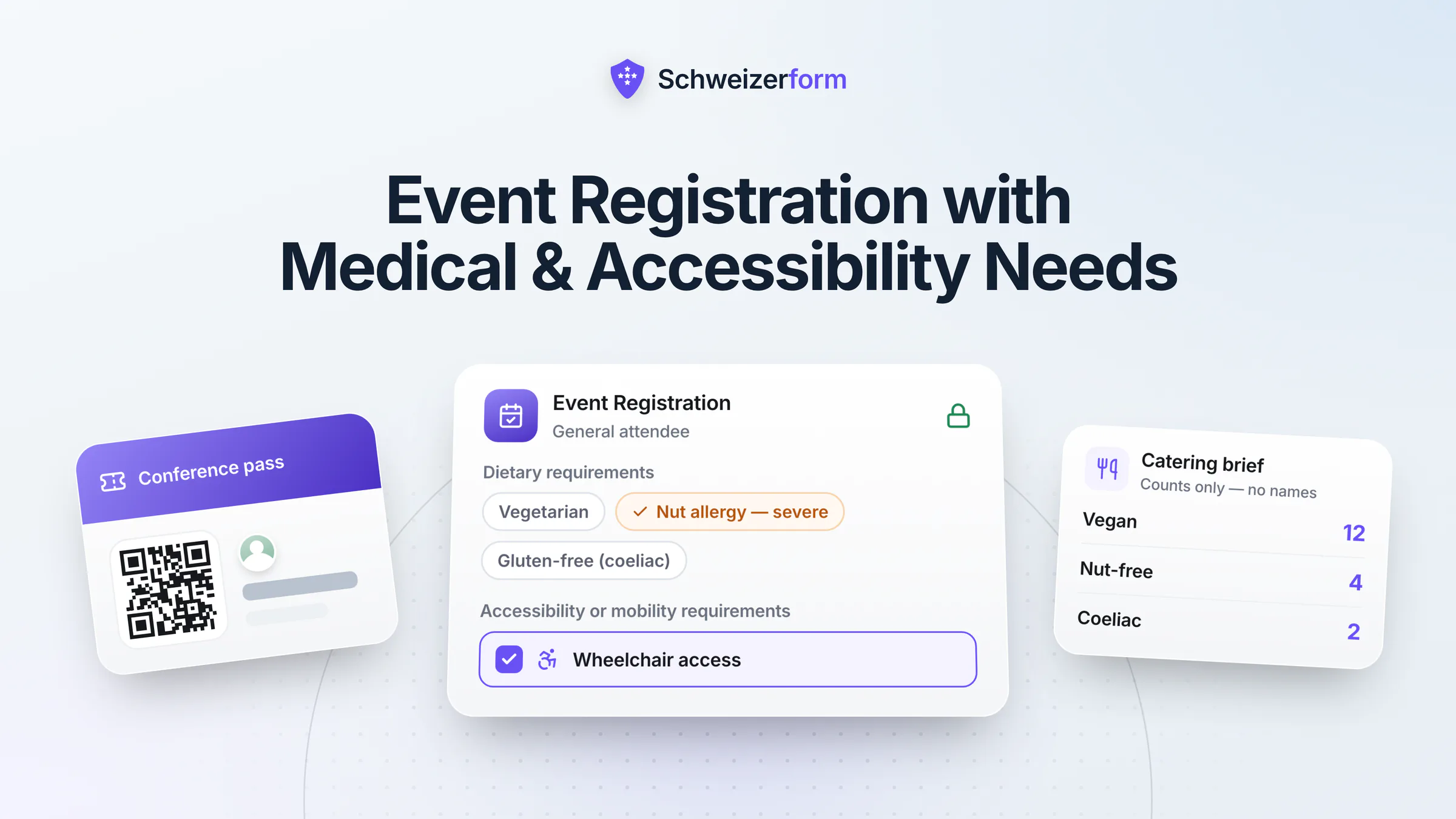
Event registration looks like one of the lightest data collections in the world: name, email, ticket type, dietary requirements, accessibility notes, emergency contact. In practice, it is one of the heaviest. A conference dietary field captures medical allergies. An accessibility note captures disability data. An emergency contact captures family relationships. A children's-camp form captures all of the above for minors. Every one of those fields is special-category data under nFADP and GDPR — and most events still gather it through Eventbrite, Google Forms, Typeform, or a generic ticketing back-end that holds it in plain text.
Schweizerform was built for that mismatch. Every submission is encrypted in the attendee's browser before it leaves the device. We physically cannot read allergy disclosures, mobility-aid requirements, mental-health accommodations, or emergency-contact details. For Swiss and European event organisers — corporate, academic, sporting, religious, charitable — that property combines with Swiss hosting and a posture aligned with nFADP, GDPR, and accessibility-law expectations.
Who this page is for
Conference organisers, university event teams, sports federations, festival producers, charity-walk coordinators, retreat hosts, school trip leads, corporate events teams, and DPOs reviewing event-registration tooling — particularly anywhere the registration form quietly collects medical, dietary, or disability information.
Why Event Registration Data Is More Sensitive Than It Looks
Event organisers often think of registration data as logistics: how many vegetarian meals to order, which rooms need wheelchair access, which attendees might have a peanut allergy. Regulators see it differently. Allergy and dietary information is health data when it relates to a medical condition. Accessibility requirements are disability data. Emergency contact details create profiles of family relationships. Children's-event registrations layer minor-data protections on top of all of that.
Most event tooling — Eventbrite, Cvent, Google Forms, JotForm, generic ticketing back-ends — operates on a conventional SaaS model. The attendee's browser sends plain text over HTTPS, the provider stores it, and the data sits readable on the provider's servers. Event volunteers, marketing partners, integration platforms, and the provider's own staff can technically reach the dietary spreadsheet and accessibility list. That exposure surface is wider than most attendees would imagine when they tick the "severe nut allergy" box during checkout.
- A 5,000-person conference collects "dietary requirements" via a US-hosted form; the resulting spreadsheet is shared by email with the catering partner and a temporary volunteer team
- A sports-club registration captures heart conditions and asthma history for a charity run; the medical disclosures sit on a third-party server alongside marketing-list metadata
- A retreat asks about "any mental-health considerations we should know about"; the responses are stored as plain text and exported into a CRM with no clear deletion process
- A school camp registration includes ADHD medication schedules and dietary intolerances for minors; the data is spread across the camp's email, the form provider's database, and a back-up on a volunteer's laptop
The volunteer factor
Events often run on volunteers with short tenure and broad access. Once a registration provider hands over a readable dietary or medical export, it tends to fan out — into email threads, shared drives, printed lists at registration desks. Zero-knowledge intake breaks that chain at the source: the data is decrypted only by the small set of authorised organisers, and only when needed.
What Changes With Zero-Knowledge Forms for Events
The technical shift is simple. Form data is encrypted in the attendee's browser before transmission, then locked inside a vault only the organiser can open. The server stores ciphertext. Only the event organiser — holding a vault key kept by a small team — can open the vault and decrypt the registration. The organiser holds the vault key alone; it never reaches us, so we cannot reset it. The provider becomes a courier of unreadable data, not a custodian of it.
- 1
Attendee fills in the registration
They open the registration link, complete contact details, ticket selection, dietary needs, accessibility requirements, emergency contacts, and any medical disclosures. Everything is encrypted in their browser before transmission — including narrative fields and any uploaded medical documentation.
- 2
Transmission and storage
Sealed registrations move over HTTPS into Swiss storage. The server stores ciphertext only — there is no plain-text copy of the dietary or accessibility data anywhere on our infrastructure.
- 3
Organiser retrieves the data
Authorised event staff (registration lead, accessibility coordinator, head chef liaison) opens the submission in their browser. The team's vault key unlocks the vault and decrypts the data on the device. Catering counts, accommodation lists, and accessibility plans are produced organiser-side.
- 4
Retention and deletion
Once the event is over, registrations can be archived, anonymised for statistics, or deleted. Because we hold no keys, deletion is cryptographically final — there is no recoverable plain-text copy of medical disclosures floating in a vendor system after the event.
Where Event Organisers Use Schweizerform
Conferences and academic events
Multi-day conferences, academic symposia, professional CPD events. Standard registration captures dietary requirements, accessibility needs, sometimes airport pickup details. Encrypting client-side keeps catering and access information inside the organising committee — not in a US-hosted attendee database that survives the event indefinitely.
Sports events, charity runs, and physical activities
Marathons, triathlons, charity walks, club tournaments. Registrations frequently include cardiac history, asthma, recent surgeries, medication, and an emergency contact who must be reachable on the day. Zero-knowledge intake means the medical waiver does not become a permanent record on a third-party server.
Retreats, wellness events, and festivals
Yoga retreats, mental-health workshops, plant-medicine retreats, music festivals with welfare tents. These events often ask explicitly about anxiety, trauma history, or medication interactions — disclosures that attendees would never want indexed by a marketing platform. Encryption matches the level of trust the event itself promises.
School trips, camps, and youth events
Class trips, sports camps, summer programmes, scouting weekends. These collect minor data with parental consent: allergies, asthma, ADHD medication schedules, swimming ability, prior injuries, family contact in case of emergency. Minor-data protections under nFADP and GDPR are stricter; encrypted intake is the proportionate technical answer.
Corporate events, off-sites, and employee gatherings
Company off-sites, all-hands events, awards dinners. Asking employees for dietary needs and accessibility requirements blurs the line between event registration and HR data. Zero-knowledge intake keeps that mosaic out of the marketing-event vendor stack and inside the responsible HR or events team.
Religious, community, and charitable events
Pilgrimages, congregational retreats, community-centre activities, charity galas. Many of these events serve audiences for whom religious affiliation, disability, or family circumstances are themselves sensitive. Encrypted intake honours that without forcing the organisation onto self-hosted infrastructure.
What Attendees, Caterers, and Auditors Actually See
Three audiences notice the difference between a generic registration form and a zero-knowledge intake: the attendees who disclose, the operational partners (catering, accessibility, security) who consume aggregated outputs, and the auditors or DPAs who supervise compliance.
| Perspective | Generic registration tool | Schweizerform |
|---|---|---|
| Attendee with severe allergies | "My medical disclosure sits in [tool]'s database — many people may technically see it" | "Only the event team can decrypt my registration; the platform itself cannot read it" |
| Catering partner | Receives a spreadsheet with names tied to allergies — full attendee mapping in one file | Receives a counts/notes summary produced from decrypted data, scoped to the day of the event |
| Accessibility coordinator | Pulls a list directly from the vendor system — broad access, often unlogged | Decrypts only the entries needed; access logged at the event-team level |
| DPA inspection or insurance audit | Has to assess the registration vendor's full readable copy and sub-processor chain | Vendor holds no readable copy — analysis collapses to the event organiser itself |
Features That Matter for Event Teams
- End-to-end encryption on every form, every plan, every submission — no paid upgrade for protecting health and accessibility data
- Encrypted submissions stored in Swiss data centres — clean answer to "where does our attendee data live?" for venues, sponsors, and DPOs
- Encrypted file uploads up to 100 MB per file and 1 GB per submission — covers medical certificates, doctor's notes, accessibility documentation, and consent forms
- Native EN / DE / FR / IT — every label, error, and confirmation in the attendee's language, not machine-translated
- Response caps and scheduling windows for limited-capacity events — close registration automatically when seats run out or when the deadline passes
- Forms behind an unlock code for restricted-access registrations (VIP guest lists, staff-only events, named-invite gatherings)
- Audit logging of administrator actions and submission views — documentation for sponsor, insurer, and ISMS reviews
- No third-party trackers on public registration pages — attendee browsers are not pinging marketing analytics with their dietary disclosures
- Plain-language privacy disclosures attendees can read in their own language — required by nFADP/GDPR transparency duties and increasingly expected by sponsors and venues
What event teams worry about
"We already use Eventbrite / Cvent — they're industry standard"
Mainstream event platforms sign data-protection addenda and offer enterprise contracts. They do not, however, encrypt registration data so the platform cannot read it. The platform still holds plain-text submissions, can be compelled to produce them under foreign legal process, and has staff and integration partners with technical access. For straightforward ticketing, that may be acceptable; for events that collect medical, accessibility, or minor data, zero-knowledge intake closes a gap the standard tools do not.
"Encryption will break our payment integration"
Schweizerform handles registration data, not card processing. Payments still flow through your existing PSP (Stripe, Worldline, Datatrans, or similar) — the attendee is redirected for payment, then returns to confirm. The encrypted layer covers the sensitive registration fields the PSP never needs to see: dietary notes, accessibility requirements, medical disclosures, emergency contacts. PCI scope stays where it belongs; health and disability data does not leak into it.
"Our caterer needs the dietary list — does encryption get in the way?"
No. Authorised event staff decrypt registrations in the browser and produce the catering brief from the decrypted data — typically a counts/notes summary, not a full attendee export. The caterer gets the operational view they need (12 vegan, 4 nut-free, 2 coeliac, 1 medically-monitored low-sodium) without receiving a personal dataset that has nothing to do with cooking.
"What if someone loses the vault key on the day of the event?"
This is the honest trade-off of genuine zero-knowledge security: because the vault key never touches our servers, we can't reset it, and if it is lost along with the recovery code, even we can't open the vault. That inability is the whole point of the design. We support a recovery-key flow: a second key set up in advance and stored separately (typically printed and held by the event director and a deputy). Operationally, treat the vault key the way you would treat the master key to the safe holding the ticket float — formal procedure, multiple trusted custodians, a tested recovery path before the event begins.
"We need integrations with our CRM and email tool"
Authorised staff decrypt submissions in the browser, then export only the fields the downstream tool actually needs through standard channels (CSV, structured forwarding, manual transfer). Marketing CRMs do not need allergy data; mailing platforms do not need accessibility notes. The zero-knowledge layer keeps the medical and disability fields inside the events team while the operational fields flow into your existing pipelines like any other input.
Getting Started for an Event Series or One-Off
- 1
Pilot with one registration form
Most teams begin with a single high-stakes registration — a sports event with medical waivers, a school camp, or a wellness retreat. The free tier (3 forms, 100 submissions/month) is enough to validate end-to-end before the next major event window.
- 2
Document the processor relationship
Put the registration channel in your processing register before the first invitation goes out. Write down the Swiss storage, the zero-knowledge model, and that no US sub-processor is in the path. For DPOs, this typically simplifies the registration workflow's data-protection assessment compared to US-hosted event platforms.
- 3
Train the event team on the Vault Key
Designate two or three custodians (event director, deputy, accessibility lead). Establish a recovery-key procedure analogous to other critical event credentials and rehearse it before the event opens.
- 4
Roll out across the event calendar
Once the pilot proves out, paid plans lift form and submission caps. Most event teams then move medical-disclosure registrations, school camps, accessibility-rich events, and corporate off-sites onto Schweizerform as the calendar permits.
- 5
Set retention to match purpose
Registrations have a natural end of life — the event itself. Use submission deletion to enforce a clean retention schedule (typically: keep until 30 days post-event for incident review, then delete). Because no key sits on our side, post-event deletion is genuinely irreversible.
Collecting medical needs without keeping them
Event registration is the friendliest face of data collection — a contact form with a ticket attached. Underneath, it is one of the broadest health-and-disability data flows most organisations run. A registration tool that can read those disclosures creates an avoidable weakness in the event's privacy posture — and an unnecessary explanation to attendees who trusted the disclosure to a small organising team, not a marketing platform.
Schweizerform offers a direct answer: zero-knowledge end-to-end encryption on every form, Swiss hosting, native four-language support, and a posture designed around the heightened expectations of medical, accessibility, and minor-data processing. No paid upgrade for protection. No US cloud dependency for medical disclosures. No readable third-party copy of attendee allergies, accommodations, or emergency contacts sitting on a server you cannot control after the event ends.
Start with one registration on the free tier. Encrypted submissions stored in Switzerland, four languages for an international delegate list, and a free tier for a first event.
Disclaimer: This page is general information and marketing content, not legal, medical, or accessibility advice. References to nFADP, GDPR, accessibility frameworks, and event-industry practice are summarised at a conceptual level and are subject to jurisdictional interpretation. Responsibility for attendee data protection and accessibility compliance remains with the event organiser. Consult a qualified data-protection or accessibility specialist in your jurisdiction before relying on any summary here for compliance decisions.