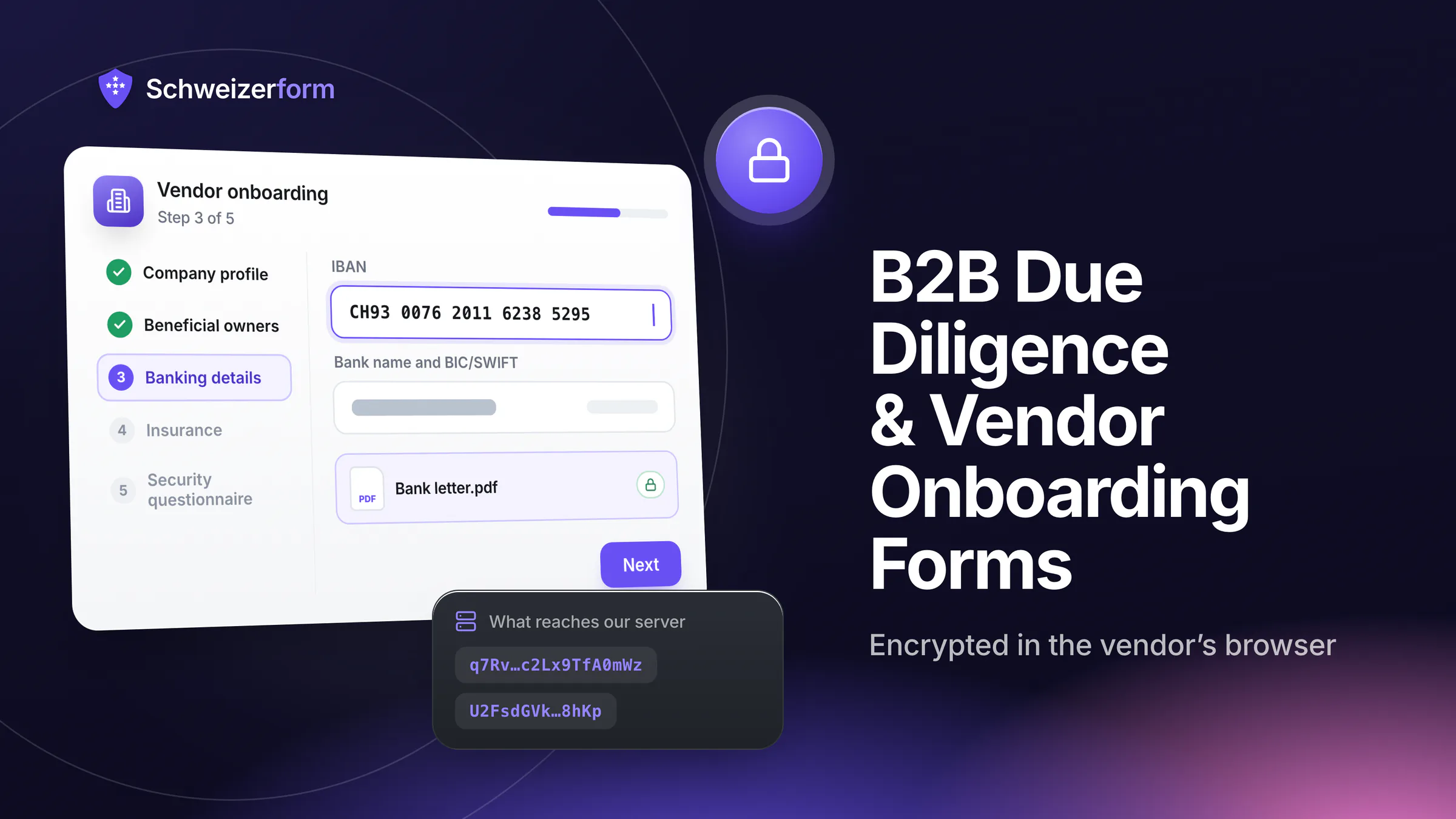
B2B due diligence and vendor onboarding generate one of the densest concentrations of confidential commercial data of any business process. A typical vendor packet collects audited financial statements, banking details for accounts payable, ultimate beneficial owner (UBO) declarations, sanctions and PEP screening data, insurance certificates with coverage limits, security questionnaires running to a hundred or more questions, subprocessor lists with their own DPAs, reference contacts at competitor customers, ISO 27001 / SOC 2 / PCI DSS reports, and tax IDs. Sales-side, the same flow runs in reverse: vendors fill out customer-supplied security questionnaires, NDA acknowledgements, and vendor-risk assessments. The data is, by any reasonable definition, commercially sensitive — and most of it today travels through email PDFs and shared procurement inboxes.
Schweizerform was built for exactly this kind of two-sided confidential exchange. Every submission is encrypted in the counterparty's browser before it leaves the device. We physically cannot read vendor onboarding packets, security questionnaire responses, RFP submissions, UBO declarations, or banking details. Hosting is in Switzerland, the four UI languages (EN / DE / FR / IT) are native — important for European procurement working across language regions and for sales teams responding to questionnaires from multilingual customers — and retention can be set per form to age out cleanly when a deal closes or a vendor is rejected. This page is for procurement, vendor management, sales operations, and security teams already aware that the email PDF model is unfit for the data the process generates.
Who this page is for
Procurement directors and category managers, vendor risk management leads, third-party risk (TPRM) teams, security and privacy teams responding to or sending out questionnaires, sales operations and revenue operations leads handling customer security reviews, legal and compliance teams managing NDAs and DPAs, and finance teams collecting banking and UBO data — particularly in Switzerland and the EU, where the cumulative regulatory pressure (GDPR, nFADP, FINMA expectations for regulated entities, AML/UBO obligations under FATF-aligned regimes, EBA guidelines on outsourcing, NIS2, DORA) makes the integrity of the due-diligence intake channel a board-level concern.
Why B2B Due Diligence Has an Outsized Data-Protection Profile
Due-diligence and onboarding data sits at the intersection of several categories that each carry meaningful obligations — and a fourth dimension (commercial sensitivity that does not necessarily fall under personal-data law but is still ruinous if leaked) that ordinary intake does not face:
- Financial confidential data — audited financials, runway, revenue concentration, customer lists, key-customer references; trade secrets in everything but legal label
- Banking and payment data — IBAN for AP setup, bank reference letters, signing-authority documentation; high-value fraud target (CEO-fraud and supplier-impersonation attacks routinely begin with leaked banking metadata)
- Beneficial ownership and AML data — UBO declarations, source-of-funds, PEP screening, sanctions screening; covered by AML regimes and increasingly aligned to public UBO registers in EU member states (with their own access-control nuances)
- Insurance and risk data — coverage limits, claims history, broker references; commercially sensitive in negotiations and useful intelligence for adversarial parties
- Security and privacy posture — answers to extensive questionnaires (SIG, CAIQ, custom), penetration test reports, ISO/SOC report letters, subprocessor lists; a complete map of the vendor's controls and gaps
- Personal data of named contacts — procurement contacts, security officers, finance leads, references at other customers; covered by GDPR / nFADP as standard
- Volume and parallelism — for every awarded vendor, a procurement function processes typically three to ten rejected vendors with the same packet density; that data is rarely deleted on schedule
Most B2B procurement and sales functions today handle this through email PDFs (the default for smaller deals), generic SaaS forms (medium deals), or dedicated TPRM platforms with full readable copies of every vendor packet (enterprise). All three leave commercial data in places the process owner does not fully control, and most large-buyer security teams have no clean answer to "who at the form vendor or TPRM platform can read our supplier packets?" beyond the contractual one.
The supplier-impersonation angle
Banking-detail leaks from procurement inboxes are a leading vector for supplier-impersonation fraud (sometimes called BEC: business email compromise — supplier variant). An adversary who learns the IBAN format, signing authorities, and approval flow of a supplier-buyer relationship can intercept a payment with a single well-timed email change. Encrypted intake of banking detail (with no plain-text copy in shared inboxes) closes the most common attack path.
What Changes With Zero-Knowledge Intake in B2B Due Diligence
The technical shift is simple. Vendor- or customer-side data is encrypted in the counterparty's browser before transmission, then sealed inside a vault only your team can open. The server stores ciphertext. Only the procurement, sales, security, or finance team — holding the team's vault key — can open the vault and decrypt the submission. Your procurement team holds the vault key outright; it never reaches us, so no reset exists. The form provider becomes a courier of unreadable data, not a custodian of UBO declarations, banking details, security questionnaire answers, or commercial financials.
- 1
Counterparty opens the secure intake link
A vendor onboarding their company, a sales prospect responding to a customer security questionnaire, or a partner submitting an RFP response receives a secure form link from the requesting team. They fill in the structured form and upload supporting documents. The questionnaire is sealed on the vendor's own machine before anything is sent.
- 2
Transmission and storage
Only ciphertext crosses the wire, and it comes to rest in Switzerland. The server stores ciphertext only — no plain-text copy of any UBO declaration, banking detail, security answer, or financial statement exists anywhere on our infrastructure.
- 3
Internal team retrieves and processes the submission
Authorised team members (procurement, security, finance, legal) open submissions in their browser. The team's vault key unlocks the vault and decrypts the data on the device. Each functional team reviews what they need; structured fields and uploaded documents flow into the relevant downstream system (TPRM platform, ERP for vendor master, security GRC tool, contract management).
- 4
Award, rejection, retention, deletion
When the vendor is awarded, the relevant data flows into the system of record (vendor master, ERP, contract management). When a vendor is rejected (typically the majority of evaluated candidates), the form-side submission can be deleted on a defined schedule — and because we hold no keys, deletion is cryptographically final. The compliance posture for rejected vendors improves automatically.
The procurement-velocity advantage
Structured intake scoped to the deal type — one packet per tier rather than one packet for everyone — reduces vendor-side completion time materially. Tiering can be done two ways: by which form you send, or by conditional rules inside one form, where the enhanced-diligence block only appears once an earlier answer calls for it. Separate forms give you two clean records with two audit trails; one conditional form gives the vendor a single link. Procurement teams report shorter cycles when the intake is structured rather than a blanket 200-question PDF; vendors return responses faster because the packet they receive is already the relevant one. The combination of better speed and better security is unusual; due diligence intake is one place where it is achievable.
Where Procurement and Sales Teams Use Schweizerform
Vendor onboarding packets
The flagship use. A structured form covers company profile (legal entity, registered office, tax IDs, VAT), UBO declaration, sanctions and PEP attestation, banking details for AP setup, signing authorities, insurance certificates, recent audited financials, and reference contacts. The depth of the packet is set either by which form you send — a short one for a CHF 5K consultancy purchase, the full one for a CHF 5M strategic supplier — or by conditional rules inside one form, so the UBO and sanctions blocks appear only above the thresholds that require them. Anything the vendor never sees is never stored: answers to conditionally hidden questions are stripped before the submission is encrypted, so a low-risk supplier leaves no high-risk data behind.
Security and privacy questionnaire intake
Customer-side: receiving completed security questionnaires (SIG Lite, SIG Core, CAIQ, custom internal frameworks) from prospective vendors. Sales-side: sending the buyer's standard questionnaire to a prospect's security team and receiving the encrypted response. Either direction, the questionnaire data is a complete map of controls and gaps that should not sit in a third-party form vendor's database in plain text.
RFP / RFQ confidential response intake
RFPs and RFQs receive responses that combine commercial pricing, technical proposals, references, and sometimes confidential roadmap material. A unified encrypted intake form gives the procurement team a single store for all responses (audit trail of when each was received) without exposing competing bidders' submissions to the form vendor.
NDA distribution and acknowledgement
Standard NDA flow with structured counterparty information capture and electronic acknowledgement. The signed NDA acknowledgement and the counterparty's contact details (often more sensitive than the NDA text itself, since they reveal who is talking to whom) are retained in encrypted form rather than scattered across email threads.
Subprocessor disclosure and DPA exchange
GDPR / nFADP-driven exchange of subprocessor lists, DPAs, and Standard Contractual Clauses. The subprocessor list itself is commercially sensitive (it reveals architectural choices and partner relationships); encrypted intake keeps the exchange clean and auditable.
UBO and source-of-funds declarations
AML-driven UBO declarations, source-of-funds attestations, and PEP / sanctions screening intake for engagements that require them (regulated industries, large transactions, jurisdictions with explicit AML thresholds). The data is high-value to fraudsters and to opposition research; encrypted intake matches the regulatory expectation behind the requirement.
Vendor renewal and annual review forms
Annual or renewal-cycle reviews refresh the vendor's onboarding data: any change in UBO, sanctions status, financial position, insurance, or security posture? The renewal form runs lighter than the original onboarding (only what changed) — usually a separate, shorter form. You can also drive it with conditional rules (“has anything changed since last year?” → reveal only the affected sections), but a distinct renewal record is easier to defend at audit than one form that behaved differently on different years.
Vendor offboarding and data return / deletion attestation
When a vendor relationship ends, the offboarding flow captures data return / deletion attestation, return of customer credentials, exit certifications, and any final reconciliation. A structured encrypted form gives the procurement team a defensible exit record without an email PDF round trip.
Reference-check and customer-reference contact intake
Vendor reference contacts are commercially sensitive (they are a poaching list for competitors and a customer-list leak in their own right). An encrypted intake form captures the references with the candidate vendor, used internally for reference checks, then aged out per retention policy — without circulating them through email.
What Counterparties, Auditors, and Regulators Actually See
Three audiences notice the difference between an email PDF / generic SaaS / standard TPRM intake and a zero-knowledge intake form: the counterparties who hand over their commercial confidential data; the internal audit, security, and procurement governance team that reviews the process; and the external auditor or regulator (where applicable) that tests the function against ISO 27001, SOC 2, FINMA, or sector-specific frameworks.
| Perspective | Email PDF / generic SaaS / TPRM platform | Schweizerform |
|---|---|---|
| Vendor or sales counterparty submitting the packet | "My company financials, UBO data, banking details, and security answers are sitting on a third-party server somewhere" | "The buyer's form encrypts my packet in my browser; only the buyer's team can read it" |
| Internal audit / security governance | Has to assess every vendor inbox, every TPRM vendor's posture, every backup of every received packet | Provider holds no readable copy — analysis collapses to the buyer's own systems and DPA |
| External auditor (ISO 27001, SOC 2, FINMA-style) | Standard SaaS exposure footprint plus extended supplier-data flow analysis | Materially reduced exposure footprint; encryption posture documentable in the ISMS / vendor risk policy |
| Counterparty exercising data-subject or commercial-confidentiality rights | Buyer must trace each copy of the packet across vendor and any sub-processors | Single deletion at the form-side store; the system of record (TPRM, ERP, contract management) holds what the relationship requires |
Features That Matter for Procurement and B2B Sales
- End-to-end encryption on every form — UBO, banking, security questionnaire, and financial data protected by default, no paid upgrade required
- Swiss hosting in Swiss data centres — direct answer to where commercial-confidential vendor data lives, important for FINMA-regulated buyers and EU procurement under DORA / NIS2 expectations
- Encrypted file uploads sized for the documents the process actually exchanges — financial statements, ISO/SOC report letters, insurance certs, signed DPAs
- Native EN / DE / FR / IT — every label, error, and confirmation in the counterparty's language; essential for European procurement and for sales teams responding to multilingual customers
- Multiple administrators with role-scoped access — procurement, security, finance, legal each see their relevant slice; no single team needs visibility into the others'
- Defined retention per form — set retention to age out for rejected vendors at decision close; keep awarded-vendor data at the system of record per the relationship's lifecycle
- Audit logging of administrator actions and submission access — documentation for ISMS audits, ISO 27001 surveillance, SOC 2 Type II testing, and internal procurement governance reviews
- Mobile-first counterparty experience — vendor security officers and procurement teams routinely work from phones; the form does not assume desktop
- No third-party trackers on public forms — the counterparty's browser is not pinging marketing analytics with their UBO declaration or banking details
Pushback from procurement
"We have a TPRM platform — Prevalent, OneTrust, ProcessUnity, etc."
Most TPRM platforms are systems of record for the vendor-risk management lifecycle, not zero-knowledge intake layers. They typically encrypt in transit and at rest, but the platform vendor still holds a readable copy of every supplier packet. Schweizerform is a specialised intake layer that can sit in front of any TPRM platform — encrypted intake from vendors, then export of the buyer-side decrypted record into the TPRM platform for ongoing risk management. The TPRM platform continues to do exactly what it does today.
"Vendors are professionals — they expect to email us PDFs"
Vendor expectations are catching up to buyer expectations. A buyer that requires structured intake (especially in regulated industries) tends to find that vendors comply readily — particularly when the alternative is the same buyer asking for a packet refresh six months later because the original PDF is now in fifteen places. The friction is rarely vendor-side; it is buyer-side procurement habits.
"What about ongoing risk monitoring after onboarding?"
Schweizerform handles intake — initial onboarding, annual renewal, ad-hoc questionnaire refresh. Ongoing monitoring (continuous external scanning, dark-web monitoring, financial-health alerts) is what TPRM platforms are designed for. The two are complementary: encrypted intake at every refresh point, then the TPRM platform handles what happens between refreshes.
"What if the key holder leaves the company?"
This is the honest trade-off of genuine zero-knowledge security: because the vault key never touches our servers, we can't reset it, and if your team loses it together with the recovery code, even we can't open the vault. That impossibility is exactly what makes Schweizerform truly end-to-end encrypted. We support a recovery-key flow: a second key set up in advance and stored separately (typically with the procurement director and a senior compliance officer). Most procurement functions treat the vault key with the same procedural rigour as banking-system credentials — formal procedure, two custodians, regular review, and a planned hand-off when team members change role.
"Will encrypted intake interfere with our SOX / ISO / SOC audit?"
It supports rather than interferes. Auditors generally appreciate clean encryption-at-source posture for sensitive vendor data, with documented decryption events at the buyer side and configurable retention. The internal audit trail (who accessed what, when) and the cryptographically final deletion at retention close both strengthen audit responses rather than complicate them. Document the architecture in the ISMS; the rest follows.
"What about Stripe / payment processor integrations for setup?"
Vendor banking setup typically does not flow through a payment processor — it flows into the buyer's ERP or AP system. The Schweizerform intake captures the banking details encrypted; the AP / treasury team decrypts and enters them into the AP system using normal change-control procedures (often requiring callback verification per BEC-prevention SOP). The encrypted intake replaces the email PDF in the most fraud-exposed step of the process.
Getting Started in Procurement or B2B Sales
- 1
Pilot with the highest-fraud-exposure form
Pick the single form where a leak or interception would do the most damage — typically the banking-detail capture in vendor onboarding, or the customer-supplied security questionnaire intake on the sales side. The free tier (3 forms, 100 submissions/month) is enough for a small pilot with a few vendors or prospects; paid plans cover production procurement volumes.
- 2
Build the intake to align with the existing onboarding SOP
Replicate the current onboarding fields, organised by section (company profile, UBO, banking, insurance, security questionnaire, references). Use page breaks so a long packet arrives as steps rather than one wall of fields, and either build one form per deal tier or use conditional rules so the deeper sections appear only when the deal size calls for them. Translate to the languages your counterparties actually speak (the platform ships native EN / DE / FR / IT — important for European procurement and for sales responding to multilingual customers).
- 3
Set up the Vault Key and recovery key
Two custodians (typically the procurement director and a senior compliance / security officer), written procedure in the relevant SOP, recovery key stored separately. About 15 minutes of process work; then it lives in the SOP alongside other procurement-critical credentials.
- 4
Define retention to match the procurement lifecycle
Set form-side retention to age out for rejected vendors at decision close (typically 30 to 90 days post-decision for the tail-end of dispute and audit windows); awarded-vendor data flows into the TPRM platform / ERP / contract management system per the existing data-flow.
- 5
Document the processor relationship
Add Schweizerform to the relevant processor register, ISMS Annex A reference, vendor risk management policy, and (for FINMA-regulated buyers) the outsourcing register where applicable. Note the Swiss storage location, the zero-knowledge design, and that no US sub-processor sits in the submission path.
- 6
Roll out across additional intake channels
Once the highest-fraud-exposure form is stable, add RFP intake, security questionnaire intake (both directions), NDA acknowledgement, subprocessor / DPA exchange, vendor renewal, and offboarding forms as procurement and sales SOPs come up for review. Most procurement functions reach a fully digital onboarding intake surface within one to two quarters; sales-side rollout typically tracks the customer-questionnaire cycle.
Rebuilding vendor onboarding around what you can prove
B2B due diligence and vendor onboarding generate a dense exchange of confidential commercial data — financials, UBO, banking, security posture, references — and most of it today flows through email PDFs and shared procurement inboxes that nobody fully controls. The fraud exposure (supplier impersonation, banking-detail interception), the audit exposure (data sprawl across mailboxes and TPRM platforms), and the counterparty-trust exposure (vendors increasingly notice when their data is handled casually) all compound. The standard practice is fine until a regulator, an auditor, or a payment-fraud incident asks the obvious question.
Schweizerform offers a direct answer at the intake layer: zero-knowledge end-to-end encryption on every form, Swiss hosting, native four-language support, encrypted file uploads sized for the documents procurement actually exchanges, and retention configurable to age out cleanly for rejected vendors at decision close. The TPRM platform, ERP, and contract management remain systems of record for the relationships that move forward. The intake layer becomes something the procurement director, the chief security officer, and the external auditor can defend cleanly — without the fraud-exposure liability of the email PDF default.
Start with the highest-fraud-exposure form on the free plan — encrypted submissions stored in Switzerland, zero-knowledge encryption, native EN / DE / FR / IT — and replace the next email PDF onboarding packet with an encrypted intake link before the next supplier-impersonation attempt lands.
Disclaimer: This page is general information and marketing content, not legal, procurement, audit, or compliance advice. References to GDPR, nFADP, FINMA, FATF / AML / UBO regimes, ISO 27001, SOC 2, NIS2, DORA, and EBA outsourcing guidelines are summarised at a conceptual level and subject to jurisdictional and sector-specific interpretation. Responsibility for vendor-risk management and counterparty-data protection remains with the buying or selling organisation. Consult a qualified procurement, security, audit, or data-protection specialist in your jurisdiction before relying on any summary here for compliance, contracting, or ISMS decisions.