Of all the comparisons a prospective Schweizerform user is likely to run, Cognito Forms is the most interesting. It is the form builder that most directly positions on the same axis we do — security, compliance, and confidential data — and it is a genuinely capable product. This is therefore the comparison that rewards the most honesty.
Cognito Forms and Schweizerform overlap in intent but diverge on technical approach and jurisdictional footprint. Both take privacy seriously. Neither is "just another form builder". Which one fits depends on a small number of specific questions about your data, your regulatory regime, and the level of trust you can extend to the operator of the platform.
Our bias, declared
Schweizerform is ours, so treat the framing accordingly. But Cognito Forms is a strong, thoughtfully built product, and we will credit it clearly where it deserves credit. The goal of this page is to help you choose correctly — not to oversell our side.
How Cognito Forms and Schweizerform position themselves
Cognito Forms — compliance-focused, US-anchored
Cognito Forms is a US-based product (Charlotte, North Carolina) aimed at small and mid-sized organisations that need functional, compliance-aware forms. Its differentiators are a capable free tier with good feature depth, HIPAA compliance on higher plans, a distinctive "Encrypted Fields" feature for sensitive data, robust calculations, conditional logic, payments, and workflow. For US-based SMBs in healthcare, finance, and education it is one of the strongest choices available.
Schweizerform — zero-knowledge, Swiss-anchored
Schweizerform is a Swiss product built around a different security model: every submission is end-to-end encrypted in the respondent's browser, and the server physically cannot decrypt it. Encrypted submissions are stored in Switzerland, and the operating entity sits outside US CLOUD Act reach. The product is designed around nFADP, GDPR Article 9 sensitive-data handling, and organisations that cannot accept any trust in the operator's ability to read submissions.
The Security Models — Where the Real Difference Lives
Both tools offer "encryption". Understanding what that word means in each product is the single most important part of this comparison.
Cognito Forms — encrypted fields, server-held keys
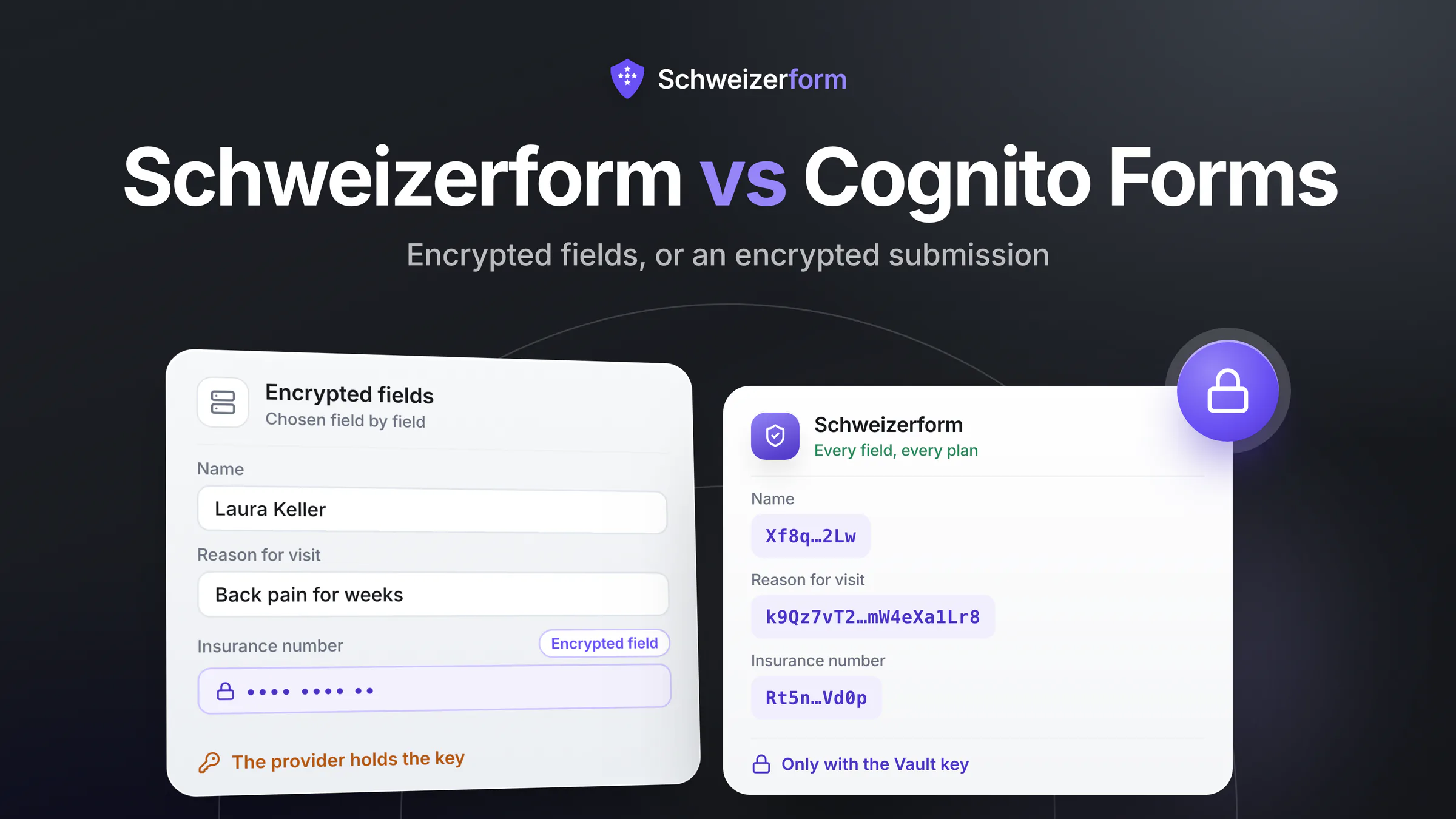
Cognito Forms supports designating individual fields as "encrypted". When that flag is set, Cognito encrypts the field value with its own encryption system before storing it, and decrypts it when the form owner views the submission. This is a real, meaningful feature and a genuine differentiator from tools that store everything in plain text. It is not, however, end-to-end encryption: the keys are held by Cognito, and Cognito's servers see plaintext during submission processing.
Schweizerform — zero-knowledge end-to-end encryption, by default
Schweizerform encrypts the entire submission (not individual fields) in the respondent's browser, before any data touches our servers. The keys are derived from the form owner's vault key, which never touches our servers and is never transmitted. Submissions live in a vault only the owner can open, and our servers receive only ciphertext. That is what makes it truly end-to-end encrypted: it applies to every form, every field, every submission, and every plan including the free tier — it is not a toggle.
The threat model difference, concretely
A Cognito Forms server breach could expose plaintext for non-encrypted fields and potentially encrypted fields if the key infrastructure is also compromised. A Schweizerform server breach exposes ciphertext with no decryption path. A US subpoena to Cognito can compel disclosure of decryptable data; a Swiss lawful request to Schweizerform yields ciphertext only.
Cognito Forms and Schweizerform, feature by feature
| Schweizerform | Cognito Forms | |
|---|---|---|
| End-to-end encryption (client-side) | Yes — default, all fields | No — server-side encryption only |
| Zero-knowledge architecture | Yes — provider cannot decrypt | No — provider holds keys |
| Field-level encryption | Not needed — whole submission is encrypted | Yes — per-field Encrypted Fields feature |
| Data hosting | Switzerland | United States (AWS) |
| Subject to US CLOUD Act | No — Swiss entity, Swiss hosting | Yes — US company, US infrastructure |
| HIPAA compliance | No BAA — we are not a HIPAA vendor. Submissions are encrypted in the browser, so we cannot read PHI, but a US covered entity should treat that as a technical safeguard, not as a reason a BAA is unnecessary | Yes — with BAA on Pro / Enterprise plans |
| nFADP alignment | Designed around the nFADP | Generic US privacy posture |
| GDPR compliance | Yes, plus Swiss adequacy for EU transfers | Yes, with SCCs for EU-US transfers |
| Free plan | 3 forms, 100 submissions/month, full encryption | Unlimited forms, 500 entries/month, no encrypted fields |
| Branding removed on free plan | Minimal footer only | "Powered by Cognito Forms" required |
| Conditional logic | Yes — show/hide a question based on earlier answers (Pro) | Yes — strong, calculation-based |
| Calculations & pricing fields | No | Strong — a standout feature |
| Payments (Stripe / Square / PayPal) | No — no payment fields in forms; Stripe is only how you pay us | Yes — mature integration |
| File uploads | Encrypted in-browser, up to 100 MB each / 1 GB total | Yes — stored server-side |
| Workflow approval steps | No — no approval or routing workflow | Strong — multi-step workflows |
| Localisation (EN / DE / FR / IT) | All four, native, fully localised UI | Primarily English |
| Audit logging | Yes | Yes (higher plans) |
| API access | No — and none is announced. Export instead: CSV on every plan, Excel / JSON / PDF / ZIP on paid plans | Yes — mature |
| AI form creation | Yes — draft from a prompt; the AI never sees responses | Yes — generates a form from a text prompt |
| Automatic form translation | Yes — DE / FR / IT / EN; only form text is translated, never responses | No — localised UI text only, one language per form; no automatic content translation |
| Team workspaces & roles | Yes — shared workspace, still end-to-end encrypted, role-based | Yes — organizations with user roles (Pro plan and above); not end-to-end encrypted |
HIPAA vs nFADP — Different Compliance Frames
Cognito Forms markets HIPAA compliance as a key differentiator. This is legitimate and, for US healthcare providers, often the decisive feature. If you are a US-based clinic, therapy practice, or other HIPAA-covered entity, Cognito's BAA and HIPAA-aligned controls are genuinely useful.
Schweizerform sits in a different regulatory frame. We are built primarily around the Swiss nFADP, which governs any organisation processing data of people in Switzerland, and around GDPR for EU data subjects. For HIPAA: we do not serve US healthcare and we sign no BAA, so US covered entities should not use Schweizerform for PHI. Our zero-knowledge architecture is the stronger technical control — we cannot view submissions at all — but under HHS guidance a provider storing encrypted ePHI is still a business associate even without the key: the architecture changes the risk posture, not the regulatory status.
| Question | Cognito Forms | Schweizerform |
|---|---|---|
| US HIPAA-covered entity with a BAA requirement? | Strong fit — BAA available on Pro/Enterprise | Not a fit — no BAA offered; do not use for PHI |
| Swiss organisation under nFADP? | Workable but generic | Purpose-built for this |
| EU organisation under GDPR? | Yes, requires SCCs for US transfer | Yes, Swiss adequacy decision simplifies transfer |
| Data sovereignty / no-US-hosting requirement? | Not supported — US-hosted | Yes — Swiss hosting, Swiss entity |
Pricing — Similar Philosophy, Different Shape
Both products offer a genuinely useful free tier, and both scale pricing with submission volume rather than seat count. The specific shapes differ.
Cognito Forms' model
Cognito's free tier is unusually generous — unlimited forms, 500 entries per month, most features available. Paid plans (Pro, Team, Enterprise) raise submission volume, unlock encrypted fields, add HIPAA compliance, and include advanced workflow features. Pricing is tier-based and mid-market friendly.
Where Schweizerform's architecture diverges from Cognito Forms's
Schweizerform's free tier is narrower in submission volume (100 submissions/month) but does not gate encryption or sovereignty. Paid plans (Pro and Business) raise form and submission counts. The deliberate choice is to never put security features behind a paywall — the cryptographic guarantees are identical on the free tier and the business tier.
The structural trade-off: Cognito gates encryption behind a paid plan (Encrypted Fields is a Pro feature). Schweizerform gates volume but never security. For high-volume, non-sensitive forms, Cognito's free tier is more generous. For any sensitive form — including your first — Schweizerform's free tier provides guarantees Cognito's free tier does not.
Which one fits a regulated intake process
Pick Cognito Forms when
- You are a US-based organisation, especially HIPAA-covered, that needs a BAA from your form provider
- You need strong calculation engines (order forms, estimators, pricing) inside the form
- Built-in payment processing via Stripe / Square / PayPal is a core requirement
- You rely on complex multi-step workflow approvals inside the form tool
- A generous free tier with many forms and medium-volume submissions matters more than zero-knowledge architecture
- Your respondents are primarily English-speaking
- Your threat model does not include the form provider itself reading the data
Choose Schweizerform when the provider must not be able to read
- Zero-knowledge — the operator physically cannot read submissions — is a requirement, not a bonus
- You are subject to nFADP, GDPR Article 9 sensitive-data rules, or Swiss data sovereignty expectations
- You need to avoid US CLOUD Act exposure for your respondents' data
- Localisation into German, French, and Italian is important for your respondents
- You need encryption on every form from day one without a paid upgrade
- Your threat model includes insider risk, subpoena risk, or operator compromise at the provider
- You want the same security posture on the free tier as on the top-tier plan
When You Might Honestly Use Both
A surprising number of organisations end up using both tools side by side. Cognito Forms handles the operational, revenue-adjacent forms — order intake with calculations, event payments, multi-step approval workflows. Schweizerform handles the confidential intake — patient onboarding, whistleblower reports, sensitive tax or legal disclosures.
This is not a cop-out. The two tools optimise for different problems and the overlap is narrower than either marketing page might suggest. Picking one for every use case often means forcing a fit in at least one direction.
Moving From Cognito Forms to Schweizerform
For teams that decide to move sensitive forms from Cognito to Schweizerform, the migration is usually straightforward:
- 1
Export historical submissions
Cognito Forms supports CSV and JSON export from the entries view. Download what you need for records — once forms are in Schweizerform, we will not be able to read historical data you did not export.
- 2
Rebuild forms in Schweizerform
Most question types have direct equivalents. If you relied heavily on Cognito's calculation engine, that part does not move: there is no calculation support here at all, so the arithmetic has to happen after export.
- 3
Update processor agreements
Remove Cognito from your processor list and add Schweizerform. For EU subjects, the Swiss adequacy decision simplifies transfer compared to Cognito's SCCs.
- 4
Test end-to-end
Submit a test response, verify you can decrypt it with your vault key, confirm file uploads and validation rules behave as expected, and check the localised form experience for each target locale.
- 5
Retire the old form
Close the Cognito form once live traffic is routed to the new form. Keep the historical export in a secure archive appropriate for its retention period.
Cognito Forms or Schweizerform
Cognito Forms and Schweizerform are both serious products, both take confidentiality seriously, and both are more thoughtful than the average form tool. Where they really part company is on two questions: (1) where does your data live, legally, and (2) can the provider read it.
If your answer to those questions is "US is fine" and "I trust the provider to manage the keys", Cognito Forms is an excellent choice — and often better than Schweizerform for payment, calculation, and workflow-heavy forms. If your answer is "Switzerland, please" and "no provider should have the technical ability to read my submissions", Schweizerform is the right answer, with no real substitute in the US-centric category that Cognito occupies.
Schweizerform offers zero-knowledge end-to-end encryption, encrypted submissions stored in Switzerland, and full nFADP alignment on every plan — including a free tier with the same cryptographic guarantees as our highest plan. Try the security model with real submissions before you decide.
Disclaimer: Competitive details for Cognito Forms (features, plan tiers, free-plan entry limits, pricing, hosting, HIPAA availability, BAA terms, Encrypted Fields behaviour) reflect publicly available information at the time of writing and may change — verify current details directly with the vendor before making procurement or compliance decisions. This content is general information, not legal, regulatory, or compliance advice. All product and company names are trademarks of their respective owners, and their use here is for factual comparison only. Competitive details were last verified on 25 July 2026.