When organisations evaluate a form tool, "data hosting" is usually a footnote — if it appears at all. Most buyers treat it as an infrastructure detail, something the IT team might check in a procurement form. It is not. The country where your form data physically resides determines which laws govern it, which authorities can compel access to it, and which guarantees you can honestly extend to the people who fill out your forms.
In this article we unpack why Swiss data sovereignty is more than marketing, how it compares to EU and US hosting, what the CLOUD Act actually does, and when "hosted in Switzerland" meaningfully changes the answer to "who can read my data?".
Who this article is for
Buyers, IT leads, DPOs, compliance officers, and anyone responsible for evaluating where sensitive data gets stored. You do not need a legal background; we translate the frameworks into practical implications.
Data Sovereignty Is Three Things, Not One
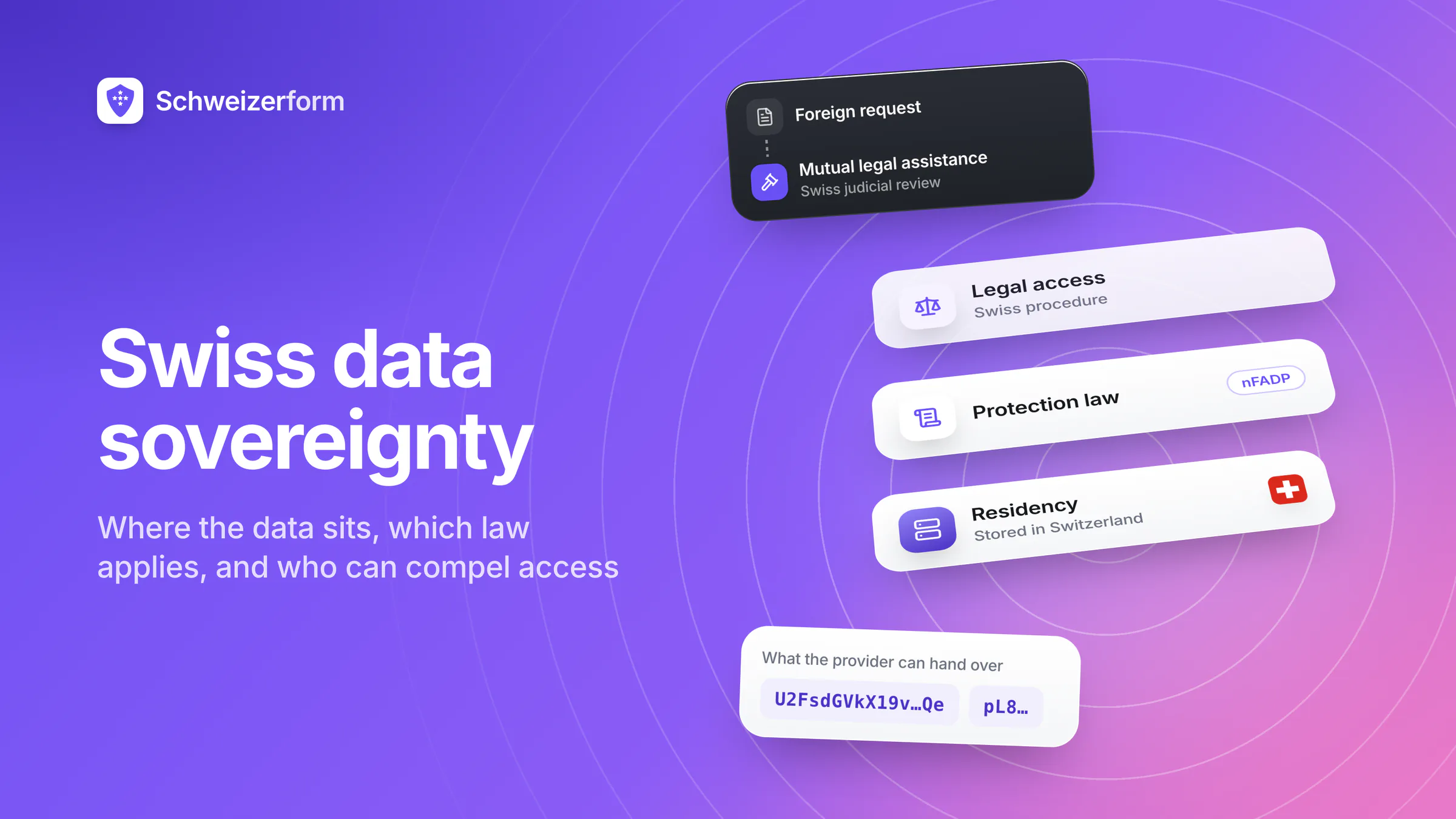
"Data sovereignty" is often used as shorthand for "hosted in country X". That's incomplete. In practice the concept covers three layered questions that have to be answered together, not substituted for one another.
- Data residency — where the bytes physically sit on disk, at rest
- Data protection law — which legal framework governs the processing, the controller, and the rights of data subjects
- Legal access and extraterritorial reach — which governments can legally compel the provider to hand data over, regardless of where it resides
These three can diverge. A server physically in Frankfurt, run by a US-headquartered company, falls under German data-protection law for the processing relationship but may still be reachable by a US CLOUD Act order directed at the parent company. Storing data in the EU does not, by itself, put the data beyond US legal reach. Swiss sovereignty is precisely the combination: residency, applicable law, and corporate structure all aligned with Swiss jurisdiction.
What Swiss Law Actually Offers
Switzerland has a distinctive, and for data-protection purposes favourable, legal framework. Four elements matter most in practice.
The nFADP, in force since September 2023
The revised Federal Act on Data Protection modernised Swiss privacy law and raised it to a standard broadly aligned with — and in some respects stricter than — the EU's GDPR. It recognises encryption as a technical safeguard, imposes breach-notification duties on controllers, and, notably for decision-makers, allows criminal penalties up to CHF 250,000 against responsible individuals for intentional violations.
An EU adequacy decision
The European Commission has formally recognised Switzerland as providing an adequate level of data protection. In practice, this means personal data can flow from the EU to Switzerland without additional safeguards such as standard contractual clauses. For many EU-based businesses, Swiss hosting is therefore legally simpler than US hosting, not more complex.
Constitutional privacy protections
Article 13 of the Swiss Federal Constitution enshrines the right to privacy and to the protection of personal data — a rare constitutional-level protection. Federal data-protection supervision sits with the Federal Data Protection and Information Commissioner (FDPIC), an independent authority.
Limits on extraterritorial access
Switzerland is not a member of the EU and is not subject to the CLOUD Act or similar extraterritorial US disclosure regimes. Swiss law requires formal international mutual legal assistance procedures (MLA) before foreign authorities can access data hosted in Switzerland — a process that is slow, documented, and subject to Swiss judicial review.
The US CLOUD Act, Plainly Explained
The Clarifying Lawful Overseas Use of Data Act (CLOUD Act), enacted in 2018, is the single most consequential piece of US legislation for non-US data. It grants US authorities the power to compel US-headquartered providers to produce data under their "possession, custody, or control" — regardless of where in the world that data physically sits.
The practical implication for form data is sharper than most buyers realise:
- If your form provider is a US company — or a subsidiary of one — and they hold decryption keys, your data can be compelled by a US authority even if the server is physically in Frankfurt, Dublin, or Zurich
- The provider may be prohibited from notifying you that a request has occurred (a gag order is the default)
- GDPR obligations on the provider do not override CLOUD Act obligations; they co-exist, and US providers generally comply with US law first
- Encryption at rest on the server does not defeat the CLOUD Act if the provider controls the keys — it simply hands over the data along with the means to decrypt it
The only two answers that survive the CLOUD Act
(1) The provider is not US-owned and does not operate US infrastructure. (2) The provider is zero-knowledge — even if compelled, they can only produce ciphertext. Swiss hosting combined with zero-knowledge encryption offers both properties at once. Either in isolation is weaker.
EU Hosting Is Not a Universal Answer
"Hosted in the EU" has become shorthand for "safe from foreign legal access". It's a useful starting point but not a complete one. Three frictions are worth being honest about.
- The Schrems II ruling (2020) invalidated the EU-US Privacy Shield. The 2023 Data Privacy Framework restores a transfer path, but is under constitutional challenge and has a less stable legal foundation than many buyers assume
- The CLOUD Act applies to US-headquartered companies regardless of where their EU datacentres sit. Large US cloud providers with EU regions remain legally reachable
- Intra-EU transfers between member states occur under GDPR but are still transfers. Country-specific rules (Germany's IT Security Act, France's SecNumCloud) add further layers that a single "EU-hosted" claim does not capture
None of this means EU hosting is bad. It means "EU hosting" is not a monolithic category, and it does not automatically solve the extraterritorial access problem. For buyers who want a clear and defensible answer, Switzerland — outside the EU, adequate under EU law, not subject to the CLOUD Act — is often a cleaner position than chasing sub-distinctions between EU member states.
What Swiss Hosting Actually Solves — Threat by Threat
| Scenario | Swiss hosting changes |
|---|---|
| US CLOUD Act request against your provider | Swiss provider is out of scope; request would need to route through Swiss MLA procedures |
| EU-to-provider data transfer compliance (nFADP, GDPR) | Swiss adequacy simplifies transfers from the EU; no SCCs needed |
| Breach notification obligations (nFADP Art. 24) | Swiss supervisory authority is the FDPIC; single-jurisdiction process |
| Respondent trust signal | "Hosted in Switzerland" is a recognisable, high-trust signal across European markets |
| Government surveillance risk | Swiss law prohibits mass surveillance; targeted access requires judicial authorisation |
| Data subject rights enforcement | Respondents have clear FDPIC recourse; no jurisdictional mismatch |
What Swiss Hosting Alone Does Not Solve
Hosting is one layer. It is necessary for certain guarantees but not sufficient for the full set. An honest description of its limits:
- Swiss hosting without encryption still leaves your data readable by the provider's staff, and therefore by anyone who compromises the provider
- A Swiss data centre operated by a US-headquartered cloud provider may still be in CLOUD Act scope — the relevant question is corporate control, not just physical location
- Swiss hosting does not protect against application-level vulnerabilities in the form tool itself
- Mutual legal assistance exists. It is slow, documented, and judicially reviewed — but it is a real legal channel through which foreign authorities can, in appropriate cases, obtain data
- Swiss hosting is meaningful mainly for the storage layer. If your data is then exported via integrations to US-hosted services (CRMs, email tools, analytics), the sovereignty claim only applies until that hop
This is why Schweizerform pairs Swiss storage of encrypted submissions with zero-knowledge end-to-end encryption. The two properties are complementary: Swiss hosting addresses the jurisdictional question, and zero-knowledge addresses what even a legally-compelled provider could disclose. Neither alone is as strong as both together.
Six Questions to Pin Down a Vendor's Real Sovereignty Position
The fastest way to cut through marketing copy is specific questions. "Hosted in Switzerland" can mean many things — the following questions force precision.
- Where, physically, is the data stored — city and datacentre operator?
- Which legal entity operates the service, where is it headquartered, and is it owned by any parent company in another jurisdiction?
- Is your service subject to the US CLOUD Act or equivalent extraterritorial orders by virtue of corporate structure?
- Do you hold decryption keys to customer data? If yes, where are those keys stored and under which jurisdiction?
- What sub-processors do you use (CDN, email, SMS, backups), where are they located, and under what agreements?
- In the event of a lawful request from a non-Swiss authority, what is your response process, and would you notify the affected customer?
A clean sovereignty position has three properties
(1) Data stored in Switzerland, (2) provider is a Swiss legal entity outside the reach of extraterritorial laws like the CLOUD Act, (3) zero-knowledge encryption so that even a lawful Swiss request produces only ciphertext. Ask for all three — accept nothing less for sensitive data.
Who Really Needs Swiss Hosting
Not every form justifies Swiss hosting. For a public RSVP or a non-personal poll, it is overkill. But for several classes of data, it is close to the only sensible default:
- Swiss regulated industries — banking, insurance, healthcare, law — where supervisory authorities expect data locality
- Swiss public-sector and educational bodies bound by federal or cantonal data-location rules
- Organisations collecting data from Swiss residents subject to nFADP sensitive-data categories (health, religion, biometric)
- Journalism and NGOs handling source or beneficiary data that may be politically sensitive
- Legal practices where attorney-client privilege must not be exposed to foreign legal process
- International organisations and diplomatic missions that expect Swiss-level neutrality
- Any business that wants to demonstrate, to clients or tender panels, that its compliance chain ends in Switzerland
Where Schweizerform Stands
Schweizerform operates as a Swiss entity with Swiss infrastructure. The combination is not an upsell or a premium add-on — it is the baseline:
- Form data is stored in Swiss data centres, across all plans including the free tier
- The operating entity is Swiss and is not a subsidiary of a non-Swiss parent — CLOUD Act scope does not apply by corporate structure
- The architecture is zero-knowledge: a lawful Swiss authority request would yield ciphertext only, because we do not hold decryption keys
- Sub-processors are minimised and their jurisdictions are disclosed
- Respondents — your users — benefit from the same sovereignty guarantees regardless of which country they fill the form from
Where your form data should live
Where your form data lives is not a line-item on a compliance checklist. It determines which laws, which authorities, and which corporate structures stand between a lawful request and your respondents' information. Swiss hosting, when paired with zero-knowledge encryption and a Swiss operating entity, is one of the cleanest answers available today — legally, operationally, and in terms of the trust signal it sends.
For most casual forms it doesn't matter. For any data that would cause harm if exposed — medical, legal, financial, HR, whistleblower — the jurisdictional chain is not a detail. It is the entire point.
Schweizerform pairs Swiss storage of encrypted submissions with zero-knowledge end-to-end encryption on every plan, including the free tier. Sovereignty as a default, not a premium feature.
Disclaimer: This article is general information, not legal, regulatory, or compliance advice. Descriptions of the nFADP, GDPR, the US CLOUD Act, Schrems II, the EU adequacy decision for Switzerland, and related frameworks are summarised at a conceptual level and are subject to ongoing legal and regulatory change. Jurisdictional analysis depends on specific facts — including corporate structure, contractual relationships, and the type of data involved. Consult a qualified legal specialist in your jurisdiction before relying on any of these summaries for compliance or procurement decisions.