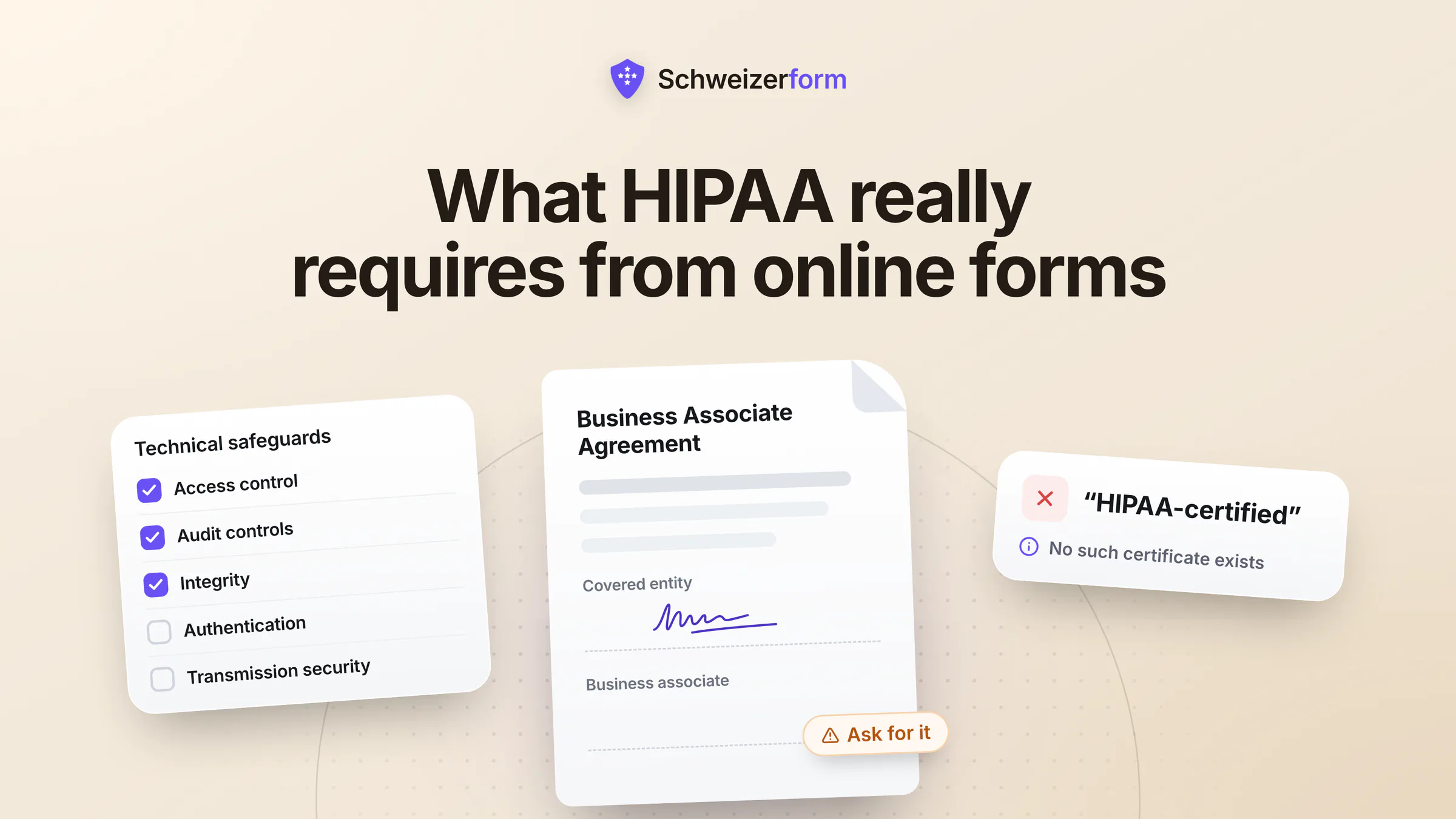
"HIPAA-compliant" is plastered across the marketing pages of nearly every US-targeted form builder. It is also one of the most casually used phrases in the industry. There is no government certification body that issues a HIPAA stamp. No product can make itself "HIPAA-compliant" on its own — compliance is a property of how a covered entity uses a tool, not a property the tool ships with. And several of the technical claims behind the phrase are weaker than they sound.
This guide is for anyone running an online form that touches Protected Health Information (PHI) under US law: clinicians, telehealth practices, dental and orthodontic offices, mental-health providers, allied-health practitioners, billing services, and the IT and compliance teams who support them. It walks through what HIPAA actually requires of online forms, what a Business Associate Agreement does and does not provide, where the encryption story is honestly strong and where it is honestly hand-waved, and how to evaluate any vendor's HIPAA story without taking the marketing copy at face value.
An honest note up front
Schweizerform is a Swiss-built form builder that stores encrypted submissions in Switzerland, with a zero-knowledge architecture. We do not currently market a HIPAA Business Associate Agreement, and our positioning is European-first. This article is meant to be useful for US healthcare buyers regardless of which vendor they choose — including frank notes on where Schweizerform's architectural property of "vendor cannot read submissions" interacts with HIPAA expectations, and where it does not substitute for a US-anchored HIPAA-compliance package.
What HIPAA Actually Is — A Short, Honest Briefing
HIPAA is the Health Insurance Portability and Accountability Act of 1996, plus the regulations the US Department of Health and Human Services has issued under it — most importantly the Privacy Rule, the Security Rule, and the Breach Notification Rule. Together, these define how Protected Health Information must be handled by certain US-regulated organisations. Three things are useful to know up front.
- HIPAA is US federal law. It does not directly govern Swiss, EU, or UK organisations — those follow nFADP, GDPR, and equivalent national frameworks. International organisations encounter HIPAA when they take on US patient data or partner with US covered entities.
- HIPAA covers two kinds of organisations: "Covered Entities" (most healthcare providers, health plans, healthcare clearinghouses) and "Business Associates" (vendors that handle PHI on behalf of a Covered Entity). Form builders that handle PHI for a clinic act as Business Associates.
- HIPAA defines what counts as PHI specifically. PHI is individually identifiable health information that is created or received by a covered entity, in any form or medium. The 18 "identifiers" — name, dates, addresses, phone numbers, email addresses, account numbers, biometric IDs, and so on — are the canonical reference for what makes data identifiable.
There is no HIPAA certification
Anyone selling you a "HIPAA-certified" product is selling marketing language that has no regulatory weight. HHS does not certify products, and there is no formal accreditation regime equivalent to ISO 27001 for HIPAA. There are credible third-party HIPAA-readiness audits and HITRUST CSF certifications that overlap with HIPAA — those are real and useful. "HIPAA-certified" by itself is not.
The Three Rules That Matter for Forms
1. The Privacy Rule
The Privacy Rule governs the use and disclosure of PHI: who can see it, what they can do with it, what authorisation a patient has to provide for non-routine uses, and what rights the patient has over their own information (access, amendment, accounting of disclosures). For online forms specifically, the Privacy Rule shapes what you can collect (only the minimum necessary), how you can use it (only for the purposes communicated to the patient), and what notice you must give (the Notice of Privacy Practices).
2. The Security Rule
The Security Rule applies specifically to electronic PHI (ePHI) and is the rule that maps most directly onto online forms. It defines administrative, physical, and technical safeguards that covered entities and business associates must implement. Crucially, it distinguishes between "required" and "addressable" specifications — addressable does not mean optional, but it allows alternatives where a covered entity documents why the standard specification is not reasonable and what equivalent measure is in place.
3. The Breach Notification Rule
Breach Notification requires covered entities and business associates to notify patients, HHS, and (for breaches above a threshold) the media when unsecured PHI is breached. "Unsecured" here is the key word: PHI that has been encrypted to NIST-specified standards is treated as not requiring notification because, technically, it is not readable. Encryption is therefore not just a security control but a Breach Notification safe harbour — a major operational reason that real-world HIPAA programmes lean on it heavily.
Security Rule Technical Safeguards That Apply to Online Forms
The Security Rule's technical safeguards are written at a deliberately high level — HHS wants the rule to age well across changing technology. The five categories that bite hardest on form builders are below.
| Safeguard | What it actually requires | How it lands on a form |
|---|---|---|
| Access control | Unique user identification, emergency access procedure, automatic logoff, encryption and decryption (addressable) | Each form-administrator account is named and authenticated; sessions time out; PHI cannot be read without authorised credentials |
| Audit controls | Hardware, software, and procedural mechanisms to record and examine activity in systems containing ePHI | Form vendor logs administrator actions on submissions: views, exports, deletions, account changes — retrievable on request |
| Integrity | Mechanisms to confirm that ePHI has not been altered or destroyed in an unauthorised manner | Submission integrity is verifiable; unauthorised modification is detectable; backups have integrity controls |
| Person or entity authentication | Procedures to verify a person is who they claim to be | Account holders: password sign-in with lockout after repeated failures, e-mail one-time codes at signup and password reset, and a per-device session list. Respondents: an unlock code on the form where access has to be restricted — there is no respondent login |
| Transmission security | Technical measures to guard against unauthorised access to ePHI being transmitted over an electronic communications network — integrity controls (required) and encryption (addressable) | All form traffic over HTTPS; for the addressable encryption specification, end-to-end encryption is the strongest answer |
On "addressable"
Several encryption-related requirements are listed as "addressable" rather than "required". This is widely misread as "optional". It is not. Addressable means: implement the specification, or document why it is not reasonable in your environment and what equivalent safeguard you have implemented instead. Since the 2013 Omnibus Rule and a series of HHS enforcement actions, regulators expect encryption in transit and at rest as the default — and have penalised covered entities who failed to encrypt without a defensible alternative analysis.
Business Associate Agreements — What They Actually Do
A Business Associate Agreement (BAA) is a contract between a covered entity and a business associate that allocates HIPAA responsibilities and obligates the business associate to comply with the relevant portions of the Security and Privacy Rules. If a form vendor handles PHI on your behalf, you cannot lawfully use them as a HIPAA-compliant tool without a signed BAA. This is one of the simplest tests of whether a vendor's "HIPAA-compliant" claim is operational or aspirational.
What a BAA does:
- Establishes that the vendor will implement the Security Rule's administrative, physical, and technical safeguards
- Defines the permissible uses and disclosures of PHI by the vendor (only as needed to provide the contracted service)
- Requires the vendor to report security incidents and breaches to the covered entity within specified timeframes
- Requires the vendor to obtain BAAs with its own subcontractors that touch PHI
- Requires the vendor to return or destroy PHI at the end of the contract, or extend the protections if return/destruction is infeasible
What a BAA does not do:
- It does not by itself make the vendor "HIPAA-compliant" — the vendor still has to actually implement the safeguards. A BAA is necessary, not sufficient.
- It does not insulate the covered entity from liability if the vendor fails. HHS can pursue both parties; a BAA is essentially a paper trail and an internal allocation of risk.
- It does not retroactively cover use that occurred before the BAA was in place. "We used Google Forms for two years and now we'll get a BAA" does not undo the prior period of unauthorised PHI handling.
- It does not extend HIPAA across borders. A non-US vendor that signs a BAA still needs the operational reality to match what the BAA promises — and a BAA does not exempt the parties from local data-protection law in the vendor's jurisdiction.
Common HIPAA Claims That Don't Survive Scrutiny
1. "We're HIPAA-compliant — see our certificate"
There is no government-issued HIPAA certificate. Third-party readiness audits and HITRUST certifications exist and are useful proxies, but they are not HHS approvals. A vendor that pitches a "HIPAA certificate" without explaining what it actually is is either confused or hoping you will be.
2. "Free Google Forms is HIPAA-compliant if you have a BAA"
Google does sign BAAs for Workspace accounts on certain editions, but the consumer free Google Forms product is not covered. Personal Gmail accounts collecting health questionnaires are unambiguously outside the BAA, and the fact that Google encrypts traffic in transit does not change that. Mistaking the consumer product for the BAA-eligible enterprise product is a common, expensive mistake.
3. "Encrypted in transit and at rest = HIPAA-compliant"
TLS in transit and disk encryption at rest are necessary baseline controls. They satisfy two specific addressable specifications, well. They do not address access control, audit controls, integrity, authentication, administrative safeguards, breach notification procedures, or BAAs. "Encrypted" is one chapter of HIPAA, not the whole book.
4. "Our forms are end-to-end encrypted, so HIPAA doesn't really apply"
End-to-end encryption is a strong technical control. It does not change the legal status of the data: ePHI is ePHI whether encrypted or not. What it does change is the breach-notification calculus — encrypted ePHI that is breached may not require patient notification because it is not "unsecured" in HIPAA's sense. That is real value, but it is a benefit on top of the rest of HIPAA, not a replacement for it.
5. "Our overseas hosting is fine because we follow GDPR"
GDPR compliance and HIPAA compliance are different regimes, with different definitions, different remedies, and different cross-border concerns. A Swiss or EU vendor processing US PHI under a BAA can be done — but "we follow GDPR" is not, on its own, a sufficient HIPAA answer. Cross-border PHI handling adds complexity (additional contractual safeguards, data-residency considerations under HHS guidance, breach-notification coordination across jurisdictions) that most overseas vendors are not currently set up for.
Setting Up a HIPAA-Aware Online Form in Practice
Whatever vendor you choose, the operational pattern that produces a defensible HIPAA-aware form is roughly the same.
- 1
Confirm the data is actually PHI
Not all health-related information is PHI under HIPAA. A wellness app that collects step counts from a consumer is not subject to HIPAA. A clinic that collects intake answers from its patients is. The distinction is whether the entity is a covered entity or business associate, and whether the information is individually identifiable health information created or received in that capacity. Get this clear up front; it determines everything that follows.
- 2
Apply minimum-necessary
The Privacy Rule requires that uses and disclosures of PHI be limited to the minimum necessary for the purpose. Audit each field on the form against an actual decision the practice has to make. Drop fields that exist for habit, not necessity. Minimum-necessary is one of the most under-implemented Privacy Rule requirements.
- 3
Confirm the BAA situation
If the vendor handles PHI, get a BAA in place before any real submissions flow. If the vendor will not sign one, you cannot use them for PHI — full stop. Document the BAA in your compliance file with the date of execution and the signatories.
- 4
Configure access control and authentication
Each administrator account is uniquely named. Multi-factor authentication is on for everyone with PHI access. Automatic logoff is configured. Account provisioning and de-provisioning are documented and triggered when staff change.
- 5
Configure encryption everywhere it matters
TLS for transit (every form vendor does this; verify it). Encryption at rest (configure or confirm). Where available, end-to-end encryption raises the bar — submissions stored as ciphertext that the vendor cannot read provide a stronger Breach Notification safe harbour and a stronger Privacy Rule story.
- 6
Verify audit logging
Confirm the vendor logs administrator actions, exports, and views, and that you can retrieve those logs when needed. If the vendor cannot show you a log of who viewed which submission and when, the audit-controls safeguard is being honoured in name only.
- 7
Document retention and disposal
How long PHI lives in the form system, how it transitions to the EHR or system of record, when and how it is deleted from the form vendor, and what happens to backups. Retention/disposal is a Privacy Rule and Security Rule concern; it is also where many programmes quietly fail.
- 8
Plan breach response
Know the vendor's breach-notification timing in the BAA. Know whom you contact at HHS, who runs the patient notifications, who notifies the media (above the 500-record threshold), and how the vendor's reporting feeds your own. Encryption that meets NIST guidance can take a breach out of the unsecured category — but only if you can document that the data was encrypted at the time.
Where End-to-End Encryption Fits Into a HIPAA Programme
End-to-end zero-knowledge encryption is not a HIPAA requirement, and no vendor selling it should claim that it is. It is, however, a powerful overlay on top of the standard HIPAA control set, and the reasons are worth being explicit about.
- Breach Notification posture: ePHI encrypted such that the vendor cannot decrypt it cleanly meets the "unsecured" exclusion under HHS encryption guidance — significantly stronger than disk-only encryption at rest, where the vendor still holds the keys.
- Privacy Rule posture: minimum-necessary and use-limitation are easier to defend when the vendor structurally cannot read PHI, because incidental access by the vendor's staff or sub-processors is technically prevented rather than contractually promised.
- Subpoena and lawful-process resistance: a vendor that physically cannot decrypt PHI cannot produce readable PHI under a subpoena directed at it. This is a feature for whistleblower-grade and high-sensitivity workloads; it is also a complication if the practice itself ever needs the vendor's cooperation in a legal matter.
- Reduced audit surface: HHS reviews of business associates focus on whether the vendor actually implemented the safeguards. "The vendor cannot read PHI" is the strongest available answer to several Security Rule technical questions, and it makes the BAA less of a contractual fiction.
An honest Schweizerform footnote
Schweizerform's architecture has the technical property — the vendor physically cannot read submissions — that, combined with a BAA, would meaningfully strengthen a HIPAA programme. We are, however, a Swiss-built product positioned for European data-sovereignty workloads, and we do not currently market a HIPAA Business Associate Agreement. US healthcare buyers who require a US-anchored HIPAA-compliance package, including a BAA, should evaluate vendors who offer that posture as part of their core product. We mention this so you can choose without confusion: zero-knowledge encryption is real and load-bearing, and it is not the same product as a turnkey HIPAA package.
Common Form Scenarios in US Healthcare
Patient intake and history forms
Standard pre-visit forms — demographics, insurance, medical history, current medications, allergies. These are PHI from the moment they exist and need the full Security Rule technical safeguard set. Vendors marketing these specifically for healthcare typically offer a BAA on a paid tier; verify what is and is not in scope under that BAA.
Telehealth onboarding and screening
Pre-appointment screening, symptom questionnaires, COVID-style triage forms. The volume can be high; the data is unambiguously PHI. Telehealth is also one of the areas where HHS has issued specific guidance, and where regulators have shown they will look at how forms feed downstream systems.
Authorization for disclosure of PHI
Forms that authorise disclosure of PHI to a third party — typically signed by the patient, often required in writing under the Privacy Rule. The form itself is metadata about a high-stakes patient action; the signed authorization is itself PHI. Audit logging of who saw and exported the authorization matters here as much as the content.
Mental-health intake and behavioural-health screening
Especially sensitive PHI: psychiatric diagnoses, substance-use disclosures, suicidality screenings. Behavioural-health information is subject to additional constraints under 42 CFR Part 2 in the US, on top of HIPAA. The encryption story matters more here than on a standard demographic form.
Billing, payment, and financial-hardship forms
These collect PHI plus financial information. PCI-DSS overlaps with HIPAA on the payment-card portion. Keep card-handling and PHI flows clean: payments go through a PSP, PHI goes through the form layer, and the two are not commingled.
Research and IRB-governed data collection
Research data may be PHI, may be subject to the Common Rule, and may require IRB-approved consent processes. HIPAA interaction with research is its own subject; the form is rarely the hardest part, but it has to fit cleanly into the IRB-approved protocol and consent flow.
A Short Checklist Before You Open a HIPAA-Relevant Form
- Have you confirmed that the data on this form is PHI under HIPAA, and that you are operating as a covered entity or business associate?
- Is the vendor willing and able to sign a Business Associate Agreement, with the BAA covering the specific product and tier you are using?
- Are administrator accounts uniquely named, MFA-enabled, and subject to provisioning/de-provisioning controls?
- Are submissions encrypted in transit (TLS) and at rest? If end-to-end encryption is available, are you using it?
- Does the vendor produce an audit log of administrator actions on submissions, and can you retrieve it on demand?
- Have you applied minimum-necessary to the form's fields, removing data you do not actually need?
- Is your retention and disposal policy written, communicated to staff, and operationally implemented (including backups)?
- Do you know the vendor's breach-notification timeline, your own internal escalation path, and the patient/HHS notification workflow?
- Is the Notice of Privacy Practices linked from the form, and the consent or authorization mechanism appropriate for the use?
- Have you walked the entire workflow yourself with a test submission before opening the form to patients?
What a US practice actually needs
HIPAA-compliant form collection is not a checkbox feature. It is a programme: a Privacy Rule analysis of what you collect and why, a Security Rule implementation of administrative, physical, and technical safeguards, a Breach Notification plan that knows what "unsecured" really means, a Business Associate Agreement with every vendor that touches PHI, and the operational discipline to keep all of that working as the practice grows and the technology drifts.
Vendor marketing tends to compress this into a phrase: "HIPAA-compliant". The phrase is fine if you treat it as the start of the conversation, not the end. Ask for the BAA. Look at the audit logs. Map their safeguards onto your Security Rule analysis. Verify their breach-notification commitment. Ask, candidly, what their architecture protects against and what it does not. The vendors that answer those questions clearly are the ones whose claims are likely to survive an HHS review; the vendors that change the subject are signalling something useful.
End-to-end zero-knowledge encryption is not a HIPAA shortcut. It is, however, the strongest available technical answer to several of the Security Rule's harder questions, and it removes whole categories of risk from the breach-notification analysis. For US practices that genuinely care about PHI confidentiality — which is most of them — it is worth understanding even when the immediate need is for a US-anchored, BAA-backed mainstream HIPAA tool.
If your workflow can accommodate a Swiss-anchored, zero-knowledge form layer alongside your existing HIPAA stack, Schweizerform's architectural property — vendor cannot read submissions — is a meaningful overlay. If you need a turnkey HIPAA-compliance package with a BAA built in, choose a vendor whose core product is positioned for that use case. Both can be the right answer; they are different products solving overlapping problems.
Disclaimer: This article is general information and marketing content, not legal, regulatory, or compliance advice. References to HIPAA, the Privacy Rule, the Security Rule, the Breach Notification Rule, the Omnibus Rule, 42 CFR Part 2, the Common Rule, NIST guidance, and HHS enforcement positions are summarised at a conceptual level and are subject to evolving interpretation. Specific HIPAA programme decisions should be reviewed by qualified US healthcare-compliance counsel before relying on any summary here for compliance or vendor-selection decisions. Competitive details were last verified on 25 July 2026. All product and company names are trademarks of their respective owners and are used here for factual comparison only.